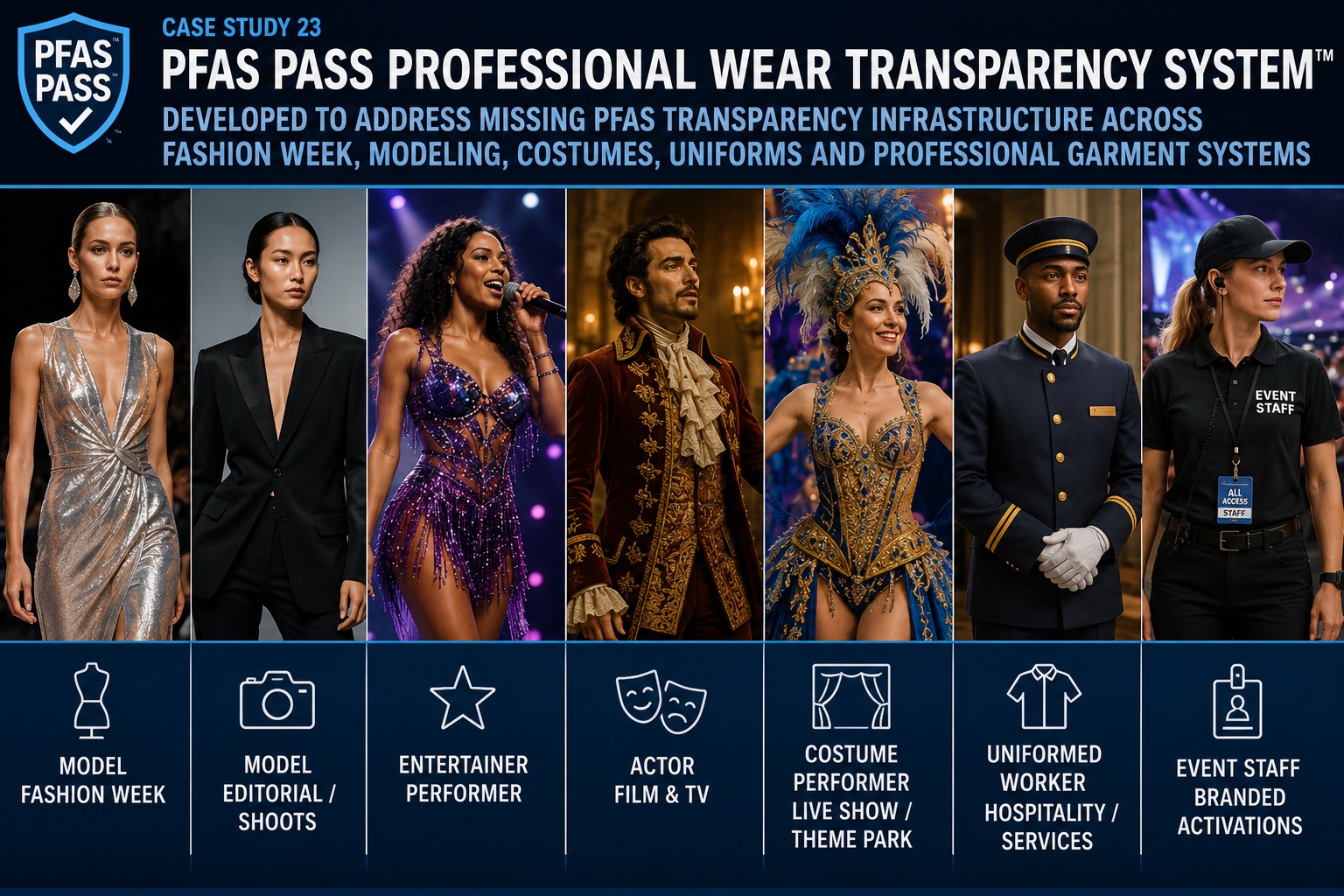
What began as an investigation into PFAS compliance exposure across Fashion Week events and emerging designer systems quickly revealed a much larger operational gap extending far beyond fashion.
A real-world designer collection was clocked moving through multiple regulated fashion systems including New York Fashion Week exposure, boutique retail placement in New York City and planned expansion into Paris Fashion Week and related Paris boutique representation systems.
The collection sourced materials through pathways connected to suppliers operating in regulated markets including New York garment district textile and trim suppliers previously documented by PFAS PASS case studies as lacking publicly visible PFAS verification systems, supplier documentation transparency or standardized compliance disclosures across many product categories.
At the same time:
- the collection entered public runway exposure
- products were marketed internationally
- boutique representation expanded into additional regulated jurisdictions
- and repeated inquiries regarding PFAS vetting procedures received no visible response
The investigation raised a larger systems question:
If fashion week organizations, boutiques and emerging designer systems operating inside regulated markets do not appear to contain visible PFAS transparency infrastructure, what protections exist for the people being professionally required to wear these garments?
That question expanded the scope of the investigation far beyond fashion retail alone.
The Professional Garment-Use Gap
Unlike consumer retail environments where individuals voluntarily choose products, professional garment-use systems frequently require workers, performers and contractors to wear assigned garments as a condition of:
- employment
- contracted work
- runway participation
- entertainment production
- promotional appearances
- branded events
- photography
- costume performance
- or uniform compliance
Often without meaningful disclosure regarding:
- textile chemistry
- coatings
- synthetic treatment history
- supplier traceability
- PFAS compliance review
- or material sourcing transparency
PFAS PASS identified what appears to be a significant transparency gap across:
- fashion week systems
- modeling agencies
- entertainment productions
- costume departments
- photography and editorial environments
- themed entertainment
- uniforms
- branded events
- hospitality systems
- and other professional garment-use environments operating inside PFAS-regulated jurisdictions.
“But the Garments Weren’t for Sale”
One potential response from industry participants may be that runway garments function primarily as:
- editorial presentation
- artistic expression
- sample collections
- prototype development
- media exposure pieces
rather than direct retail inventory.
PFAS PASS recognizes that runway presentation itself may occupy a complex space between artistic display, promotion, sampling and commercial activity depending on how collections are later marketed, represented or distributed.
However, the issue identified in this case study extends beyond direct retail sales alone.
The garments were still:
- physically worn by workers and contracted professionals
- used in professional environments
- photographed and promoted publicly
- represented internationally
- moved through regulated jurisdictions
- and connected to broader commercial fashion systems
while no visible PFAS transparency or intake infrastructure could be identified at the fashion week, showroom, boutique or professional garment-use level.
The Worker Transparency Question
As PFAS-regulated textile laws now exist in markets including:
- New York
- California
- and France
workers and contractors operating inside these environments may have legitimate grounds to begin requesting greater material transparency regarding garments they are required to wear professionally.
This includes:
- models
- performers
- actors
- dancers
- stunt performers
- costume workers
- hospitality staff
- convention workers
- promotional teams
- entertainment employees
- themed entertainment performers
- and uniformed workers
particularly in systems involving:
- synthetic textiles
- coated fabrics
- imported garments
- recycled materials
- prolonged skin contact
- steaming and heat exposure
- repeated backstage handling
- and unclear supplier documentation pathways
PFAS chemistry and microplastic shedding are not identical issues, but both contribute to broader questions regarding transparency in synthetic textile systems worn directly against the body in professional environments.
The regulations already exist.
The transparency systems largely do not.
The Result: A New PFAS PASS™ Compliance System
Case Study 23 ultimately resulted in development of a new PFAS PASS™ operational framework designed specifically to address this emerging gap.
07- PFAS PASS Professional Wear Transparency System™
Contract & Disclosure Framework for Professional Garment Use in Regulated Markets
A structured disclosure and intake framework designed for industries where workers, performers, models and contractors are required to wear garments professionally in PFAS-regulated environments.
Developed to address emerging transparency gaps across:
- fashion week systems
- modeling
- entertainment
- costumes
- uniforms
- photography
- editorial environments
- branded events
- hospitality systems
- themed entertainment
- and international professional garment-use systems
where garments may be worn without meaningful material disclosure or visible compliance review.
Core Function:
- Professional garment-use disclosure requests
- Contract and employment language templates
- Material transparency and supplier disclosure pathways
- PFAS-related acknowledgment language
- Intake review for assigned garments and costume systems
- Risk classification for synthetic, coated and imported textile systems
- Documentation request workflows for regulated markets
- Transparency tools for workers, agencies, productions and organizations
This system was developed to help create front-end transparency and documentation pathways for professional garment-use environments where workers may be contractually required to wear garments in regulated jurisdictions without clear visibility into material sourcing or PFAS compliance status.
Related PFAS PASS Case Studies
- Case Study 02 — FabricWholesaleDirect and Independent Testing Responsibility
- Case Study 06 — Carr Textile and Supplier Documentation Gaps
- Case Study 07 — IAAPA and the Trade Show Compliance Blind Spot
- Case Study 11 — WAWAK and the Hidden Risk of Notions & Components
- Case Study 15 — The Los Angeles Garment District PFAS Visibility Problem
- Case Study 21 — One Garment. Three Suppliers. Zero Verifiable Compliance.
Explore the full suite PFAS PASS™ Compliance Systems here:
Leave a Reply
You must be logged in to post a comment.