The Vetting Wall
Eighteen months into a binding law, the people selling the goods don’t know it exists, can’t recognize its documents, and are learning about it from their customers.
Buying fabric responsibly now requires the buyer to teach the seller their own legal obligations. That inversion — more than any single product or supplier — is the finding of this case study.
Over roughly six weeks, PFAS PASS ran the same exercise again and again: approach a textile seller, ask whether a fabric was PFAS-compliant, and — when the answer was a confident yes — ask them to substantiate it. The pattern did not vary. Of every seller contacted, not one was able to demonstrate awareness of the regulation, recognize what a valid compliance document looks like, or produce the certificate the law already requires them to have on hand.
This is not a story about one uncooperative supplier. It is a story about a wall — and about what that wall is actually made of. It is not built of evasion. It is built of ignorance, and ignorance is far harder to fix than refusal, because you cannot ask someone to produce what they do not know exists.
The SpecimenAn easy case, and still a wall
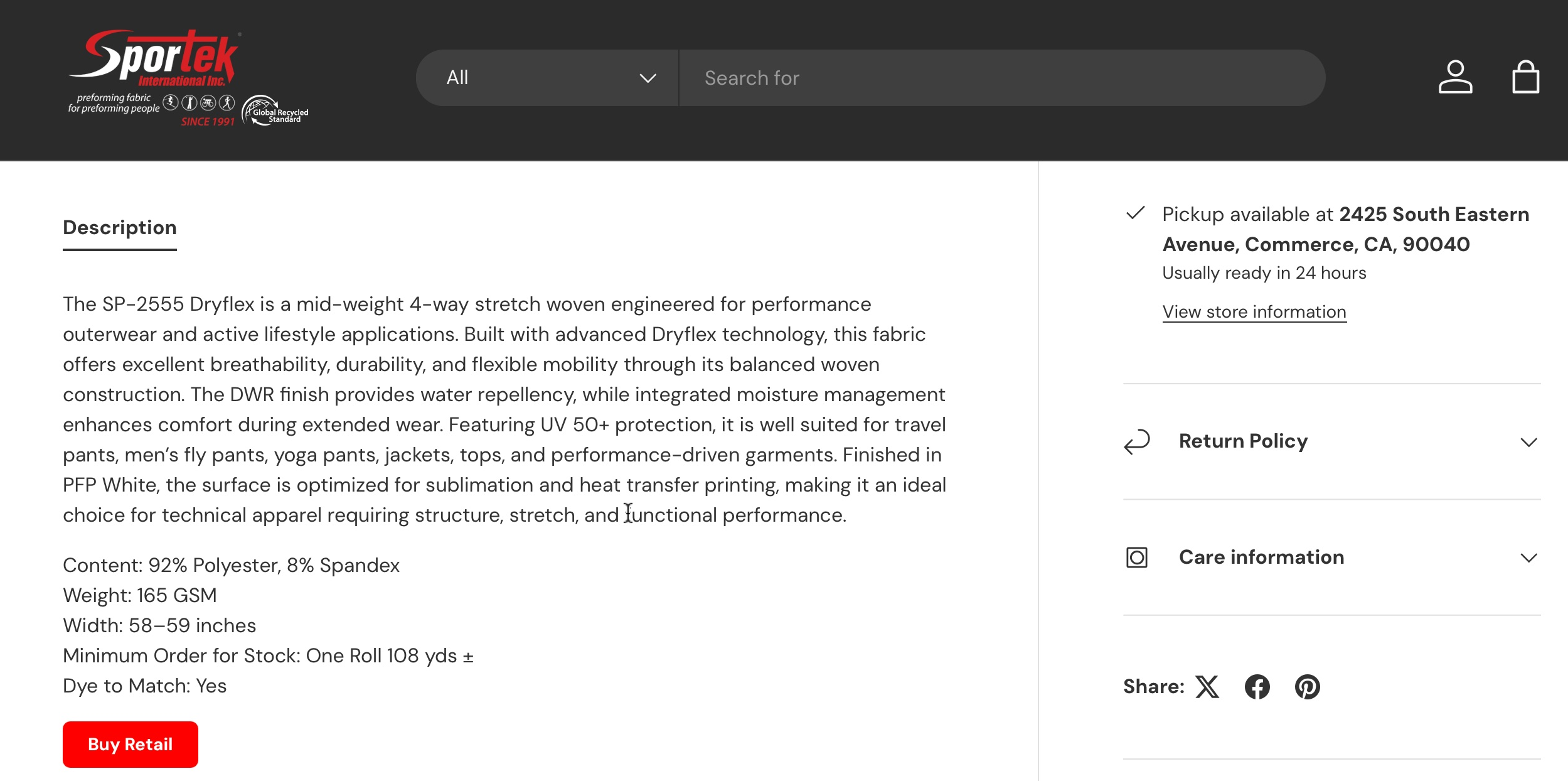
The anchor example is a fabric listed by Sportek International, the SP-2555 Dryflex — a mid-weight, 4-way stretch woven marketed for activewear. It is worth examining precisely because it is the easy case. It is a 92% polyester / 8% spandex performance fabric sold for water repellency, and fluorine-free durable water repellent (DWR) finishes for exactly this kind of fabric are commercially established and widely adopted. There is no “no alternative existed” defense available here.
The listing markets “advanced Dryflex technology” and states that “the DWR finish provides water repellency.” It says nothing about the chemistry of that finish — fluorinated or not. And it is offered for sale, with pickup, from a California address.

California’s AB 1817, the Safer Clothes and Textiles Act, has since January 1, 2025 prohibited offering for sale in the state any new textile article — activewear included — containing regulated PFAS at or above 100 ppm total organic fluorine. The same law requires the manufacturer to furnish a signed certificate of compliance to anyone offering the goods for sale. A DWR finish is precisely the use the law was written around.
The first question was the plain one: is this PFAS-free / compliant? The reply was immediate — and it was the product’s marketing description, the same copy anyone can read on the page. When the request narrowed to the specific, un-deflectable ask — the finish chemistry and the certificate of compliance for the DWR coating — the engagement stopped. After the second request, there was only silence.
The wall did not go up over a hard question. It went up the moment the question could no longer be answered with a brochure.
The listing is preserved as documented because listings can be edited or removed. The product swatch card below is retained as independent backup of the same fabric and finish identity.

The AnatomyThree layers of not-knowing
Across the sellers contacted, the failure was not uniform refusal. It was a descending staircase of ignorance — and each step is worse than a flat “no” would have been, because each one represents good faith colliding with an absence of knowledge.
They don’t know compliance is a thing
Not avoidance — absence. Front-line staff in sales, marketing, and customer service responded as though they had never heard the question before and did not regard it as their responsibility to answer. There was no concept that a regulation governs what they are selling.
They can’t recognize a compliance document
When pressed, some sellers sent documents they believed were compliance proof — and the documents failed review. A recycled-content certificate, a general safety standard, a spec sheet: offered in good faith, none of them addressing PFAS. A seller who hands over the wrong document is, in a way, more revealing than one who hands over nothing. It proves they are trying, and that they have no idea what the right document even looks like.
They were never told by their own employer
The worker fielding the question was hearing about the law, in several cases, for the first time — from a prospective customer, not from the company that employs them. The information never flowed down from the top. One New York seller’s answer captured the whole inversion: the buyer was told to purchase the fabric and have it tested themselves.
That last exchange deserves to sit on its own. A seller, asked to substantiate a compliance claim about their own product, directed the prospective buyer to purchase the goods and pay for testing — offloading the seller’s own legal burden onto the customer, as though verifying the lawfulness of the merchandise were the shopper’s job rather than the seller’s.
The QuestionWhy don’t they know?
Eighteen months after the law took effect, why are textile sellers operating out of California and New York — businesses physically located in, and directly regulated by, the very states whose textile laws govern them — the ones most unaware of those laws? This is the part that should astonish anyone. These are not out-of-state vendors stumbling over an unfamiliar rule from somewhere else. They are California and New York companies, selling from California and New York addresses, apparently in conflict with the textile law their own legislatures passed and that is in effect in their own state. Their sales, marketing, and customer-service staff field a basic PFAS-compliance question with no tools, no training, and no script — and a prospective customer ends up delivering the news. We cannot see inside these companies, so we will not pretend to know which explanation is true. But every explanation that can be constructed is damning.
Either leadership doesn’t know either — the regulation never registered at the top, so there was nothing to push down. The most charitable reading, and still a failure of basic regulatory diligence about the law governing your core product.
Or leadership knows and is waiting it out — aware that active state enforcement is still years away, they’ve quietly decided not to equip anyone yet. In that reading, the uninformed front-line worker is not an oversight; they are a buffer, kept able to honestly say “I didn’t know.”
Or leadership has nothing compliant to say — they cannot hand their staff a truthful script because the inventory itself cannot be substantiated. Silence downward is the symptom of having no compliant answer to give.
Pick any branch. In each one, the law is in effect, liability is quietly accruing, and the people on the front line of the sale are left exposed by the organization above them. The worker is not the villain of this story. The worker is its clearest casualty — sent to field a question their employer should have prepared them for, and left to absorb the shock in real time from a stranger.
The ConsequenceThe inventory no one wants to talk about
There is a reason this knowledge is so unwelcome, and it sits in the warehouse. AB 1817 provides no sell-through period and no grandfather clause for pre-2025 inventory. The prohibition attaches to the act of selling, not the date of purchase — and it reaches any sale within the state, which captures a California-based seller shipping out of California just as squarely as a sale into it. Stock acquired in good faith in 2023 or 2024 is still “new, not previously owned” when a seller goes to move it today — and if it contains regulated PFAS, that California seller cannot lawfully sell it, regardless of which direction the goods travel. New York’s parallel law works the same way for sellers operating out of New York.
PFAS PASS has not audited anyone’s warehouse, and puts no number on it. But the logic is unavoidable: a binding ban with no transition window, plus a seller population that — by every contact I made — is unaware the ban exists, means the volume of stranded, unsellable inventory across the industry is almost certainly substantial. The shock encountered again and again on the front line is the leading edge of a much larger reckoning that most of these businesses have not yet had.
This is why no one is asking about audit systems or compliant-build systems yet. You cannot sell a solution to someone who has not finished absorbing the problem.
The MeaningWhy the burden fell to the buyer
Put the pieces together and the conclusion writes itself. The seller side of this market cannot currently carry the compliance burden — it does not know the burden exists, cannot recognize the documents that would discharge it, and has not been equipped from the top to try. So the burden has fallen, by default, to the buyer. That is exactly backwards from how the law is designed, and it is exactly the vacuum that the PFAS PASS systems are built to fill.
The single most important takeaway for any buyer sourcing from a regulated state: do not assume a seller is compliant. “It’s for sale, so it must be legal” is the precise false assumption this entire market is leaning on — and as this case shows, a seller being located inside the regulating state is no assurance whatsoever. The burden of proof belongs to the seller, and the only way that burden actually gets carried, right now, is if the buyer refuses to let it be skipped.
If you’re a buyer — or a seller reaching for the light
If you are sourcing fabric, you can learn to ask the un-deflectable question, recognize a non-answer, demand the certificate the law already requires, and document the result. If you are a seller staring at inventory you’re no longer sure you can move, the first step is not panic and it is not a write-off — it is triage: finding out what is actually compliant before anything is discarded.
That is the work: audit systems for sellers who want to know where they stand, compliant-build systems for those rebuilding, and a buyer’s field guide for everyone who has realized they can no longer assume.
Leave a Reply
You must be logged in to post a comment.