Tag: microplastics

  • “Forever Chemicals” Sewing Systems and Lifecycle Blind Spots Now Being Questioned

    “Forever Chemicals” Sewing Systems and Lifecycle Blind Spots Now Being Questioned

    The trends were temporary. The textiles were forever.

    Fashion trained consumers to replace garments seasonally while increasingly relying on synthetic material systems designed for durability, stain resistance, weather resistance, and chemical persistence.

    Consumers were encouraged to consume by industries profiting from overproduction, while being reassured through recycling and sustainability narratives that may not have fully accounted for the long-term persistence of the material systems being recirculated.

    As PFAS regulations expand across textiles and sewn products, a larger question is beginning to emerge:

    Is fabric alone enough to evaluate compliance anymore?

    Most PFAS discussions have focused on:

    • fabrics
    • waterproof coatings
    • trims
    • thread
    • intentionally added chemistry

    But garments do not exist in isolation.

    A garment moves through an entire lifecycle of contact systems before reaching the consumer and long after:

    • sewing systems
    • cutting surfaces
    • ironing systems
    • heat transfer systems
    • packaging
    • laundering
    • storage
    • shipping
    • resale
    • rental circulation
    • repairs
    • disposal systems

    Modern garment production environments now involve countless synthetic and engineered contact surfaces that rarely appear in compliance discussions:

    • plastic sewing machine beds
    • coated presser feet
    • roller feet
    • trim feeding systems
    • self-healing cutting mats
    • laminated cutting tables
    • molded plastic needle containers
    • synthetic packaging systems
    • poly bags
    • heat press transfers
    • PTFE or nonstick pressing surfaces
    • washing machines and dryers with synthetic internal components
    • dry cleaning systems
    • plastic hangers and storage systems

    This does not automatically mean these systems contain PFAS or contaminate garments.

    But it does raise an important systems-level question:

    If compliant fabrics can theoretically be invalidated by undocumented trims, coatings, packaging, or contamination pathways, where does accountability stop once the production environment itself becomes part of the discussion?

    Industries involving contamination-sensitive environments such as medical manufacturing, food systems, industrial hygiene, and cleanroom production already recognize that contact surfaces matter.

    Fashion manufacturing historically did not operate under that framework.

    The industry optimized for:

    • speed
    • scalability
    • synthetic performance
    • low friction
    • stain resistance
    • weather resistance
    • rapid turnover

    Not contamination-controlled manufacturing systems.

    As scrutiny expands beyond intentionally added chemistry into broader contamination-pathway discussions, questions may also emerge around:

    • product liability
    • insurance coverage
    • economic loss
    • consumer trust
    • greenwashing
    • recycling narratives
    • disposal responsibility
    • lifecycle accountability

    Especially as brands, suppliers, retailers, and consumers begin questioning what constitutes a “PFAS compliant” product across manufacturing, handling, packaging, laundering, reuse, and disposal environments.

    This emerging discussion is one of the reasons PFAS PASS™ is introducing:

    PFAS Lifecycle Contact Systems Evaluation™

    A structured framework designed to evaluate production, packaging, handling, consumer interaction, recirculation, and end-of-life contact systems that may influence PFAS-sensitive textile and sewn-product environments.

    The framework includes evaluation layers for:

    • production contact systems
    • packaging and distribution systems
    • consumer interaction systems
    • post-production lifecycle systems
    • reuse and recirculation systems
    • disposal and end-of-life considerations

    The goal is not to promote fear or claim that every contact surface creates contamination.

    The goal is to recognize that PFAS compliance may ultimately function less as a simple yes-or-no question and more as a lifecycle risk assessment and contamination-awareness framework.

    Because the larger issue may not simply be whether PFAS were intentionally added to a fabric.

    The larger issue may be whether modern fashion and textile systems were ever designed for chemically persistent material environments in the first place.

    The trends were temporary.

    The material systems were designed to persist.

    PFAS Compliance Systems Expert for Clothing, Costumes and Textile-Based Products

    Creator of PFAS PASS™ — a structured compliance and verification framework addressing regulatory gaps across fashion, uniforms and performance systems
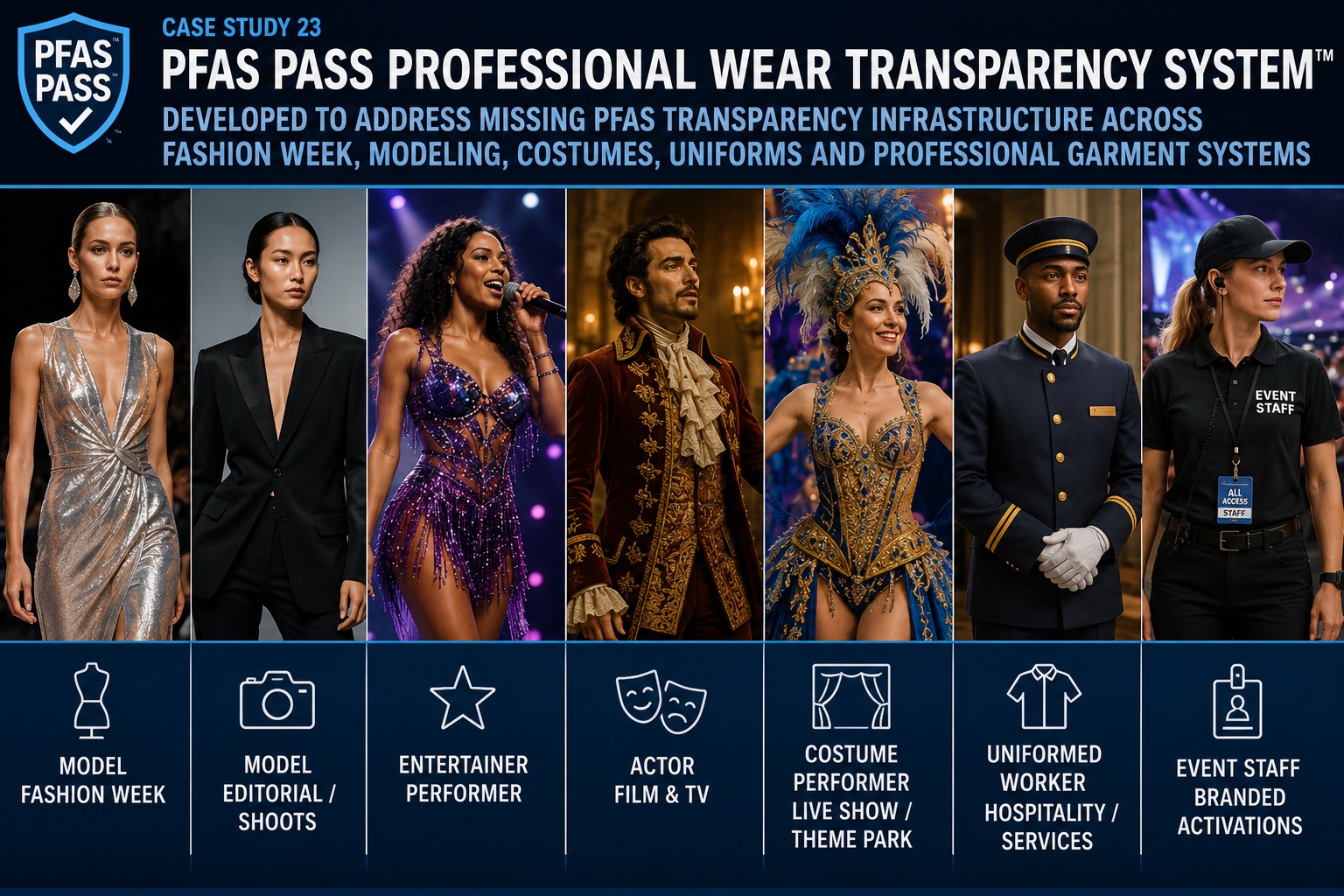
  • Case Study 23 – Professional Wear Transparency System™ Developed to Address Missing PFAS Transparency Infrastructure Across Fashion Week, Modeling, Costumes, Uniforms and Professional Garment Systems

    Case Study 23 – Professional Wear Transparency System™ Developed to Address Missing PFAS Transparency Infrastructure Across Fashion Week, Modeling, Costumes, Uniforms and Professional Garment Systems

    What began as an investigation into PFAS compliance exposure across Fashion Week events and emerging designer systems quickly revealed a much larger operational gap extending far beyond fashion.

    A real-world designer collection was clocked moving through multiple regulated fashion systems including New York Fashion Week exposure, boutique retail placement in New York City and planned expansion into Paris Fashion Week and related Paris boutique representation systems.

    The collection sourced materials through pathways connected to suppliers operating in regulated markets including New York garment district textile and trim suppliers previously documented by PFAS PASS case studies as lacking publicly visible PFAS verification systems, supplier documentation transparency or standardized compliance disclosures across many product categories.

    At the same time:

    • the collection entered public runway exposure
    • products were marketed internationally
    • boutique representation expanded into additional regulated jurisdictions
    • and repeated inquiries regarding PFAS vetting procedures received no visible response

    The investigation raised a larger systems question:

    If fashion week organizations, boutiques and emerging designer systems operating inside regulated markets do not appear to contain visible PFAS transparency infrastructure, what protections exist for the people being professionally required to wear these garments?

    That question expanded the scope of the investigation far beyond fashion retail alone.

    The Professional Garment-Use Gap

    Unlike consumer retail environments where individuals voluntarily choose products, professional garment-use systems frequently require workers, performers and contractors to wear assigned garments as a condition of:

    • employment
    • contracted work
    • runway participation
    • entertainment production
    • promotional appearances
    • branded events
    • photography
    • costume performance
    • or uniform compliance

    Often without meaningful disclosure regarding:

    • textile chemistry
    • coatings
    • synthetic treatment history
    • supplier traceability
    • PFAS compliance review
    • or material sourcing transparency

    PFAS PASS identified what appears to be a significant transparency gap across:

    • fashion week systems
    • modeling agencies
    • entertainment productions
    • costume departments
    • photography and editorial environments
    • themed entertainment
    • uniforms
    • branded events
    • hospitality systems
    • and other professional garment-use environments operating inside PFAS-regulated jurisdictions.

    “But the Garments Weren’t for Sale”

    One potential response from industry participants may be that runway garments function primarily as:

    • editorial presentation
    • artistic expression
    • sample collections
    • prototype development
    • media exposure pieces

    rather than direct retail inventory.

    PFAS PASS recognizes that runway presentation itself may occupy a complex space between artistic display, promotion, sampling and commercial activity depending on how collections are later marketed, represented or distributed.

    However, the issue identified in this case study extends beyond direct retail sales alone.

    The garments were still:

    • physically worn by workers and contracted professionals
    • used in professional environments
    • photographed and promoted publicly
    • represented internationally
    • moved through regulated jurisdictions
    • and connected to broader commercial fashion systems

    while no visible PFAS transparency or intake infrastructure could be identified at the fashion week, showroom, boutique or professional garment-use level.

    The Worker Transparency Question

    As PFAS-regulated textile laws now exist in markets including:

    • New York
    • California
    • and France

    workers and contractors operating inside these environments may have legitimate grounds to begin requesting greater material transparency regarding garments they are required to wear professionally.

    This includes:

    • models
    • performers
    • actors
    • dancers
    • stunt performers
    • costume workers
    • hospitality staff
    • convention workers
    • promotional teams
    • entertainment employees
    • themed entertainment performers
    • and uniformed workers

    particularly in systems involving:

    • synthetic textiles
    • coated fabrics
    • imported garments
    • recycled materials
    • prolonged skin contact
    • steaming and heat exposure
    • repeated backstage handling
    • and unclear supplier documentation pathways

    PFAS chemistry and microplastic shedding are not identical issues, but both contribute to broader questions regarding transparency in synthetic textile systems worn directly against the body in professional environments.

    The regulations already exist.

    The transparency systems largely do not.

    The Result: A New PFAS PASS™ Compliance System

    Case Study 23 ultimately resulted in development of a new PFAS PASS™ operational framework designed specifically to address this emerging gap.

    07- PFAS PASS Professional Wear Transparency System™

    Contract & Disclosure Framework for Professional Garment Use in Regulated Markets

    A structured disclosure and intake framework designed for industries where workers, performers, models and contractors are required to wear garments professionally in PFAS-regulated environments.

    Developed to address emerging transparency gaps across:

    • fashion week systems
    • modeling
    • entertainment
    • costumes
    • uniforms
    • photography
    • editorial environments
    • branded events
    • hospitality systems
    • themed entertainment
    • and international professional garment-use systems

    where garments may be worn without meaningful material disclosure or visible compliance review.

    Core Function:

    • Professional garment-use disclosure requests
    • Contract and employment language templates
    • Material transparency and supplier disclosure pathways
    • PFAS-related acknowledgment language
    • Intake review for assigned garments and costume systems
    • Risk classification for synthetic, coated and imported textile systems
    • Documentation request workflows for regulated markets
    • Transparency tools for workers, agencies, productions and organizations

    This system was developed to help create front-end transparency and documentation pathways for professional garment-use environments where workers may be contractually required to wear garments in regulated jurisdictions without clear visibility into material sourcing or PFAS compliance status.

    Related PFAS PASS Case Studies

    • Case Study 02 — FabricWholesaleDirect and Independent Testing Responsibility
    • Case Study 06 — Carr Textile and Supplier Documentation Gaps
    • Case Study 07 — IAAPA and the Trade Show Compliance Blind Spot
    • Case Study 11 — WAWAK and the Hidden Risk of Notions & Components
    • Case Study 15 — The Los Angeles Garment District PFAS Visibility Problem
    • Case Study 21 — One Garment. Three Suppliers. Zero Verifiable Compliance.

    Explore the full suite PFAS PASS™ Compliance Systems here:

  • 82 Questions Nobody Wants to Answer About PFAS “forever chemicals”, Synthetic Textiles and the Global Waste System

    82 Questions Nobody Wants to Answer About PFAS “forever chemicals”, Synthetic Textiles and the Global Waste System

    If PFAS regulation is real, then why are most consumers still completely unaware these regulations already exist in major markets including New York, California and parts of Europe?

    If PFAS contamination presents a legitimate environmental and public health concern, why are unverified textile goods still freely entering regulated markets?

    Why are PFAS compliance documents not required at ports of entry before goods are imported into regulated states and countries?

    Which agencies should already be addressing this?
    Customs?
    EPA?
    State environmental agencies?
    Consumer protection agencies?
    International trade regulators?

    If products can no longer legally be sold in certain markets due to PFAS restrictions, should those same products still be allowed to be donated, recycled, exported or redistributed elsewhere?

    If contaminated goods cannot safely remain in circulation, what are they becoming legally and operationally?

    Waste?
    Hazardous waste?
    Unregulated chemical liabilities?

    If PFAS-contaminated products are entering landfills, incinerators and recycling systems, where are the standardized global disposal protocols?

    Why are there no universal hazardous textile handling standards?

    Where are the segregation systems?
    The chain-of-custody systems?
    The disposal labeling systems?
    The contaminated inventory registries?

    If microplastics are now being investigated globally as an environmental contaminant, why is the textile industry not being openly discussed as one of the largest continuous distribution systems?

    If washing synthetic garments releases microplastics and potentially associated chemical contaminants into wastewater systems daily, who is responsible for the downstream contamination?

    Consumers?
    Municipalities?
    Wastewater facilities?
    Or the industries that designed and marketed the products?

    If wastewater systems were never designed to remove these materials at global scale, who pays for the retrofit?

    Taxpayers?
    Utility customers?
    Governments?
    Or the industries that profited from the contamination?

    If PFAS and synthetic textile contamination are now being recognized as long-term environmental risks, should resale and donation systems continue redistributing potentially contaminated goods into secondary markets?

    Should thrift stores and nonprofit organizations be expected to manage chemical compliance without infrastructure, funding or testing systems?

    If recycling contaminated synthetic textiles redistributes PFAS and microplastics into new products, was “circularity” solving pollution or recirculating it?

    Why were consumers told recycling synthetic clothing into carpets, insulation, building materials and new garments was environmentally responsible before toxicological verification systems existed?

    Did recycling systems accidentally spread contamination into entirely new product categories?

    Or were economic incentives prioritized over chemical containment concerns?

    Who funded and promoted those narratives?

    Chemical companies?
    Petroleum interests?
    Synthetic textile industries?
    ESG investment systems?
    Government sustainability grants?
    Fashion trade organizations?

    Why do so many industry sustainability conversations focus on optics, carbon language and circularity while avoiding direct discussion about PFAS, synthetic dependency and contamination pathways?

    Why are major fashion trade organizations, sourcing expos and textile conferences still largely silent about operational PFAS compliance?

    Why are textile industry associations not publicly leading large-scale compliance education initiatives?

    Why are costume industries, entertainment sectors, hospitality systems, schools, healthcare systems and uniform providers not openly discussing retrofit exposure?

    Do employers even know their workforce uniforms may already fall under regulated material scrutiny?

    Have hospitals audited their textiles?
    Have schools?
    Have airlines?
    Have theme parks?
    Have government agencies?
    Have military procurement systems?

    Who is responsible for auditing existing inventory already in circulation?

    If synthetic textiles and chemically treated materials become increasingly restricted globally, who absorbs the replacement costs for:

    • clothing
    • uniforms
    • furniture
    • upholstery
    • bedding
    • mattresses
    • footwear
    • automotive interiors
    • commercial seating
    • performance systems
    • theater and costume inventories

    Consumers?
    Employers?
    Taxpayers?
    Insurance systems?
    Or manufacturers?

    If the cost of compliance and replacement is massive, is industry silence being driven by fear of economic collapse?

    How much existing inventory globally may already be noncompliant under emerging regulations?

    What happens if governments begin enforcing import verification aggressively?

    What happens if contaminated goods begin getting rejected at ports of entry?

    Should contaminated inventory be returned to exporting nations?

    Who pays for international reverse logistics and disposal?

    What happens to countries whose economies depend heavily on synthetic textile exports if chemically verified compliance becomes mandatory?

    If REACH and emerging EU regulations are already acknowledging lifecycle chemical risks, how long before disposal and remediation frameworks expand globally?

    If PFAS regulation is accelerating internationally, why does the fashion industry still behave publicly as though this is a niche issue?

    Why are major fashion publications willing to discuss textile waste and sustainability failures while rarely directly confronting the synthetic chemical dependency underlying the system?

    Why is the public being encouraged to consume “sustainable” synthetic products while governments simultaneously investigate microplastic contamination?

    If consumers were never clearly informed about PFAS, microfiber shedding or unresolved disposal risks, was meaningful informed consent ever present?

    If contamination pathways were known or reasonably foreseeable, when did industries know?

    What internal studies exist?
    What warnings existed?
    What discussions occurred behind closed doors?

    Will future litigation eventually expose timelines similar to:

    • asbestos
    • tobacco
    • lead
    • opioids
    • firefighting foam
    • industrial chemical contamination cases

    If governments eventually determine PFAS-contaminated textiles require specialized disposal systems, who funds the remediation?

    Will taxpayers inherit another industrial cleanup burden?

    Will there be:

    • producer responsibility laws
    • remediation funds
    • import levies
    • mandatory take-back systems
    • disposal taxes
    • textile waste regulations
    • retrofit mandates
    • or class action litigation?

    If synthetic textile contamination ultimately becomes recognized as a distributed environmental hazard, could the global fashion industry face one of the largest retrofit and remediation events in modern industrial history?

    And perhaps the most important question of all:

    If these risks are serious enough to regulate quietly, why is nobody discussing them loudly?

    These 82 questions all need to be answered.

    Ask your employers.
    Ask your procurement departments.
    Ask your suppliers.
    Ask your school boards.
    Ask your hospitals.
    Ask your environmental agencies.
    Ask your wastewater authorities.
    Ask your elected representatives.
    Ask your customs agencies.
    Ask your trade organizations.
    Ask your retailers.
    Ask your governments.

    Request the documentation.
    Request the compliance records.
    Request the import verification standards.
    Request the disposal protocols.
    Request the transparency that should already exist.

    Because if PFAS regulation is real, then accountability can no longer stop at the point of sale.

    The questions have now entered the global waste system, the recycling system, the import system, the environmental system and the financial system.

    Silence is no longer an acceptable answer.

    Explore the documented case studies, compliance systems and investigative PFAS PASS DIY Library framework at PFAS PASS™.

    The conversation is already here.
    The accountability phase may be next.