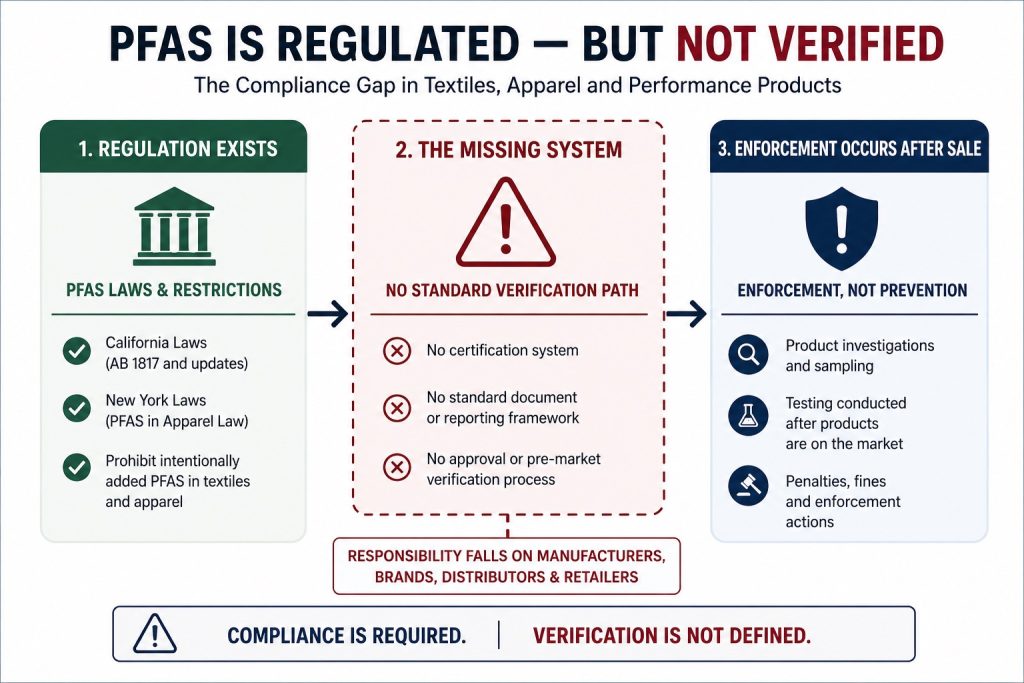
PFAS Is Regulated. Verification Is Not Defined.
States like California and New York have enacted laws restricting PFAS in textiles and apparel.
These laws prohibit the use of intentionally added PFAS in products entering their markets.
What they do not provide is equally important.
There is no:
- Certification system
- Required verification document
- Standardized approval process
There is no official pathway to confirm compliance before a product is sold.
Compliance Is Required — But Not Defined
PFAS laws are structured around restriction, not instruction.
They define what is not allowed, but they do not define how compliance must be proven.
Responsibility is placed on:
- Manufacturers
- Brands
- Distributors
- Retailers
Products must be compliant at the time of sale and must be defensible if challenged.
There is no pre-approval system. There is only post-market accountability.
Enforcement Exists. Verification Does Not.
State agencies have the authority to:
- Investigate products
- Conduct independent testing
- Issue penalties and enforcement actions
They do not:
- Test products before they enter the market
- Certify products as compliant
- Provide a standard documentation framework
Compliance is required. Verification is not defined.
Where Testing Fits — and Where It Stops
Companies like Intertek provide:
- PFAS laboratory testing
- Analytical chemical data
- Detection thresholds and reporting
Testing is a critical component of compliance.
However, laboratory reports:
- Do not declare legal compliance
- Do not track supply chain inputs
- Do not verify finished products as complete systems
They provide data, not a compliance determination.
The Industry Gap
This creates a structural gap across the entire supply chain.
Currently:
- Suppliers often cannot provide complete PFAS documentation
- Brands rely on partial or non-standardized data
- Designers cannot verify materials at the point of use
- Products continue entering regulated markets without full traceability
There is no unified system connecting:
- Raw materials
- Chemical testing
- Component inputs
- Finished product evaluation
Why This Information Is So Difficult to Find
The lack of a defined verification system directly affects how PFAS compliance information appears across supplier and brand websites.
Most companies are not operating with a standardized framework because none has been established.
As a result:
- Compliance is often communicated through general statements rather than documented verification
- Terms such as “PFAS free” or “non-toxic” are used without supporting test data
- Disclosures are inconsistent and rarely tied to specific materials or production batches
- Documentation, when it exists, is fragmented across laboratories, suppliers and internal records
Without a required format or centralized standard, there is no consistent way for companies to present compliance information publicly.
This is why PFAS compliance cannot be verified through website claims alone. It requires structured documentation and traceable data.
If You Cannot Prove Compliance, You Are Exposed
Under current law, liability sits with the company placing the product into the market.
If a product is challenged:
- Documentation is expected
- Proof must be provided
- Claims must be supported by data
Verbal assurances and generalized statements are not defensible.
PFAS PASS™ Was Built to Solve This
PFAS PASS™ is a structured compliance system designed to bridge the 18 gaps we found between regulation and verification.
It provides:
- Supply chain level verifications no one else is offering
- Integration of laboratory testing data
- Bill of Materials traceability
- Alignment between suppliers, testing and production
- Formal verification reports and certificates
This creates a documented, defensible compliance record before enforcement occurs.
Request PFAS Verification
If you are producing or selling supply chain level components into regulated markets, verification is no longer optional.
Request PFAS PASS™ Verification and establish a structured compliance pathway.