Tag: New York PFAS law

  • Buying From California or New York Is Not the Same as Buying Compliant Goods

    Buying From California or New York Is Not the Same as Buying Compliant Goods

    PFAS PASS Compliance Systems™

    Buying From California or New York Is Not the Same as Buying Compliant Goods

    Two failures are happening at once: buyers assume a regulated-state seller means compliant product, and sellers — often the customer service reps speaking for them — don’t seem to know what their own claims now obligate them to prove.


    There is a comfortable assumption moving through the textile, fashion, costume and consumer-goods world right now: that a seller established in a serious, regulated market like California or New York must, by virtue of being there, be selling compliant goods.

    The law points the other way — and so does what we keep finding when we ask for the paperwork.

    California AB 1817 and New York ECL § 37-0121 both took effect on January 1, 2025. They restrict PFAS in textile and apparel products, and AB 1817 requires manufacturers to provide sellers with a signed certificate of compliance. The obligation is created by where you operate and what you do. It is not created by anyone actually meeting it. Location creates the obligation. It does not create the documentation. The space between those two things is where the trouble sits — and right now there are two different people standing in that space, neither of them aware of the other.

    Two Failures, One Gap

    The buyer assumes too much. The seller knows too little. Both are reading the same situation wrong.

    Failure One — The Buyer Side

    “They’re in California, so it must be compliant.”

    A buyer — a brand sourcing fabric, a retailer accepting a line, a procurement lead outfitting a production — sees a New York or California address and reads it as reassurance. The reasoning feels sound: a regulated state means scrutiny, scrutiny means compliance, compliance means I’m covered.

    Every step of that chain is wrong in the same way. A regulated-state location tells you the seller carries an obligation. It tells you nothing about whether the seller met it — and it does not transfer any protection to you. If anything, it should raise the question, not settle it: this party is operating where the duty exists, so where is the document that satisfies it?

    The buyer has mistaken the seller’s exposure for the buyer’s protection. Those are opposite things. And when the goods move — transformed in one state, sold or performed in another — the assumption travels with them, unexamined, until someone finally asks for the certificate and discovers it was never there.

    Failure Two — The Seller Side

    “Of course our products are PFAS-free.” Said by someone with no document behind it.

    On the other side of the transaction, the claim gets made — frequently by a front-line customer service representative — with apparent confidence and no apparent awareness that the sentence carries weight. “All our fabrics are free of PFAS.” “Completely PFAS-free and Proposition 65 compliant.” These are stated the way a rep might confirm a shipping date.

    But an affirmative compliance claim is not a courtesy. Under Section 5 of the FTC Act — and the substantiation principle reflected in the FTC’s Green Guides, which are guidance under Section 5, not an “Act” of their own — a claim you cannot substantiate is a problem on its own terms, in any state. The rep saying it almost certainly doesn’t know that. The company may not have prepared them to know it. That is precisely the blind spot: the people speaking for the seller are being set up to make representations their organization has no documentation to support.

    Here is how cleanly the two failures meet. In the investigation series, the same support channel will sometimes assert a product is “completely free of PFAS” and, in a different message on the same matter, concede that it cannot guarantee its mills don’t use PFAS and that outside testing on the finished product would be required for full assurance. The confident claim and the honest admission come from the same seller. The buyer who relied on the first never sees the second.

    That pattern is described generally and scoped to the case studies examined to date; it is not a statement about every seller.

    Why a claim keeps failing to become evidence

    The reason both sides get this wrong is that a claim and a compliance document are different categories of thing, and most of the market treats them as interchangeable:

    • A sustainability report is a corporate narrative. It is not a PFAS test result.
    • A recycled-content credential tells you where the feedstock came from. It tells you nothing about whether the finished material is PFAS-free — recycled does not mean clean.
    • Words like eco, green, coated, treated and Prop 65 compliant describe an intention or a different regulation entirely. None of them substantiate a PFAS-free claim.

    A compliance document has numbers on it.
    Lab results. Not assurances, not adjectives, not a logo.

    One more distinction that changes the legal picture and is easy to get backwards: “selling out of” a regulated state and “selling into” one are not the same thing. They attach obligations at different points and to different parties. The error almost always runs toward false comfort — which is exactly the buyer’s mistake and the seller’s blind spot, restated in legal terms.

    Wherever you sit in the chain, the gap finds you

    Whether you are the one assuming or the one claiming, there is a documentation-driven system built for your position. Find yourself below.

    If you are a… The gap shows up as… The system built for it
    Brand or production team Sourcing on the assumption your suppliers are covered, and building new goods that repeat the gap. Audit System™ (existing inventory) → Design Development & Build System™ (new production)
    Retailer, reseller or marketplace Accepting brands on their say-so — liability walking in with every unscreened SKU. Retailer / Reseller Intake System™
    Supplier, mill or manufacturer Buyers now asking for a certificate of compliance you have no standardized way to produce. Supplier Compliance System™
    Team whose reps keep getting blindsided Front-line staff making compliance claims no one prepared them to back up. Educational & Training System™
    Buyer, performer or procurement lead No visibility into what was ever documented — and no structured way to ask. End User System™

    None of these systems is a lab certification, and none is legal advice. They are documentation-driven frameworks — ways to build a defensible record of what was asked, what was claimed, what was substantiated, and what was not. In a regulated market, that record is the difference between an assumption and a position you can stand behind.

    A reasonable first step

    If you are a buyer, take one document a seller has given you — an assurance, a certificate, a sustainability claim — and ask whether it has numbers on it that actually speak to PFAS. If you are a seller, ask whether the claim your team makes every day has a document behind it. In both cases, if you’re not certain, that uncertainty is the finding.

    Test one document first. The Rapid Document Review™ runs a single supplier document through a structured evaluation and returns one of two clear outcomes — Requirements Met or Requirements Not Met — against applicable law.

    Start a Rapid Document Review™ →

    Address the whole picture. If your exposure is broader than one document — an inventory, a production line, a marketplace, a supplier base, a customer-facing team — request pricing and access. The intake form routes you to the system built for your category and scale.

    Request Pricing & Access →

    The buyers who handle this well will not be the ones who assumed correctly. The sellers who handle it well will not be the ones who guessed their reps were saying the right thing. Both will be the ones who built the record before anyone asked for it.


    PFAS PASS Compliance Systems™ are documentation-driven compliance frameworks. They are not legal advice and not laboratory certification. Regulatory references — including California AB 1817, New York ECL § 37-0121, and Section 5 of the FTC Act and its Green Guides — are provided for general context and should be reviewed with qualified counsel for your specific situation. Patterns described in the PFAS PASS investigation series are scoped to the case studies examined to date.

  • Case Study Review – What Happens When Reseller Marketplaces Operate Inside Regulated Forever Chemicals Markets?

    Case Study Review – What Happens When Reseller Marketplaces Operate Inside Regulated Forever Chemicals Markets?

    As traditional sewing and sourcing infrastructure collapses, online reseller marketplaces increasingly appear to be replacing local supply chains at the same moment PFAS textile regulations become active in regulated markets including California and New York.

    One of the most important patterns emerging through PFAS PASS investigations is that the growing compliance discussion may no longer apply only to manufacturers.

    It may increasingly apply to reseller marketplaces and redistribution systems moving textile-based goods through regulated markets.

    Following the collapse and liquidation of Joann Fabrics nationwide, large portions of the sewists and crafters shifted online in search of replacement supplies after PFAS textile restrictions became active in California and New York beginning January 2025.

    That shift appears to have accelerated reliance on redistribution systems including:

    Some of these companies do not manufacture the goods themselves. They curate and redistribute them and occasionally develop and manage their own private labeled versions.

    Increasingly, those systems appear connected to:

    • fabrics
    • trims
    • notions
    • coatings
    • foams
    • adhesives
    • transfers
    • sample development
    • prototype development
    • uniforms
    • costumes
    • theatrical wardrobe systems
    • entertainment productions
    • finished garments
    • children’s products
    • textile-based consumer goods

    If products are imported through, sourced, warehoused, sold, redistributed or shipped through regulated markets including California and New York, what documentation exists proving those goods are compliant?

    What supplier representations were collected after Jan 2025?

    What audit trails were preserved after Jan 2025?

    What visibility systems were implemented after January 2025 once PFAS textile restrictions became active?

    What unsupported or undocumented goods continued moving through redistribution systems operating inside regulated states after Jan 2025?

    One of the most important findings emerging through PFAS PASS investigations is that supplier documentation often did not appear until “why” was explained and pressure was applied.

    In multiple prior reviews, documents submitted as supporting evidence appeared insufficient to function as defensible product-level compliance verification despite being presented in good faith as proof of compliance.

    We have yet to receive ANY document that PASSED our VERIFICATION process when compared to the current PFAS Regulations in NY or CA.

    That distinction matters.

    Because the growing issue may not simply involve isolated bad actors.

    It may involve a redistribution and documentation infrastructure that evolved before regulated PFAS textile environments existed.

    That raises a growing series of operational and evidentiary questions:

    • What documentation did reseller marketplaces require BEFORE textile-based goods entered regulated markets AFTER Jan 2025?
    • What products continued shipping into California and New York without publicly visible verification systems AFTER Jan 2025?
    • What mechanisms exist to gate unsupported or undocumented goods from entering regulated states AFTER Jan 2025?
    • Were sellers instructed to stop shipping unsupported textile-based products into California or New York AFTER Jan 2025?
    • Were sourcing departments or downstream buyers notified regarding documentation limitations AFTER Jan 2025?
    • Were reseller systems distinguishing verified products from unsupported claims AFTER Jan 2025?
    • What happens once products pass through multiple redistribution layers before reaching end users AFTER Jan 2025?
    • Through which ports are textile-based goods entering the United States before redistribution through marketplace ecosystems operating inside regulated states AFTER Jan 2025?
    • What visibility currently exists between import records, redistribution systems and downstream marketplace listings AFTER 2025?
    • Were ANY new systems implemented internally by ANY organization in the supply chain AFTER Jan 2025 or has it been business as usual?

    If large-scale gating systems for unsupported textile products were already operational across regulated states, visible disruptions in seller behavior, shipping availability and sourcing access would likely already be occurring across marketplace ecosystems serving California and New York.

    Instead, many textile-based products still appear broadly accessible through redistribution systems despite the growing complexity surrounding PFAS-related regulations.

    That observation may point toward a larger operational reality emerging across the sewing, costume, apparel and textile industries:

    the reseller marketplace economy may be expanding faster than the compliance visibility infrastructure surrounding it.

    That realization directly contributed to the merger of:

    Framework is being developed in response to the growing realization that forever chemicals compliance pressure may not emerge exclusively from the supply chain downward.

    It may increasingly emerge from the end users upward.

    Case Update — May 27, 2026

    One of the central questions this review posed at publication was whether any organization within the reseller marketplace ecosystem had implemented visible compliance systems after January 2025 — or whether it had been business as usual.

    That question now has a documented written answer from one of the named platforms.

    Etsy’s Buyer Escalations team responded today to a formal compliance inquiry connected to a Pacific Trimming transaction. Both Pacific Trimming and Etsy, Inc. operate within New York State, where PFAS apparel restrictions have been in effect since January 1, 2025. The buyer is located in Florida — outside the regulated market entirely. The compliance obligation in this transaction rested with the New York seller and the New York platform, not with the out-of-state buyer.

    Etsy’s response characterized the platform as a purely third-party marketplace with no custody over seller products, offered a $30 gift credit as resolution, and cited a 180-day commercial return policy as the basis for declining financial remedy — directing that commercial policy at a buyer who was never the regulated party in this transaction.

    The response also confirmed in writing that Etsy’s own seller policies require compliance with applicable regulatory requirements. No compliance review of the seller was initiated. No documentation was requested. No verification infrastructure was referenced. No internal system for flagging regulated product categories in a regulated state was described.

    The answer to whether visible compliance systems were implemented after January 2025 is now on the record, in writing, from the platform itself.

    It is no.

    The full case documentation, regulatory notice, and bank dispute filing are recorded in Case Study 10 and Case Study 21. This review’s framing questions remain open across every other named platform and redistribution system. The Etsy response establishes the documented baseline for what marketplace compliance engagement currently looks like when directly tested by an out-of-state buyer purchasing from a regulated-state seller through a regulated-state platform.

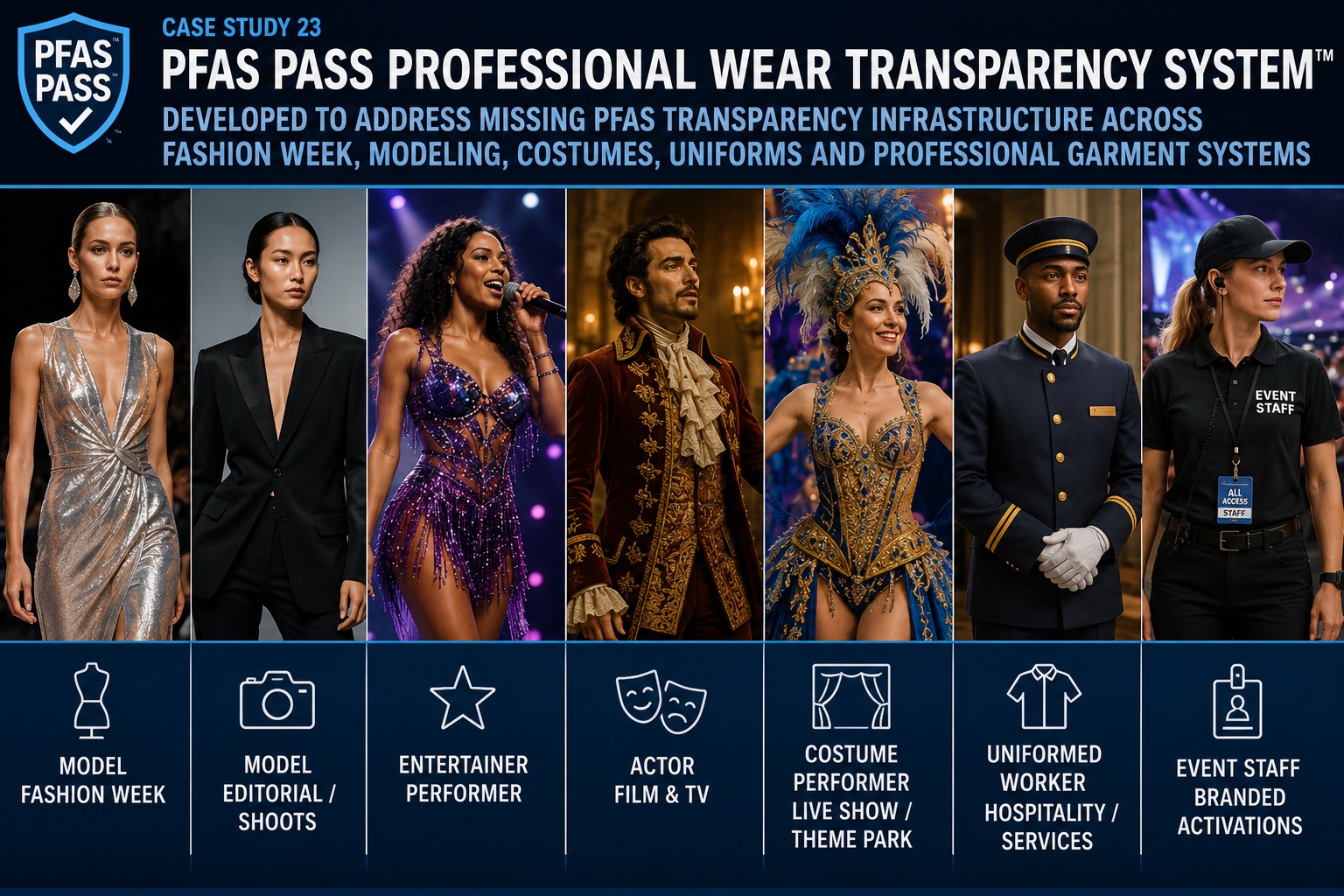
  • Case Study 23 – Professional Wear Transparency System™ Developed to Address Missing PFAS Transparency Infrastructure Across Fashion Week, Modeling, Costumes, Uniforms and Professional Garment Systems

    Case Study 23 – Professional Wear Transparency System™ Developed to Address Missing PFAS Transparency Infrastructure Across Fashion Week, Modeling, Costumes, Uniforms and Professional Garment Systems

    What began as an investigation into PFAS compliance exposure across Fashion Week events and emerging designer systems quickly revealed a much larger operational gap extending far beyond fashion.

    A real-world designer collection was clocked moving through multiple regulated fashion systems including New York Fashion Week exposure, boutique retail placement in New York City and planned expansion into Paris Fashion Week and related Paris boutique representation systems.

    The collection sourced materials through pathways connected to suppliers operating in regulated markets including New York garment district textile and trim suppliers previously documented by PFAS PASS case studies as lacking publicly visible PFAS verification systems, supplier documentation transparency or standardized compliance disclosures across many product categories.

    At the same time:

    • the collection entered public runway exposure
    • products were marketed internationally
    • boutique representation expanded into additional regulated jurisdictions
    • and repeated inquiries regarding PFAS vetting procedures received no visible response

    The investigation raised a larger systems question:

    If fashion week organizations, boutiques and emerging designer systems operating inside regulated markets do not appear to contain visible PFAS transparency infrastructure, what protections exist for the people being professionally required to wear these garments?

    That question expanded the scope of the investigation far beyond fashion retail alone.

    The Professional Garment-Use Gap

    Unlike consumer retail environments where individuals voluntarily choose products, professional garment-use systems frequently require workers, performers and contractors to wear assigned garments as a condition of:

    • employment
    • contracted work
    • runway participation
    • entertainment production
    • promotional appearances
    • branded events
    • photography
    • costume performance
    • or uniform compliance

    Often without meaningful disclosure regarding:

    • textile chemistry
    • coatings
    • synthetic treatment history
    • supplier traceability
    • PFAS compliance review
    • or material sourcing transparency

    PFAS PASS identified what appears to be a significant transparency gap across:

    • fashion week systems
    • modeling agencies
    • entertainment productions
    • costume departments
    • photography and editorial environments
    • themed entertainment
    • uniforms
    • branded events
    • hospitality systems
    • and other professional garment-use environments operating inside PFAS-regulated jurisdictions.

    “But the Garments Weren’t for Sale”

    One potential response from industry participants may be that runway garments function primarily as:

    • editorial presentation
    • artistic expression
    • sample collections
    • prototype development
    • media exposure pieces

    rather than direct retail inventory.

    PFAS PASS recognizes that runway presentation itself may occupy a complex space between artistic display, promotion, sampling and commercial activity depending on how collections are later marketed, represented or distributed.

    However, the issue identified in this case study extends beyond direct retail sales alone.

    The garments were still:

    • physically worn by workers and contracted professionals
    • used in professional environments
    • photographed and promoted publicly
    • represented internationally
    • moved through regulated jurisdictions
    • and connected to broader commercial fashion systems

    while no visible PFAS transparency or intake infrastructure could be identified at the fashion week, showroom, boutique or professional garment-use level.

    The Worker Transparency Question

    As PFAS-regulated textile laws now exist in markets including:

    • New York
    • California
    • and France

    workers and contractors operating inside these environments may have legitimate grounds to begin requesting greater material transparency regarding garments they are required to wear professionally.

    This includes:

    • models
    • performers
    • actors
    • dancers
    • stunt performers
    • costume workers
    • hospitality staff
    • convention workers
    • promotional teams
    • entertainment employees
    • themed entertainment performers
    • and uniformed workers

    particularly in systems involving:

    • synthetic textiles
    • coated fabrics
    • imported garments
    • recycled materials
    • prolonged skin contact
    • steaming and heat exposure
    • repeated backstage handling
    • and unclear supplier documentation pathways

    PFAS chemistry and microplastic shedding are not identical issues, but both contribute to broader questions regarding transparency in synthetic textile systems worn directly against the body in professional environments.

    The regulations already exist.

    The transparency systems largely do not.

    The Result: A New PFAS PASS™ Compliance System

    Case Study 23 ultimately resulted in development of a new PFAS PASS™ operational framework designed specifically to address this emerging gap.

    07- PFAS PASS Professional Wear Transparency System™

    Contract & Disclosure Framework for Professional Garment Use in Regulated Markets

    A structured disclosure and intake framework designed for industries where workers, performers, models and contractors are required to wear garments professionally in PFAS-regulated environments.

    Developed to address emerging transparency gaps across:

    • fashion week systems
    • modeling
    • entertainment
    • costumes
    • uniforms
    • photography
    • editorial environments
    • branded events
    • hospitality systems
    • themed entertainment
    • and international professional garment-use systems

    where garments may be worn without meaningful material disclosure or visible compliance review.

    Core Function:

    • Professional garment-use disclosure requests
    • Contract and employment language templates
    • Material transparency and supplier disclosure pathways
    • PFAS-related acknowledgment language
    • Intake review for assigned garments and costume systems
    • Risk classification for synthetic, coated and imported textile systems
    • Documentation request workflows for regulated markets
    • Transparency tools for workers, agencies, productions and organizations

    This system was developed to help create front-end transparency and documentation pathways for professional garment-use environments where workers may be contractually required to wear garments in regulated jurisdictions without clear visibility into material sourcing or PFAS compliance status.

    Related PFAS PASS Case Studies

    • Case Study 02 — FabricWholesaleDirect and Independent Testing Responsibility
    • Case Study 06 — Carr Textile and Supplier Documentation Gaps
    • Case Study 07 — IAAPA and the Trade Show Compliance Blind Spot
    • Case Study 11 — WAWAK and the Hidden Risk of Notions & Components
    • Case Study 15 — The Los Angeles Garment District PFAS Visibility Problem
    • Case Study 21 — One Garment. Three Suppliers. Zero Verifiable Compliance.

    Explore the full suite PFAS PASS™ Compliance Systems here:

  • CASE STUDY 22 — THREE SUPPLIERS PROVIDED PFAS COMPLIANCE DOCUMENTS. ALL THREE FAILED REVIEW.

    CASE STUDY 22 — THREE SUPPLIERS PROVIDED PFAS COMPLIANCE DOCUMENTS. ALL THREE FAILED REVIEW.

    During ongoing PFAS sourcing investigations connected to regulated-market builds, PFAS PASS identified a new and potentially significant compliance problem:

    Supplier-provided PFAS compliance documents that initially appeared credible failed structured verification review.

    Importantly, nothing in these investigations suggested intentional deception or bad faith by the suppliers involved.

    In all three cases, the documents appeared to have been shared as genuine attempts to support compliance questions in a rapidly evolving regulatory environment.

    That is what makes this discovery important.

    Most buyers, sourcing departments, costume shops, schools, brands, Etsy sellers, Amazon sellers and small businesses likely would have accepted these documents, filed them away and assumed the compliance issue had been addressed.

    PFAS PASS did not.

    Three separate suppliers.
    Three separate document types.
    Three separate failure points.

    The findings revealed a larger problem:
    documents are being interpreted as PFAS compliance evidence without independent verification of whether those documents actually satisfy the regulatory exposure attached to the product.

    CASE 01 — WAWAK / YKK ZIPPER DOCUMENT FAILURE

    Previously documented in Case Study 11 and Case Study 21, WAWAK provided PFAS-related documentation connected to a YKK zipper inquiry.

    PFAS PASS review identified a critical issue:

    FAILURE POINT DETECTED:
    Expired documentation.

    Why this matters:
    A supplier-provided document may appear legitimate while no longer supporting current compliance standing, chemistry status or regulatory applicability.

    Why third-party review matters:
    Most buyers are not trained to independently evaluate expiration relevance, regulatory timelines or whether older documentation still supports current PFAS compliance exposure.

    RESULT:
    REQUIREMENTS NOT MET

    CASE 02 — CARR TEXTILE CHINO TWILL SDS FAILURE

    Carr Textile provided a Safety Data Sheet (SDS) connected to Chino Twill fabric during a PFAS compliance inquiry.

    At first glance, the SDS appeared technical, formal and potentially supportive as compliance evidence.

    PFAS PASS review identified a different problem:

    FAILURE POINT DETECTED:
    Incorrect document type.

    The SDS did not function as product-level PFAS compliance verification evidence.

    PFAS PASS identified:
    • no product-specific PFAS verification
    • no TOF threshold testing
    • no signed certificate of compliance
    • no analytical evidence tied to the specific fabric reviewed
    • no buyer-facing verification structure for regulated market exposure

    Why this matters:
    Many buyers may reasonably assume that a technical SDS document functions as PFAS compliance evidence when it may not satisfy that purpose under current regulatory exposure.

    Why third-party review matters:
    PFAS compliance review requires evaluating not just whether a document exists, but whether the document itself is capable of supporting the compliance claim being made.

    RESULT:
    REQUIREMENTS NOT MET

    CASE 03 — FRANKLIN CHILDREN’S FOOTBALL PADDING DOCUMENT FAILURE

    PFAS PASS also reviewed documentation connected to Franklin children’s football shoulder padding labeled for Ages 4–5.

    The product appeared heavily documented at first review and included toy-related testing and supplier declarations.

    PFAS PASS identified a much more complex failure pattern.

    FAILURE POINT DETECTED:
    Regulatory scope mismatch.

    PFAS PASS identified:
    • toy protocol testing presented as PFAS compliance support
    • self-declared Letter of Guarantee lacking framework specificity
    • no direct evidence addressing California juvenile products PFAS restrictions
    • layered exposure involving children’s products, textiles and apparel frameworks
    • age labeling functioning as a regulatory trigger that was not adequately addressed

    Why this matters:
    A product may appear heavily documented while still failing to address the actual regulatory frameworks governing the product category.

    This creates one of the most dangerous compliance situations:
    the appearance of safety without verified applicability.

    PFAS PASS review further identified that California’s juvenile products PFAS restrictions became effective July 1, 2023, predating the textile bans by approximately 18 months. The supplied documentation did not directly address that framework despite the product being labeled for children ages 4–5.

    Why third-party review matters:
    Most buyers are not equipped to independently interpret overlapping regulatory systems, determine which laws apply simultaneously or identify gaps between supplier documents and actual point-of-sale exposure.

    RESULT:
    REQUIREMENTS NOT MET

    THE DISCOVERY

    The issue may no longer be the absence of documents.

    The issue may now be widespread misinterpretation of what those documents actually prove.

    In all three cases, supplier-provided documents appeared to be shared in good faith as evidence of PFAS compliance support.

    In all three cases, PFAS PASS identified critical verification gaps that many buyers, sourcing departments, costume shops, schools, brands or small businesses may have reasonably accepted without question.

    That is the compliance risk.

    Not necessarily the absence of documents but the false confidence created when documents appear credible without actually satisfying the regulatory exposure attached to the product.


    June 10, 2026 Update — A Fourth Failure Mode: An Indemnification Agreement Submitted in Place of a Compliance Document

    This case study originally documented three failure modes: an expired document, an incorrect document type, and a regulatory scope mismatch. A fourth has now been recorded, connected to Case 01 above (WAWAK / YKK).

    After the original WAWAK / YKK zipper document failed review as expired, and after a formal escalation was sent to all available WAWAK / Cleaner’s Supply contacts, a new document was produced on June 8–9, 2026: an executed Vendor Compliance Agreement and PFAS Addendum between Cleaner’s Supply Inc. and YKK (U.S.A.) Inc., e-signed by a YKK Vice President of Sales. PFAS PASS conducted a Rapid Document Review (RDR).

    FAILURE POINT DETECTED: Indemnification agreement submitted as compliance evidence.

    The document is structured as a private liability-allocation agreement — YKK agreeing to hold Cleaner’s Supply harmless from PFAS-related claims. The RDR identified:

    • no certification that any product is free of intentionally added PFAS
    • no test data, TOF results, or defined compliance threshold
    • no reference to the specific stock number or order at issue
    • no rights extended to the purchasing customer, who is not a party to the agreement
    • a “Limitation of Liability” clause capping the vendor’s obligation at fees already paid

    Why this matters: the presence of a PFAS indemnification clause indicates that PFAS exposure is being managed as a financial liability to be shifted, rather than a substance to be tested for and documented. An agreement about who is liable for a PFAS problem is not evidence that there is no PFAS problem.

    Why third-party review matters: a buyer, sourcing department, or small business receiving an official, signed, formally executed agreement of this kind could reasonably mistake it for compliance documentation, file it, and assume the matter resolved. It does not resolve the regulatory exposure. WAWAK / Cleaner’s Supply sells in and from New York under NY ECL § 37-0121; a private contract does not displace that statutory obligation or bind the downstream purchaser.

    RDR RESULT: FAIL.

    Powered by PFAS Library and PFAS PASS Rapid Document Review™ Systems.

    The findings documented in this case study directly led to the creation of:

    PFAS PASS Rapid Document Review™

    An independent third-party PASS / FAIL review system designed to identify:
    • expired documents
    • incorrect document types
    • unsupported compliance claims
    • regulatory scope mismatches
    • missing verification evidence

    Submit Supplier Documents for Review:

  • FEEDING THE MACHINE

    | PFAS PASS Compliance Build Series | PFASPASS.com

    Part One of the Feeding the Machine Series | First published May 8, 2026

    PFAS Drift In or Out™ is an original concept of PFAS PASS™. First published May 11, 2026. All rights reserved. This article constitutes independent research and does not constitute legal advice.


    Feeding the Machine

    What the petroleum crisis just revealed about everything you were sold

    You are wearing it right now.

    Not the trend. Not the label. Not the team color or the logo or the limited drop you waited in line for. The petroleum. The crude barrel. The base ingredient of the global supply chain currently in geopolitical crisis — the one the news is covering as though it has nothing to do with your closet, your child’s backpack, the jersey hanging in your hallway, the foam-filled character head your family stood in line to photograph.

    It has everything to do with all of it.

    The world is having a very public argument about oil. Energy prices were among the most volatile of 2025, swinging sharply as Middle Eastern tensions escalated, as threats to the Strait of Hormuz — the chokepoint through which nearly one-fifth of global petroleum flows — moved markets within hours. Analysts wrote forecasts. Governments responded. The price of crude became front page news.

    And almost no one connected it to your jacket.

    That omission was not an accident.

    This is the piece that connects it.

    Part One: The ordinary world — you were inside it

    You didn’t know you were in the machine because the machine was the water you swam in.

    It told you what was in style before you knew you wanted it. It made last season feel like failure without you noticing the mechanism. It installed the desire and then sold you the solution, and it did this so continuously, across so many channels, at so many price points, for so many decades, that you stopped experiencing it as persuasion and began experiencing it as taste. As identity. As self.

    That is not an accident of culture. That is a business model — and it runs, at its molecular foundation, on petroleum chemistry.

    Synthetic textiles — polyester, nylon, acrylic, spandex — are petroleum derivatives. The global fashion industry is approximately 60 percent synthetic fiber by volume. That fiber does not come from a field. It comes from a refinery. The same one currently in crisis. The same one whose price swings are dominating the financial news while the fashion industry watches from a careful distance and says nothing.

    PFAS compounds — the per- and polyfluoroalkyl substances now banned in apparel in New York, California, Maine, Minnesota, and France, with restrictions advancing across the European Union — are fluorinated petroleum chemistry. The durable water repellent on your rain jacket. The performance coating on your synthetic zipper. The stain-resistant finish on the fabric your brand sourced from a supplier who called it PFAS-free without a single document to back the claim. All of it — petroleum derivatives.

    The foam inside the helmet your child’s favorite athlete wears. The padding in the stadium seat you paid to occupy. The character costume head at the theme park — stuffed with expanded foam, clad in synthetic fabric, sold to your family as magic and manufactured from the same upstream barrel. The sets constructed for the productions you stream. The synthetic backings. The coated interfacings. The performance fabrics marketed as innovation.

    Petrochemical. Petrochemical. Petrochemical.

    The machine was always running on oil. It just never put that on the label.

    Part Two: The call — something is cracking and you can feel it

    Here is what the petroleum crisis is actually exposing, underneath the gasoline prices and the geopolitical headlines.

    The fashion industry, the sports industry, the entertainment industry, and the consumer goods machine built on top of them are as dependent on crude oil as any combustion engine ever was. The crisis is not arriving from outside the system. It is arriving from inside the foundation the system was built on.

    And now — for the first time in the history of this industry — the chemical cost of that foundation is being made legally measurable.

    New York and California enacted landmark PFAS apparel bans that took effect January 1, 2025. France followed. Maine, Minnesota, the European Union. The regulations did not land randomly. They landed in the capitals of the industries they disrupt — the fashion capitals, the entertainment capitals, the cities where the machine’s most powerful institutions have always operated.

    You can decide whether that was coincidence.

    What is not coincidence is what the regulations actually require. They require proof. Not claims — proof. Third-party laboratory documentation. Verified supply chains. Substantiated certifications. The kind of evidence that a verbal assurance from a supplier, a notation on a spec sheet, or a certification mark whose scope stops at the fabric and never reaches the zipper, the snap, the buckle, or the coated trim cannot provide.

    The machine has been running on claims for decades. The law just asked to see the receipts.

    Part Three: The road of trials — what you were not told, and who decided that

    You were not told about this by the institutions positioned to tell you.

    The garment districts of New York and Los Angeles — the physical supply chain infrastructure that thousands of independent designers and small brands depend on for fabric, trims, hardware, and notions — published no PFAS compliance guidance for tenants or customers. The laws took effect in their home states. The districts proceeded as normal.

    The trade associations that collect your membership dues, publish restricted substances lists, submit regulatory comments on your behalf, and present themselves as the voice of your industry — engaged at the lobbying level and left the small brand, the independent designer, the trim supplier, and the zipper house without a single published guidance document.

    The certification bodies whose marks appear on sustainable-branded product — the ones you trusted to tell you what was safe and what wasn’t — did not expand their scope to cover the hardware and notions supply chain where the PFAS compliance gap is deepest. The buckle on your bag. The snap on your jacket. The coated interfacing inside every structured garment. Uncertified. Unchecked. Still selling.

    The fashion press did not cover the supplier-level compliance question. Not the glossies. Not the trades. Not the sourcing publications whose specific editorial mandate is the supply chain decisions that brand founders and buyers navigate every day.

    Now — here is the part of the story where you meet the dragon.

    Women’s Wear Daily, the self-described bible of the fashion industry — and the publication most positioned to tell the sourcing community what the new regulations required of suppliers — was previously owned by a major entertainment corporation. It passed through Condé Nast on its way to Penske Media Corporation, which now owns it alongside Sourcing Journal, Variety, The Hollywood Reporter, Billboard, Rolling Stone, Deadline Hollywood, and Dick Clark Productions, including the Golden Globes and the American Music Awards.

    The company that owns both the fashion trade bible and the primary sourcing publication received its largest outside investment — more than $200 million — from the sovereign wealth fund of an oil-producing nation.

    We are not telling you what to conclude from that. We are telling you it is documented, public, and sourced. The publication most positioned to cover the PFAS compliance question in the fashion supply chain is owned by the same company that received a nine-figure investment from the fund of a petroleum state.

    Draw your own map.

    Part Four: The ordeal — you are in the cave now

    This is the part of the journey where we stop moving and you sit with what you know.

    We are going to ask you some questions. We are not going to answer them. That is not a rhetorical device — it is the point. The answer is yours. We are just the ones willing to ask out loud.

    Who had both the platform and the responsibility to publish supplier-facing PFAS compliance guidance before January 1, 2025? Write down the names. Count them. Count how many did it.

    The garment districts of New York and Los Angeles exist in the two states that enacted the landmark PFAS apparel bans. Their tenants are the suppliers. Their customers are the brands. If they don’t publish compliance guidance for their own ecosystem, what exactly is the district for?

    You wore the logo. You carried the bag. You dressed your child in the team jersey and the character ears and the foam-headed souvenir. You did it because the feeling it produced was real — belonging, arrival, inside the circle. The feeling was real. The engineering of that feeling was also real. When you understood one and not the other, who benefited?

    The luxury label on the bag was the aspiration that started the cascade. The fast fashion industry industrialized access to that aspiration — the synthetic echo of the runway, the trend cycle that refreshed every three weeks, the polyester approximation of belonging. Both tiers ran on the same petrochemical supply chain. Both went silent when the regulations came. Is that a coincidence of timing, or a coincidence of interest?

    The sports uniform on the field in California is subject to the same state regulations as the rain jacket in the boutique. The foam costume in the theme park in California is subject to the same state regulations as the children’s garment on the rack. The Broadway wardrobe assembled from garment district suppliers in New York is subject to the same state regulations as every other apparel seller in New York. Has any governing body in any of those industries published a PFAS compliance standard for their supply chain? Go look. We’ll wait.

    The petroleum crisis and the PFAS regulation wave arrived in the same period. The base ingredient of the machine is in geopolitical crisis at the same moment the chemical output of that ingredient is being regulated out of the consumer product supply chain. Two pressures on the same root. Is that a coincidence? Or is it what the end of a petrochemical era looks like from the inside?

    The brands that moved — the ones who built verified PFAS-free supply chains without waiting for institutional guidance — are now the compliant tier as enforcement windows open. The brands who waited for their association, their district, their certifier, their trade press to tell them what to do are not. The silence did not protect them. Who did the silence protect?

    And finally: If you are a small designer, an emerging brand, an independent label who trusted the garment district you source from, the certification mark on your supplier’s materials, the trade press you read every week — and none of them told you that the law changed, that your supplier’s verbal claim isn’t enough, that you are carrying liability you don’t know you have — what does that trust cost you now?

    Sit with that last one.

    Part Five: The revelation — the thread puller

    I want to tell you who I am, because at this point in the story it matters.

    I am an Emmy Award-winning seamstress. I have worked with fabric at a technical and physical level for my entire professional career. I have served over seventy celebrity clients. I was the managing partner of a green deconstruction, demolition, and salvage company — I have hazmat experience, environmental remediation experience, the kind of hands-on understanding of what toxic materials actually do in the physical world that you cannot acquire from a white paper.

    I am the founder and author of PFAS PASS Compliance Systems. I am building the DDS-BF-SNCN — Supplier Non-Compliance Notification — because brands need a formal, documented tool to put suppliers on notice that a verbal claim is not sufficient. I built the PFAS PASS Library because designers and brands deserved the same quality of compliance infrastructure that the industry’s largest players can afford to buy. I built the Verified Registry because the compliant tier needed somewhere to be recognized and the non-compliant tier needed to be able to see the distance between where they are and where the standard is.

    I built all of it because no one else was building it.

    And I built it because I understand, at the level of physical craft, what a thread does inside a constructed textile.

    A garment holds its shape because of tension — carefully managed, deliberately placed tension between threads that each carry part of the load. The structure looks permanent. It is not. Pull the right thread — the one bearing the hidden tension, the one the whole thing depends on — and the garment comes apart. Not explosively. Deliberately. One thread, chosen with knowledge, unravels what looked fixed.

    I am pulling the thread on the textile industry.

    I am the Fast Fashion Slayer and I hold that title without apology, because someone has to and I have the background, the knowledge, the standing, and frankly the fury to do it.

    The thread I am pulling is this: what is actually in what you are wearing, who was supposed to tell you, and why they didn’t.

    The petroleum crisis did not create this unraveling. It made it visible. The machine was always going to reach this moment — when the base ingredient became unstable, the regulations became enforceable, the silence became conspicuous, and the consumer looked down at what they were wearing and asked, for the first time with real stakes, what is this actually made of.

    That moment is now.

    The machine is on the floor.

    The monster has been slayed.

    If you are still reading, and you want the door — it is here.

    If you are a brand, designer, or production team: PFAS PASS Compliance Self-Assessment — the door is narrow. Come prepared to tell the truth about where you are.

    If you are plaintiff counsel, a legal researcher, or a journalist: This is Part One of an ongoing series. To download the Legal Expert Overview and request a retained expert engagement, visit the PFAS PASS Media & Press page.

    PFAS Drift In or Out™ is an original concept of PFAS PASS™. First published May 11, 2026. All rights reserved. This article constitutes independent research and does not constitute legal advice.


    The Feeding the Machine Series

    Part One — Feeding the Machine: What the Petroleum Crisis Revealed About Everything You Were Sold

    Part Two — What PFAS Litigation Has Won, What It Has Missed, and What the Laundry Pathway Changes

    Part Three — 158 Million Americans, One Washing Machine at a Time: The Science of the Laundry Pathway

    Part Four — Hazardous by Any Other Name: The Case for Reclassifying PFAS Textiles as Regulated Hazardous Material

    Part Five — Who Pays to Clean It Up: Making Fashion and Petroleum Fund the Infrastructure Their Production Model Created

    Part Six — Feeding the Machine: The Legal Case — The Petroleum Industry’s Compounded Liability

    Part Seven — Statute of Limitations vs. Expired Window: How Sellers and Banks Hide Behind Refund Timelines to Bury Post-Sale PFAS Claims

    Read the full argument. Own the book.

    The complete Feeding the Machine argument — all parts, the eight gaps, and the personal story behind it — is available in one volume. PDF, signed edition, and Amazon Kindle, paperback, and hardcover formats are linked on the series hub.

    Get the Book →

    For plaintiff counsel and litigation teams.

    PFAS PASS™ develops independent litigation research, case gap analysis, and compliance-documentation strategy. Counsel pursuing PFAS contamination, greenwashing, or post-sale compliance matters can request case gap analysis and retained-expert engagement through the litigation strategy and media kit.

    Litigation Strategy & Media Kit →

  • Solutions for 19 “Forever Chemicals” Compliance Gaps Across Fashion, Children’s Products, Costumes, Uniforms, Textiles and Their Supply Chains

    Solutions for 19 “Forever Chemicals” Compliance Gaps Across Fashion, Children’s Products, Costumes, Uniforms, Textiles and Their Supply Chains

    Nearly a year and a half after “Forever Chemicals” (PFAS) regulations took effect in January 2025, in major U.S. textile markets like California and New York, operational compliance infrastructure across the textile industry remains largely nonexistent.

    In less than 30 days of investigation, PFAS PASS was formed and identified 19 major compliance gaps affecting fashion, costumes, uniforms, footwear, home goods, children’s products, PPE systems, retail intake, supply chains and consumer protection pathways.

    No complete operational framework existed that we could find.

    So we began building one.

    The scale of the current exposure is difficult to overstate.

    Once the industry begins honestly auditing products through a PFAS-risk lens, large portions of modern inventory may immediately enter high-risk review status, including:

    • synthetic performance fabrics
    • stain-resistant textiles
    • wrinkle-resistant apparel
    • moisture-wicking garments
    • waterproof and water-resistant materials
    • weatherproof outerwear
    • technical coatings and finishes
    • foam systems and padding
    • synthetic leather and faux leather products
    • heat transfers and applied graphics
    • screen printing systems
    • adhesives and bonding materials
    • trims, elastics and notions
    • performance footwear
    • uniforms and occupational wear
    • costumes and entertainment wardrobe systems
    • outdoor textiles and gear
    • treated upholstery and soft goods
    • children’s products
    • imported low-documentation textile goods

    Anyone educating themselves on the current regulatory landscape can begin triaging large portions of modern textile systems almost immediately.

    The following gaps were identified during the development of PFAS PASS and operational solutions are now being developed to close them.

    01 — No Supply Chain Audit System or Pathways to PFAS Compliance Existed

    02 — No Third-Party PFAS Verification System to Compare Lab Reports to Regulations Existed

    03 — No Public Verification Registry for PFAS-Verified Textile Materials, Components or Products Existed

    04 — No Fashion Brand Support Existed to Audit Existing Designs Being Sold From or Into Regulated Markets or to Build New Compliant Designs

    05 — No Costume Support Existed to Audit Existing Designs in and for Regulated Markets or to Build New Compliant Designs

    06 — No Uniform or Workwear Support Existed to Audit Existing Designs in and for Regulated Markets or to Build New Compliant Designs

    07 — No Occupational or PPE Support Existed to Audit Existing Designs in and for Regulated Markets or to Build New Compliant Designs

    08 — No Home Goods Support Existed to Audit Existing Goods Being Sold From or Into Regulated Markets or to Build New Compliant Designs

    09 — No Children’s Clothing, Safety Gear or Soft Goods Systems Existed to Audit Existing Goods Being Sold From or Into Regulated Markets or to Build New Compliant Designs

    10 — No Retailer or Reseller Intake System Existed to Vet PFAS VERIFIED Brands Being Sold From or Into Regulated Markets

    11 — No Consumer-Facing Remedies Existed to File for Refunds on Non-Compliant Goods Sold From or Into Regulated Markets

    12 — No Performance Gear Support Existed for Racing, Skydive, Scuba or Other Sports Safety Systems to Audit Designs Being Sold From or Into Regulated Markets or to Build New Compliant Designs

    13 — No Footwear Guidance Existed to Audit Existing Goods Being Sold From or Into Regulated Markets or to Build New Compliant Designs

    14 — No PFAS Compliance Education Programs Exists

    15 — No Tradeshow, Convention or Industry Guidance on PFAS Compliance is Currently Being Offered

    16 — No Disposal Remedies Existed for PFAS-Contaminated Goods We Believe Should be Treated as Haz Mat

    17 — No Import, Port-of-Entry or Market-Entry Documentation Gates Exist for PFAS Compliance

    18 — No Unified Operational Infrastructure Exists Connecting Regulations, Suppliers, Testing, Documentation, Products, Retailers and Consumers

    19 — No Pet Related PFAS Guidance Exists

    Bonus (we will keep updating this section)

    20 – The Garment Industries in the Regulated States of NY and CA Have Been Silent on the Issue

    21 – Major Fashion Magazines Have Been Silent on the Issue

    22 – Textile Industry Organizations Have Been Silent on the Issue

    23 – Washing Machines Need to be Connected to the Micro Plastic Contamination in Municipal Water Supplies

    Organizations already operating on PFAS-free, restricted chemistry or transparent sourcing pathways are likely substantially closer to successful verification than organizations starting from zero.

    Brands and suppliers already pursuing PFAS-free materials, documented sourcing or restricted chemistry standards are likely the closest to becoming PFAS PASS VERIFIED.

    Every supplier, brand, retailer, costume department, uniform provider, footwear company, children’s product manufacturer, institution and textile-based organization should now be evaluating their exposure.

    The next phase requires strategic implementation partners willing to help pressure test, develop and operationalize real-world solutions.

    How to Get Involved

    PFAS PASS is currently seeking strategic partners across:

    • fabric and material suppliers
    • trims and notions suppliers
    • fashion brands
    • children’s product companies
    • costume departments and entertainment organizations
    • uniform companies
    • footwear companies
    • PPE and occupational safety systems
    • home goods companies
    • retailers and resale platforms
    • laboratories and testing organizations
    • colleges and universities
    • trade shows, expos and conventions
    • event planners and conference organizers
    • waste management and disposal innovators
    • compliance technology developers
    • media and consumer advocacy organizations

    Use the contact form below to:

    • become a strategic partner
    • begin PFAS PASS VERIFIED pathways
    • participate in pilot programs
    • request speaking or training
    • join the PFAS PASS DIY Compliance Library
    • discuss educational programs
    • develop category-specific compliance systems
    • collaborate on disposal solutions
    • discuss testing, verification or infrastructure development
    • request media interviews or press materials

    In closing, if you operate in any of the industries identified above, there are now three possible outcomes:

    Comply.
    Retire.
    Or risk being litigated out of business.

    I Want To Get Involved As:

    Strategic Partner
    Supplier
    Fashion Brand
    Children’s Product Company
    Costume / Entertainment Organization
    Uniform Company
    Footwear Company
    Retailer / Reseller
    Educator / University
    Trade Show / Event Organizer
    Media / Press

    I Am Interested In:

    Becoming PFAS PASS VERIFIED
    Strategic Partnership
    Product Audit
    DIY Compliance Library
    Education / Training
    Speaking / Workshops
  • Case Study 21: One Garment, Three Suppliers, Zero Verifiable Compliance — The First Multi-Supplier PFAS Enforcement Action

    Case Study 21: One Garment, Three Suppliers, Zero Verifiable Compliance — The First Multi-Supplier PFAS Enforcement Action


    The Situation May 4, 2026

    A garment was designed and developed using materials sourced from three separate suppliers:

    • Spoonflower (Case Study 04 — Fabric Source out of NC)
    • Wawak (Case Study 11 — Notions Supplier with headquarters in NY)
    • Pacific Trims (NYC) (Trim Supplier located in NY)

    Two of the three suppliers are based in or sell from regulated markets, including New York and California, where PFAS restrictions on apparel textiles took effect January 1, 2025.
    The third supplier operates from an unregulated state, but the materials were sourced for use in a garment intended to enter regulated markets.

    The garment was intended to be produced as a prototype for a client with potential downstream exposure to regulated markets.

    At the time of sourcing, no SKU-level PFAS compliance documentation was provided by any supplier.


    The Discovery

    Following publication of the PFAS Compliance Playbook and development of the PFAS PASS Audit System™, the materials used in this build were reassessed.

    Using structured audit criteria including:

    • fiber composition
    • product category
    • performance characteristics
    • supplier disclosure behavior

    Each component was classified as:

    Unverified / Risk-Relevant for PFAS Compliance

    Supplier responses confirmed the absence of a pre-existing compliance system:

    • Spoonflower — Provided information limited to inks, not base fabric compliance (Case Study 04) Status – still waiting on a fabric compliance reply.
    • Wawak — No publicly available PFAS documentation; offered to review specific SKUs upon request (Case Study 11) – Status – still waiting on a notion compliance reply.
    • Pacific Trim — Required post-sale factory inquiry to determine compliance status – Status – still waiting on a trim compliance reply.

    The Failure

    No supplier was able to provide:

    • SKU-level PFAS compliance documentation
    • third-party laboratory verification
    • or a declaration supporting compliance with regulated market requirements

    at the time of sale or upon immediate request.

    This reveals a consistent condition:

    Textile components are being sold from regulated markets without verifiable compliance status at the SKU level.


    The System Failure

    This garment was not a single product.

    It was a system composed of:

    • fabric
    • trim
    • notions
    • custom embroidered components

    Each sourced independently.

    Each unverified.

    The garment fails as a whole when any one component cannot be verified.

    In this case:

    All components failed verification simultaneously.


    The Exposure

    The impact extends beyond material cost.

    This single garment now carries:

    • Material loss — all sourced components are non-verifiable
    • Labor exposure — design, development and construction time already invested
    • Custom component risk — embroidered patches now require separate compliance review
    • Client notification requirement — disclosure of compliance uncertainty
    • Potential redesign or rebuild — replacement with verifiable materials

    The cost of unverified materials is not the material.
    It is everything built on top of them.


    The Response

    This case introduces a new operational phase:

    Post-Production Compliance Enforcement

    A standardized supplier response protocol has been initiated across all vendors involved in this build.

    Each supplier has been issued a formal notice requesting:

    • PFAS compliance documentation tied to the specific SKU(s)
      (declaration and/or third-party lab testing)

    or

    • Refund / credit for materials sold without verifiable compliance status

    Labor and downstream impacts have been documented and disclosed as part of the case context, with escalation reserved pending supplier response.


    The System That Made This Possible

    This response was not reactive.

    It was system-driven.

    PFAS PASS enabled:

    • SKU-level audit classification
    • risk-tier assignment without immediate lab testing
    • identification of documentation gaps
    • multi-supplier tracking within a single garment system
    • structured enforcement communication

    In this case:

    PFAS PASS was the only functional compliance system present.


    Case Status

    CASE STATUS UPDATE — May 7, 2026

    Pacific Trim — Escalated / Refund Disputed

    Following the initial factory inquiry acknowledgment on May 1, 2026, Pacific Trim issued a final position letter on May 7, 2026, declining to provide documentation or issue a refund.

    Their position rested on three claims:

    • The return window had expired (purchase date: October 2025)
    • Retail transactions do not carry SKU-level documentation obligations
    • The compliance burden falls entirely on the party placing the finished garment into the regulated market

    Each claim contains a partial truth. None of them address the central issue.

    On May 1, 2026, when asked directly whether the ribbed knit trim was PFAS compliant, a Pacific Trim representative responded: “Hello, yes it is.”

    That statement was made without qualification, without documentation, and without disclosure that it was based on unverified supplier attestation. The buyer relied on that representation.

    The legal obligation to disclose is a separate question from the liability created by making an affirmative, unsubstantiated compliance claim at point of sale. Pacific Trim conflated the two.

    Their letter also cited pfaspass.com in an attempt to use the PFAS PASS Mandatory Core Document against the buyer’s own request — selectively quoting a passage about supplier disclosure obligations while omitting the regulatory context for suppliers actively making compliance claims.

    Escalation status: Etsy buyer protection process initiated. Correspondence retained for documentation.

    Refund requested: $27.45 Documentation provided by supplier: None Compliance claim made at point of sale: Yes — unsubstantiated


    Wawak — Documentation Submitted. Documentation Rejected.

    Following publication of Case Study 11 and a direct formal inquiry, Wawak responded by forwarding a third-party manufacturer compliance letter.

    PFAS PASS’s Rapid Document Review system assessed the submitted document. It was a YKK Corporation of America product compliance letter dated November 30, 2023, addressed to Cleaner’s Supply.

    The review identified four disqualifying deficiencies:

    1. The letter does not address PFAS. It covers REACH SVHCs, CPSIA lead and phthalate limits, California Proposition 65, and EU RoHS frameworks. None of those map to New York ECL § 37-0121 — the operative standard banning intentionally added PFAS in apparel effective January 1, 2025. The word “PFAS” does not appear in the submitted document.

    2. The letter is expired. Its own language states a validity period of one year from the date of issue. It expired November 30, 2024.

    3. The letter was not issued to Wawak. It was issued to Cleaner’s Supply. Supplier compliance letters apply to specific supply chain relationships. A letter issued to a different buyer does not extend its representations to Wawak’s customers.

    4. The letter does not meet New York’s documentation standard. NY ECL § 37-0121 requires an affirmative certification that products contain no intentionally added PFAS. This letter makes no such certification.

    PFAS PASS responded in writing, identifying each deficiency and requesting a current, PFAS-specific certification issued directly to Wawak, dated within the past year, that addresses intentionally added PFAS under NY ECL § 37-0121.

    As of the date of this update, no corrected documentation has been received.

    Spoonflower — Inquiry Pending.

    A formal PFAS compliance inquiry was submitted to Spoonflower requesting documentation for the base fabric used in this build. Prior communication was limited to ink compliance; base fabric compliance was not addressed.

    As of May 7, 2026, no response has been received.

    Case Update — Etsy Buyer Escalations Response — May 27, 2026

    The Etsy buyer protection process initiated following Pacific Trimming’s May 7 refusal has now produced a formal written response from Etsy’s Buyer Escalations team. The full analysis of that response, including the regulatory notice submitted in reply, is documented in Case Study 10.

    As it applies to this case, three points are directly relevant.

    First, the buyer in this transaction is located in Florida. Pacific Trimming is located in New York. Etsy is headquartered in New York. The compliance obligation does not rest with the buyer. It rests with the seller and the platform, both operating within a regulated state. That is the correct framing for every supplier dispute documented in this case — the obligation runs upstream, not downstream to the party placing an order from outside the regulated market.

    Second, Pacific Trimming‘s position throughout this enforcement action — that compliance responsibility rests entirely with whoever places the finished garment into the regulated market — does not survive that framing.

    A New York seller selling apparel components from New York, after January 1, 2025, carries an obligation that does not transfer to a buyer in Florida simply because the package crossed a state line.

    Third, Etsy’s 180-day commercial return policy is irrelevant to the regulatory question. The policy governs platform transactions. It does not govern whether a sale originating in a regulated state met the compliance requirements of that state. A latent compliance failure — one that only becomes visible when documentation is requested and cannot be produced — is not foreclosed by a return clock that assumed the buyer could identify the problem at point of sale.

    A $30 store credit redeemable on a platform with no compliance infrastructure does not address any of this. It has been declined.

    Additionally, a dispute has been filed with the issuing financial institution regarding the Pacific Trimming transaction. That dispute is currently under review. When both platform and seller remedies are exhausted without resolution of the underlying compliance question, consumer financial dispute protections represent a documented available pathway — and one that now sits on the record in this case.

    Pacific Trimming — Case 21 status as of May 27, 2026:

    Etsy buyer escalation response received. Gift credit declined. Regulatory notice submitted requesting compliance officer review. Bank dispute filed and under review. NY DEC and NY AG referral reserved pending Etsy response. All correspondence, support ticket documentation, and written communications retained as part of the Case 21 evidentiary record.

    Three suppliers. Three different response pathways. The compliance obligation belonged to all of them. The outcome is the same at every stage.


    What These Three Statuses Confirm Together

    Three suppliers. Three different response types.

    One provided an unsubstantiated verbal claim — then refused to substantiate it when pressed. One submitted documentation — which did not survive review. One has not responded at all.

    The result is the same in every case:

    Zero verifiable compliance. Three different pathways to the same outcome.

    This is not a coincidence.

    It is a system condition.

    And it is exactly what Case Study 21 was opened to document.

    Open — Active Supplier Response Pending

    • Spoonflower — Prior response on inks; fabric compliance unresolved
    • Wawak — SKU-level review pending
    • Pacific Trim — Factory inquiry pending

    Updates will be documented as responses are received.


    Cross-Case Convergence

    This case represents the convergence of previously documented supplier gaps:

    • Case Study 04 — Spoonflower
    • Case Study 11 — Wawak

    Previously isolated issues are now demonstrated as:

    a single garment system failure across multiple suppliers

    Each of these cases will be updated to reflect inclusion in this active enforcement scenario.


    Industry Implication

    If one garment requires verification across multiple components and none of the suppliers can provide it:

    the issue is not supplier-specific.
    it is systemic.

    Suppliers are currently operating without:

    • inventory-level compliance systems
    • SKU-level documentation tracking
    • or point-of-sale verification protocols

    in regulated markets where such verification is now required for defensible use.


    What Changes Now

    This case establishes a new baseline behavior:

    Buyers are no longer limited to accepting unverified materials.

    With structured audit systems in place, they can:

    • classify risk
    • demand documentation
    • restrict use
    • and pursue resolution

    This is the beginning of:

    market-driven compliance enforcement


    CTA

    Join the PFAS PASS DIY Library

    Audit every material you’ve purchased or used in production since January 2025.

    If it cannot be verified:

    You now have a system to identify it
    and a structured way to act.


    Update: May 5, 2026 — The System Built to Fill the Gap

    When Case Study 21 was published, it documented a condition that had no structured buyer-facing response tool: a garment built from three suppliers, zero verifiable compliance, and no existing system for a downstream buyer to formally demand documentation or recover damages.

    That gap has now been filled.


    What Was Built

    In direct response to the conditions documented in this case, PFAS PASS has developed and released the first PFAS PASS Audit Compliance Systems – Buyer Facing – Enforcement Bundle AS-BF-EB in the textile compliance space.

    The bundle consists of three formal documents, each serving a distinct function within a structured enforcement sequence:


    Document 1 — AS-BF-SRR  

    PFAS PASS Audit System – Buyer Facing – Supplier Refund Request – AS-BF-SRR

    The first and required document in this sequence. Use this to formally notify a supplier of a compliance deficiency and demand either SKU-level PFAS compliance documentation or a full refund on unverified materials. Establishes the evidentiary record through Exhibit A (supplier claims) and Exhibit B (due diligence contact record). Must be completed and refunded before proceeding to AS-BF-SDC

    Document 2 — AS-BF-SDC  

    PFAS PASS Audit Systems – Buyer Facing – Supplier Damages Claim – AS-BF-SDC

    This secondary claim document, gets filed after an AS-BF-SRR (Supplier Refund Request) resulted in a paid claim. Use this to claim additional damages resulting from the incorporation of unverified materials into a build — including labor, design development, pattern making, construction, client notification, redesign, and redevelopment costs. This document also captures independently funded laboratory testing costs and PFAS PASS VERIFIED independent review costs, with result classifications that escalate the claim basis if YOUR testing confirms non-compliance.

    Document 3 — AS-DDB -CN-PN

    PFAS PASS Audit Systems – Design Development / Build Facing – Client Notification: PFAS Compliance Advisory & Remediation Notice AS-DDB -CN-PN

    A parallel document issued to the end client or consumer whose project contains materials under active compliance review. Serves as a good faith, due diligence notice disclosing the compliance status of materials used in their build, the actions currently in progress, and the options available to them pending supplier response. Does not require resolution of the supplier claim before issuance.


    The Verification Gap This Bundle Addresses

    At the time of publication, the PFAS compliance verification market is occupied almost entirely by large-scale laboratory testing and certification bodies — Intertek, Bureau Veritas, UL Solutions, SGS — operating upstream, certifying manufacturers and brands before materials reach the market.

    None of them operate at the buyer-facing layer. None of them provide a structured tool for a designer, costume shop, small brand, or independent builder to formally respond when a supplier cannot produce documentation for materials already purchased and already incorporated into a build.

    As of May 2026, PFAS PASS Rapid Document Review is the only known third-party service filling that gap — providing independent review of supplier PFAS claims and lab reports at the SKU level for downstream buyers. That position is not a marketing claim. It is a documented condition of the current market, timestamped here as part of this case study record.


    Why This Matters Beyond This Case

    Case Study 21 involved one garment, three suppliers, and a total compliance failure across all of them simultaneously. The bundle built in response to it was not designed for that scenario alone.

    It was designed for the condition that scenario revealed:

    Suppliers are currently operating in regulated markets without inventory-level compliance systems, without SKU-level documentation tracking, and without point-of-sale verification protocols. Buyers have been absorbing that risk without any structured tool to respond to it.

    That changes with this bundle.

    Buyers can now classify risk, demand documentation, restrict use, recover material costs, recover damages, recover testing and verification costs, notify clients, and build an audit trail — all within a structured, versioned, formally documented system.

    This is what market-driven compliance enforcement looks like at the buyer level.

    Access the Bundle

    The PFAS PASS Audit System – Buyer Facing – Supplier Enforcement Bundle AS-BF-SEB is only available through the PFAS PASS DIY Library at PFASPass.com.

    If you have purchased textile fabrics, materials, notions, hardware, or trims from ANY supplier operating in or selling into regulated markets since January 1, 2025, and you cannot verify PFAS compliance at the SKU level — you now have a system to act.

    This case study remains open. Supplier responses from Spoonflower, Wawak, and Pacific Trim will be documented here as they are received.


    PFAS PASS Compliance Systems — Developed by PFASPass.com

  • Case Study 16: The Industry Platform Blind Spot — MAGIC (SOURCING by Informa) and the Complete Absence of PFAS Compliance in Fashion’s Most Influential Trade Ecosystem

    Case Study 16: The Industry Platform Blind Spot — MAGIC (SOURCING by Informa) and the Complete Absence of PFAS Compliance in Fashion’s Most Influential Trade Ecosystem

    PFAS PASS Investigation Series


    The Organization

    MAGIC — formally operating as SOURCING by Informa under the Fashion by Informa / MMGNET Group umbrella — is the most recognized and attended fashion trade show ecosystem in the United States.

    Produced by Informa PLC, one of the world’s largest events and publishing companies, MAGIC and its co-located shows draw tens of thousands of industry professionals to the Las Vegas Convention Center biannually, and operate additional marquee events at the Jacob K. Javits Convention Center in New York City.

    The scale is not incidental to this case study. It is central to it.

    MAGIC connects:

    • Global manufacturers and fabric suppliers
    • Trim, component, and notions vendors
    • Apparel brands and private label buyers
    • Sourcing executives and production managers
    • Fashion technology and compliance solution providers
    • Designers, retailers, and merchandising teams

    By their own figures: 36,000+ attendees. 3,500+ exhibitors. 26+ countries represented.

    This is not a niche platform. This is the infrastructure of the U.S. fashion supply chain — assembled twice a year in one place.


    The Regulatory Position of This Organization

    This is where the facts become impossible to ignore.

    MAGIC’s organizer is headquartered in Santa Monica, California. California is a regulated state. As of January 1, 2025, California prohibits the manufacture, distribution, or sale of any textile article containing intentionally added PFAS or total organic fluorine exceeding 100 ppm. By January 1, 2027, that threshold drops to 50 ppm. Manufacturers are required by law to provide certificates of compliance to sellers and distributors.

    MAGIC stages events at the Jacob K. Javits Convention Center in New York City. New York is a regulated state. As of January 1, 2025, New York prohibits the sale of any apparel containing PFAS as intentionally added chemicals. By January 1, 2028, the ban extends to outdoor apparel for severe wet conditions. Compliance certification requirements apply to anyone selling or offering apparel for sale in the state.

    To be precise:

    • The organization that runs MAGIC is based in a regulated state
    • The trade show floor where MAGIC physically operates in New York is located in a regulated state
    • The brands, buyers, and sourcing teams attending MAGIC are selling into regulated states
    • The suppliers exhibiting at MAGIC are supplying into regulated states

    Every party in this ecosystem is inside the regulatory perimeter.

    None of them are being informed of it by the platform that convenes them.


    The Investigation

    A full audit of the publicly accessible content on sourcingatmagic.com was conducted — including the Resources section, the Editorial library, and all published Fashion Technology Foundations reports — to determine whether PFAS compliance is addressed anywhere within their content infrastructure.

    The result is unambiguous:

    The word “PFAS” does not appear anywhere in the publicly accessible content on sourcingatmagic.com.

    Not once.

    Not in the Regulations, Compliance & Disclosure report. Not in the Sustainability report. Not in the 2025 Fashion Sustainability Report. Not in the editorial archive covering sourcing strategy, supply chain resilience, sustainability policy, or business planning. Not in trend forecasting. Not in country and region guides. Not anywhere.


    What Was Found

    SOURCING by Informa has invested significantly in compliance-adjacent content. Their Fashion Technology Foundations: Regulations, Compliance & Disclosure guide explicitly addresses:

    • EU Digital Product Passport requirements
    • U.S. traceability regulations
    • Supply chain disclosure frameworks
    • Cross-border compliance preparation

    Their Fashion Technology Foundations: Sustainability report addresses:

    • Environmental impact of the textile industry
    • Legislative regulation of supply chains
    • Greenwashing and unsubstantiated sustainability claims
    • Design-to-impact and circularity frameworks

    Their 2025 Fashion Sustainability Report addresses shifting policy agendas, innovation momentum, and consumer demand.

    All of this is exactly the context in which PFAS compliance belongs.

    None of it mentions PFAS.

    The organization is publishing compliance content. It is publishing sustainability content. It is publishing regulatory content. And it is doing so with a blind spot so complete that the most actively enforced chemical regulation in U.S. textile history does not appear in a single sentence.


    The Gap in Numbers

    This is not abstract. The regulatory calendar is set.

    • January 1, 2025 — California and New York PFAS apparel restrictions in force
    • January 1, 2027 — California threshold tightens from 100 ppm to 50 ppm total organic fluorine
    • January 1, 2028 — New York ban extends to outdoor apparel for severe wet conditions
    • Ongoing — EU REACH restriction proposal covering all PFAS under active consideration

    Violations of California’s regulations carry civil penalties of up to $10,000 per violation per day.

    The exhibitors on the MAGIC trade floor are not being told this. The buyers writing orders at MAGIC are not being told this. The sourcing teams building supply chains through MAGIC are not being told this.


    The Pattern

    This follows the identical structure documented across every prior PFAS PASS case study:

    1. An industry-leading organization operates in direct proximity to the compliance gap
    2. Regulatory and sustainability content is produced — but stops short of chemical transparency
    3. PFAS is not named, mapped, or addressed as a compliance category
    4. The audience continues operating without the framework they are legally required to have
    5. Liability remains with the designer, brand, buyer, or production team downstream

    What makes this case study different from prior investigations is the scale.

    A single supplier failing to provide PFAS documentation affects the brands sourcing from them. A single trade show failing to address PFAS affects an entire industry — tens of thousands of professionals, across thousands of supply chain relationships, across dozens of countries — all operating under the assumption that if it mattered, someone would have said something.

    Someone should have said something.

    No one has.


    Why This Matters Beyond MAGIC

    MAGIC is not uniquely negligent. That is precisely the point.

    The fashion industry’s most influential platforms — its trade shows, content networks, education systems, and sourcing infrastructure — have collectively failed to integrate PFAS as a compliance category. When the industry’s premier sourcing platform does not address a regulatory requirement, it signals to tens of thousands of professionals that the topic is either not yet relevant or not yet actionable.

    Both conclusions are wrong.

    The regulations are active. The enforcement mechanisms are in place. The penalties are real. And the supply chain that runs through MAGIC’s trade floor has no current mechanism — offered by the platform, by exhibitors, or by buyers — to verify PFAS compliance at the material, component, or finished product level.

    This is not a gap at the edges of the industry. It is a gap at the center of it.


    From Investigation to Infrastructure

    PFAS PASS was not built to document the problem alone. It was built to solve it.


    Pillar 1 — PFAS Compliance Playbook Series

    The Playbook Series translates regulatory pressure into practical execution:

    • Fabric, footwear, and component-level breakdowns
    • Construction system risk identification
    • Real-world sourcing and decision frameworks
    • Step-by-step compliance evaluation guidance

    For every sourcing professional leaving a MAGIC trade floor with a new supplier relationship and zero PFAS documentation: this is where to start.

    This is where the industry moves from confusion → to clarity.


    Pillar 2 — PFAS PASS Compliance Systems™

    Our Compliance Systems establish a structured approach to:

    • Full-system garment review
    • Component-level risk mapping
    • Construction pathway analysis
    • Pre-production compliance decision making

    For the brands, manufacturers, and sourcing teams building or rebuilding supply chains through MAGIC’s exhibitor network: this shifts the industry from assumption-based sourcing to system-based compliance strategy.


    Pillar 3 — PFAS PASS Verification System™

    The missing layer in the current market is verification.

    PFAS PASS provides:

    • Controlled document submission pathways
    • Review of supplier-provided lab documentation
    • Structured verification criteria
    • Buyer-facing transparency through the PFAS PASS VERIFIED framework

    For every buyer writing orders at MAGIC into California and New York markets: this creates a traceable, defensible compliance position where none currently exists.


    Closing Position

    MAGIC convenes the fashion supply chain at scale — twice a year, in Las Vegas and New York, in two of the most aggressively regulated states in the country.

    Its organizer is headquartered in California. Its New York events are staged inside New York. Its attendees are selling into both.

    The regulations are not coming. They are here.

    And the platform that has the greatest reach, the greatest influence, and the greatest responsibility to inform this industry has not said the word “PFAS” once.

    That is not a content gap. That is a system-wide failure — documented, dated, and on the record.

    PFAS PASS exists to bridge that gap. Not through claims. But through systems, documentation, and verification pathways.


    PFAS PASS Investigation Series | Case Study 16 pfaspass.com

    If you have a suggestion on what we should cover next, comment below.

  • Case Study 11 & 12 — Component Review The Invisible Failure Layer: Thread, Notions, and Heat Press Systems Can Invalidate Verified Fabrics

    Case Study 11 & 12 — Component Review The Invisible Failure Layer: Thread, Notions, and Heat Press Systems Can Invalidate Verified Fabrics

    The industry conversation around PFAS compliance is still overwhelmingly fabric-focused. That is a critical mistake.

    Case Study 11 and Case Study 12 demonstrate a structural failure point that sits below fabric selection:
    components and construction systems.

    • Thread
    • Interfacing
    • Elastics
    • Adhesives
    • Heat press appliqués
    • Transfer systems

    These elements are routinely excluded from compliance verification conversations. They should not be.


    Case Study 11 — Wawak Thread & Notions

    Read:

    Wawak is a major supplier embedded across costume shops, workrooms, and theme park fabrication pipelines.

    Key issue:

    • No publicly available PFAS compliance documentation
    • No client-facing lab verification
    • No response to direct inquiry

    Implication:
    Even when a designer sources compliant or verified fabrics, the assembly layer introduces unknown chemical inputs.

    Thread alone is not inert in compliance terms. It is a material input.
    If unverified, it becomes a point of failure.


    Case Study 12 — Ninja Transfers Heat Press Systems

    Read:

    Heat press systems are rapidly expanding across:

    • Small batch fashion
    • Etsy-based production
    • Theme park costume augmentation
    • Entertainment branding applications

    Key issue:

    • Marketing-level claims without full system disclosure
    • No complete breakdown of adhesive chemistry
    • No verified PFAS compliance documentation across all layers

    Critical insight:
    A heat press appliqué is not a decorative layer.
    It is a chemical system bonded to fabric under heat and pressure.

    That system can:

    • Introduce restricted substances
    • Override base fabric compliance
    • Trigger regulatory failure in finished garments

    The Core Failure Pattern

    Across both case studies, the same pattern appears:

    1. Fabric may be claimed or even VERIFIED
    2. Components remain unverified
    3. No supplier provides full lab documentation
    4. Designers are expected to “assume compliance”
    5. Liability shifts downstream to the builder, brand, or buyer

    Result:
    A garment that appears compliant at the material level
    → fails at the system level


    This Is a Systems Problem, Not a Supplier Problem

    Suppliers are not structured to provide:

    • Full chemical disclosure
    • Cross-component verification
    • Buyer-facing lab documentation

    And in many cases:

    • They will not respond
    • They will defer responsibility
    • Or they will rely on generalized certifications that do not address full-system compliance

    This creates a gap that is now operationally dangerous for:

    • Costume designers
    • Theme parks
    • Entertainment productions
    • Independent brands
    • Small batch makers

    Why Components Matter More Than Ever

    Regulated markets like California and New York do not evaluate garments based on intent.
    They evaluate finished systems.

    That means:

    A garment can fail compliance if:

    • The thread contains restricted chemistry
    • The adhesive system is unverified
    • The appliqué introduces PFAS
    • The interfacing or coating layer is non-compliant

    Even if the base fabric is VERIFIED


    The Immediate Risk

    Designers are currently building products where:

    • Supply chains are opaque
    • Documentation is withheld
    • Compliance cannot be proven
    • And products are being shipped into regulated markets

    This is not theoretical.
    This is already happening at scale.


    The Gap: No Buyer-Facing Verification

    The most critical failure point is this:

    There are no client-facing lab test documents available across most of the supply chain.

    Without that:

    • Designers cannot verify
    • Buyers cannot confirm
    • Brands cannot defend
    • Compliance cannot be proven

    Where PFAS PASS Intervenes

    This is exactly the gap PFAS PASS is designed to address.

    1. Compliance Systems

    We establish:

    • Full-system review protocols
    • Component-level risk identification
    • Construction pathway analysis
    • Documentation requirements before production

    This moves compliance from assumption → to structured evaluation


    2. Verification System

    We introduce:

    • Third-party submission pathways
    • Document review structures
    • Controlled verification labeling
    • Buyer-facing transparency frameworks

    This creates a traceable compliance layer where none currently exists


    3. Playbook — Hardware, Notions & Construction Systems Deep Dive

    Download: PFAS Compliance Playbook – Hardware, Notions & Construction Systems Deep Dive Edition

    This playbook breaks down:

    • Where hidden PFAS risks exist
    • How construction methods affect compliance
    • What to audit before production
    • How to avoid invisible failure points

    Final Position

    The industry is still asking:
    “Is this fabric PFAS compliant?”

    The correct question is:
    “Is this entire system compliant once constructed?”

    Because:

    • Thread can fail a garment
    • Adhesives can fail a garment
    • Heat press systems can fail a garment

    And right now,
    no one is providing the documentation needed to prove otherwise


    Closing Statement

    PFAS Compliance is Required
    Component-Level Verification is Missing
    The System Cannot Prove It

    PFAS PASS exists to close that gap
    Before it becomes a liability event for the people actually building the work

    If you have a suggestion on a situation we should turn into a Case Study, comment below.

  • CASE STUDY 10: Marketplace Without Compliance — Etsy, Supplier Opacity, and the Designer Liability Gap

    CASE STUDY 10: Marketplace Without Compliance — Etsy, Supplier Opacity, and the Designer Liability Gap

    The Situation

    I operate an Etsy store under Psycho Seamstress, selling stagewear designs that ship into regulated markets including California and New York.

    These designs include materials sourced through third-party suppliers, including:

    • Spoonflower
    • Ninja Transfers
    • Fabric Wholesale Direct

    As PFAS regulations came into effect, I initiated a standard compliance check:

    • Request verification documentation from suppliers
    • Confirm material-level compliance
    • Cross-check platform guidance

    What I found is the gap.


    Supplier Response: Partial Claims, No Documentation

    Suppliers are not saying “we are non-compliant”

    They are saying:

    • “Our inks are PFAS-free”
    • “We follow general safety standards”
    • “We cannot provide documentation”

    What is missing:

    • Base fabric verification
    • Full material system testing
    • Client-facing compliance documentation

    This creates a critical condition:

    Compliance cannot be confirmed, even when intent appears aligned.


    Platform Response: No Guidance, No System

    I contacted Etsy directly to determine whether any systems exist to:

    • Flag regulated products
    • Restrict non-verified goods
    • Provide seller compliance guidance

    The response:

    No available information on PFAS regulations or seller requirements.

    No tools
    No warnings
    No structure

    This confirms:

    Marketplace platforms are not currently acting as compliance intermediaries.


    The Reality

    The liability does not disappear.

    It shifts.

    From:

    • Supplier
    • Platform

    To:

    • Designer
    • Maker
    • Small business operator

    This is the exact point where most systems fail.


    My Response: Live Compliance Protocol

    Instead of waiting for enforcement or ignoring the issue, I implemented a real-time response:

    1. Material Audit

    • Identified all products using third-party custom fabrics
    • Flagged orders shipped into regulated states

    2. Customer Disclosure

    • Issued direct communication to affected clients
    • Framed as verification gap, not confirmed failure

    3. Public Listing Transparency

    Updated Etsy listings with the following disclosure:


    Sample Public Listing Disclosure

    PFAS Compliance Notice

    Psycho Seamstress is actively reviewing all materials used in our designs in response to evolving PFAS regulations in states including California and New York.

    Some garments in this shop are produced using custom-printed fabrics, heat press materials and fabrics sourced through third-party suppliers, including Spoonflower, Ninja Transfers, Fabric Wholesale Direct and Wawak.

    At this time, while certain suppliers have provided general statements regarding PFAS-related practices (such as ink systems), full verification documentation for all material components — including base fabrics — is not consistently available across the supply chain.

    This does not indicate confirmed non-compliance. It reflects an industry-wide verification gap under current regulatory expectations.


    4. Replacement Pathway Development

    • Sourcing alternative materials
    • Prioritizing suppliers capable of providing buyer facing documentation
    • Preparing upgrade and redesign options

    Why Naming Suppliers Is a Strategic Move

    Most designers avoid naming suppliers.

    That approach is no longer protective.

    It is exposure.

    Naming suppliers does three things:

    1. Transfers ambiguity back to the source

    You are no longer absorbing unknown risk silently

    2. Creates traceability

    If compliance is challenged, your sourcing path is documented

    3. Applies pressure to the supply chain

    Suppliers who want to retain clients must evolve toward verification


    The Core Problem

    Suppliers are not structured to provide:

    • Lab reports
    • Material-level verification
    • Public compliance documentation

    Not because they are necessarily non-compliant

    But because:

    The system to prove compliance has not been built at scale.


    Why PFAS PASS Exists

    This is exactly the gap PFAS PASS is designed to solve.

    Not awareness
    Not theory

    Verification infrastructure

    PFAS PASS provides:

    • Structured verification pathways
    • Documentation review systems
    • Supplier-to-client compliance bridging
    • Public registry for verified materials and products

    Because right now:

    Designers are being held accountable for compliance standards they have no ability to verify.


    What This Case Confirms

    • Suppliers are operating on partial disclosures
    • Marketplaces are not enforcing or guiding compliance
    • Designers are carrying downstream liability
    • No unified verification system currently exists

    Operational Update: May 6, 2026

    After reviewing emerging PFAS compliance regulations affecting apparel and textile products in regulated markets including New York and California, I contacted Etsy Support again to determine whether sellers had the ability to restrict sales to individual US states.

    Etsy Support confirmed that Etsy currently does not offer a feature allowing sellers to block sales specifically to New York or California. In response, I voluntarily deactivated my fashion and costume design listings that could potentially involve unresolved PFAS compliance concerns within current textile and trim supply chains.

    I updated my shop profile with a public notice explaining that new fashion and costume builds were being paused until material sourcing and compliance verification standards become more transparent and reliable for regulated markets.

    This situation further highlights the growing operational gap between evolving PFAS regulations and the current compliance tools available to independent designers, costume builders and online marketplace sellers operating across multiple jurisdictions.

    Case Update — Marketplace Response – May 12, 2026

    Following a request for PFAS compliance documentation connected to apparel trim purchased through Etsy from Pacific Triming, a New York-based seller and Marketplace both operating within a regulated state, Etsy Support stated that their platform could not compel the seller to provide PFAS compliance documentation and would not issue a refund outside the platform’s standard refund window.

    The situation raises broader operational questions for online reseller marketplaces operating within or selling into regulated jurisdictions after PFAS apparel restrictions took effect in January 2025.

    Were sellers of apparel materials, trims, notions or related components required to affirm compliance status after the regulations became active? Were legacy listings reviewed, re-certified or re-submitted under updated compliance standards? Were marketplaces maintaining any visible verification infrastructure requiring regulated product categories to retain supporting documentation tied to PFAS compliance claims?

    From the buyer and downstream manufacturing perspective, no such verification system was visible at the point of sale in this case.

    Etsy Support further stated that sellers are responsible for ensuring compliance with applicable laws and regulations and advised that buyers should request PFAS compliance documentation directly from sellers prior to purchase.

    However, this raises a broader systems-level question now emerging within regulated markets:

    Consumers generally assume they are purchasing lawful and compliant goods through lawful and compliant marketplaces.

    Buyers are not typically positioned to function as chemical compliance auditors, supply chain investigators or regulatory enforcement agents at the point of sale.

    If compliance documentation is required to substantiate PFAS-free or legally compliant apparel-related products entering regulated commerce, the responsibility for maintaining and producing that documentation would reasonably be expected to exist upstream within the seller, supplier and marketplace infrastructure itself — not solely as a burden shifted onto consumers after purchase.

    This exchange highlights a significant operational gap now emerging across online marketplaces operating within regulated jurisdictions:

    There is currently no standardized marketplace-level PFAS verification infrastructure requiring sellers to maintain or publicly provide compliance documentation for apparel materials, trims, notions or garment components entering commerce, outside of the types of structured verification and compliance framework models publicly proposed through PFAS PASS Compliance Systems Solutions for Retailers and Resellers.

    Retailers, sellers and reseller marketplaces may be developing internal compliance systems in response to evolving regulations, but from a consumer and downstream manufacturing perspective, those systems are not currently visible or transparently verifiable at the point of sale.

    This scenario also differs from a PFAS Drift In™ or PFAS Drift Out™ pathway analysis because both the seller and the reseller marketplace operate directly within New York, a regulated market where PFAS apparel textile restrictions are already in effect.

    Irrespective of the refund eligibility window, the underlying compliance question still remains: a seller operating within a regulated market should reasonably be able to provide documentation supporting PFAS compliance claims for apparel-related components that were sold into commerce after January of 2025.

    The inability to access or obtain that documentation a year and a half after the regulations took effect highlights the broader transparency and verification gap now emerging across apparel, trim, notions and component supply chains serving regulated markets.

    Case Update — Etsy Buyer Escalations Response & Regulatory Notice — May 27, 2026

    Following escalation through Etsy’s buyer protection process, a formal written response was received today from Jordan, a Senior Specialist on Etsy’s Buyer Escalations team, regarding order 3818555631 — the Pacific Trimming purchase at the center of this case.

    The response is significant not for what it resolved, but for what it revealed.

    Etsy’s escalation team characterized the platform as a purely third-party marketplace that does not manufacture, source, import, distribute, or hold physical inventory — and on that basis, asserted that Etsy has no custody over or access to products offered by its sellers. The response offered a $30.00 Etsy gift credit in lieu of a refund, citing the platform’s policy that refunds are not available after 180 days from purchase.

    Both elements of that response require examination.

    On the $30 gift credit:

    The buyer in this transaction is located in Florida. The seller, Pacific Trimming, is located in New York. The platform, Etsy, Inc., is headquartered in Brooklyn, New York. The compliance obligation in this transaction does not rest with the buyer. It rests with the seller and the platform, both of whom are operating within a regulated state where PFAS apparel restrictions have been in effect since January 1, 2025.

    A $30 store credit redeemable on a platform that has not implemented PFAS compliance infrastructure does not remediate the regulatory failure that produced this transaction. It is an offer to repeat the same unverifiable purchase. The credit has been declined.

    On the 180-day refund policy:

    Etsy’s 180-day refund window is a commercial policy. It governs buyer satisfaction disputes and transactional remedies within the platform’s own terms of service. It has no legal bearing on whether a transaction was compliant with New York State law in the first place.

    New York’s PFAS apparel restrictions are statutory law. They do not have a 180-day window. They did not expire when Etsy’s return clock ran out. A transaction originating from a New York seller, processed through a New York platform, does not become compliant — or legally unreviewable — because an internal platform refund policy has closed.

    The 180-day rule also assumes the buyer had sufficient information to identify a problem within that window. PFAS compliance failures are not visible at point of sale. There is no label, no apparent defect, no immediate signal that would trigger a standard return. The compliance gap in this transaction only became apparent when documentation was formally requested and could not be produced. A time-based commercial return policy is not a defensible mechanism for foreclosing a regulatory claim on a latent compliance issue — particularly when the compliance obligation belonged to the seller and platform, not the buyer.

    On Etsy’s own policy language:

    The escalation response contains this sentence:

    “Third-party sellers are responsible for compliance with applicable regulatory requirements and our policies.”

    That acknowledgment — made in writing, in a formal support ticket by Etsy’s own Buyer Escalations team — confirms that Etsy’s policies require seller compliance with applicable regulatory requirements. That is not a neutral administrative statement. It is a self-imposed enforcement obligation that cannot be simultaneously asserted and disclaimed in the same communication.

    If sellers are required by Etsy policy to comply with applicable regulatory requirements, the operational question that follows is: what does Etsy do when a seller operating within a regulated state cannot produce compliance documentation for apparel components sold after those regulations took effect?

    Based on this case, the answer is: issue a store credit to the out-of-state buyer and cite the return window.

    On the component exemption question:

    New York regulates PFAS in apparel. Pacific Trimming sells apparel components — trimmings, notions, and trim hardware — from within New York State. The implicit argument running through both Pacific Trimming’s position and Etsy’s response is that components are not finished apparel and therefore fall outside the scope of New York’s PFAS restrictions.

    That argument, if accepted, eliminates meaningful supply chain accountability entirely.

    No maker, designer, or brand can produce a PFAS-compliant finished garment from non-compliant components. The finished product restriction has no functional meaning without component-level compliance upstream.

    A buyer — regardless of where they are located — who purchases apparel components from a New York seller through a New York platform is entitled to assume that transaction meets the compliance requirements of the state from which it originates. The compliance burden does not travel with the package to Florida. It remains with the seller and platform in New York.

    This is not a PFAS Drift In™ or PFAS Drift Out™ scenario in the traditional analytical sense. The drift framework addresses ambiguous cross-jurisdictional pathways. This case involves no ambiguity of jurisdiction. Both the seller and the marketplace are physically located in New York. The regulation is in effect. The component feeds directly into apparel production. The question of who carries the compliance obligation has a clear answer — and it is not the buyer in Florida.

    The component exemption argument is the next documented frontier of marketplace PFAS liability deflection. This case records its first formal written appearance in the PFAS PASS investigation record.

    Regulatory notice submitted:

    A formal response has been submitted to Etsy’s escalation team reframing this matter as a regulatory compliance issue, not a buyer satisfaction dispute, and requesting escalation to a compliance officer or legal team representative. The response requests written confirmation of whether Pacific Trimming’s shop has been reviewed for compliance with New York PFAS sales restrictions, whether Etsy maintains any process for vetting NY-based sellers against applicable state chemical safety law, and whether Etsy intends to take any action regarding this seller’s listed products.

    If this matter cannot be addressed at the regulatory level internally, it will be directed to the New York State Department of Environmental Conservation and the NY Attorney General’s consumer protection division, both of which have independent jurisdiction over PFAS sales violations occurring within New York State.

    Bank dispute filed:

    In addition to the platform escalation, a dispute has been filed with the issuing financial institution regarding this transaction. That dispute is currently under review. When a New York seller cannot produce compliance documentation for materials sold from a regulated state after regulations took effect, and the platform that facilitated that sale declines to address the regulatory dimension, consumer financial dispute protections become a documented and available remedy for the out-of-state buyer who had no mechanism to verify compliance at point of sale. The outcome of that review will be documented here when available.

    What this update confirms:

    The compliance obligation in this transaction belonged to the seller and the platform — both New York entities operating under New York law.

    A commercial return window does not close a statutory compliance question.

    A store credit does not constitute regulatory remediation.

    And a marketplace that requires seller compliance with applicable regulatory requirements in its own written policies has no clean path to simultaneously disclaim any role in enforcing that obligation when a buyer — located outside the regulated state entirely — discovers the compliance gap and asks for accountability.

    Closing

    This is not a failure story.

    This is a systems failure being met with a systems response.

    If you are a designer, manufacturer, or supplier:

    You are already inside this gap.

    The question is whether you acknowledge it now
    Or wait until enforcement forces the issue


    PFAS PASS is building the infrastructure to close it.

    If you are navigating this in real time, or want your materials reviewed and verified:

    Start here:
    https://pfaspass.com/pfas-pass-compliance-systems/


    Do you have any situations that would make for a good Case Study? Comment below.