Category: PFAS Compliance Gap

  • Buying From California or New York Is Not the Same as Buying Compliant Goods

    Buying From California or New York Is Not the Same as Buying Compliant Goods

    PFAS PASS Compliance Systems™

    Buying From California or New York Is Not the Same as Buying Compliant Goods

    Two failures are happening at once: buyers assume a regulated-state seller means compliant product, and sellers — often the customer service reps speaking for them — don’t seem to know what their own claims now obligate them to prove.


    There is a comfortable assumption moving through the textile, fashion, costume and consumer-goods world right now: that a seller established in a serious, regulated market like California or New York must, by virtue of being there, be selling compliant goods.

    The law points the other way — and so does what we keep finding when we ask for the paperwork.

    California AB 1817 and New York ECL § 37-0121 both took effect on January 1, 2025. They restrict PFAS in textile and apparel products, and AB 1817 requires manufacturers to provide sellers with a signed certificate of compliance. The obligation is created by where you operate and what you do. It is not created by anyone actually meeting it. Location creates the obligation. It does not create the documentation. The space between those two things is where the trouble sits — and right now there are two different people standing in that space, neither of them aware of the other.

    Two Failures, One Gap

    The buyer assumes too much. The seller knows too little. Both are reading the same situation wrong.

    Failure One — The Buyer Side

    “They’re in California, so it must be compliant.”

    A buyer — a brand sourcing fabric, a retailer accepting a line, a procurement lead outfitting a production — sees a New York or California address and reads it as reassurance. The reasoning feels sound: a regulated state means scrutiny, scrutiny means compliance, compliance means I’m covered.

    Every step of that chain is wrong in the same way. A regulated-state location tells you the seller carries an obligation. It tells you nothing about whether the seller met it — and it does not transfer any protection to you. If anything, it should raise the question, not settle it: this party is operating where the duty exists, so where is the document that satisfies it?

    The buyer has mistaken the seller’s exposure for the buyer’s protection. Those are opposite things. And when the goods move — transformed in one state, sold or performed in another — the assumption travels with them, unexamined, until someone finally asks for the certificate and discovers it was never there.

    Failure Two — The Seller Side

    “Of course our products are PFAS-free.” Said by someone with no document behind it.

    On the other side of the transaction, the claim gets made — frequently by a front-line customer service representative — with apparent confidence and no apparent awareness that the sentence carries weight. “All our fabrics are free of PFAS.” “Completely PFAS-free and Proposition 65 compliant.” These are stated the way a rep might confirm a shipping date.

    But an affirmative compliance claim is not a courtesy. Under Section 5 of the FTC Act — and the substantiation principle reflected in the FTC’s Green Guides, which are guidance under Section 5, not an “Act” of their own — a claim you cannot substantiate is a problem on its own terms, in any state. The rep saying it almost certainly doesn’t know that. The company may not have prepared them to know it. That is precisely the blind spot: the people speaking for the seller are being set up to make representations their organization has no documentation to support.

    Here is how cleanly the two failures meet. In the investigation series, the same support channel will sometimes assert a product is “completely free of PFAS” and, in a different message on the same matter, concede that it cannot guarantee its mills don’t use PFAS and that outside testing on the finished product would be required for full assurance. The confident claim and the honest admission come from the same seller. The buyer who relied on the first never sees the second.

    That pattern is described generally and scoped to the case studies examined to date; it is not a statement about every seller.

    Why a claim keeps failing to become evidence

    The reason both sides get this wrong is that a claim and a compliance document are different categories of thing, and most of the market treats them as interchangeable:

    • A sustainability report is a corporate narrative. It is not a PFAS test result.
    • A recycled-content credential tells you where the feedstock came from. It tells you nothing about whether the finished material is PFAS-free — recycled does not mean clean.
    • Words like eco, green, coated, treated and Prop 65 compliant describe an intention or a different regulation entirely. None of them substantiate a PFAS-free claim.

    A compliance document has numbers on it.
    Lab results. Not assurances, not adjectives, not a logo.

    One more distinction that changes the legal picture and is easy to get backwards: “selling out of” a regulated state and “selling into” one are not the same thing. They attach obligations at different points and to different parties. The error almost always runs toward false comfort — which is exactly the buyer’s mistake and the seller’s blind spot, restated in legal terms.

    Wherever you sit in the chain, the gap finds you

    Whether you are the one assuming or the one claiming, there is a documentation-driven system built for your position. Find yourself below.

    If you are a… The gap shows up as… The system built for it
    Brand or production team Sourcing on the assumption your suppliers are covered, and building new goods that repeat the gap. Audit System™ (existing inventory) → Design Development & Build System™ (new production)
    Retailer, reseller or marketplace Accepting brands on their say-so — liability walking in with every unscreened SKU. Retailer / Reseller Intake System™
    Supplier, mill or manufacturer Buyers now asking for a certificate of compliance you have no standardized way to produce. Supplier Compliance System™
    Team whose reps keep getting blindsided Front-line staff making compliance claims no one prepared them to back up. Educational & Training System™
    Buyer, performer or procurement lead No visibility into what was ever documented — and no structured way to ask. End User System™

    None of these systems is a lab certification, and none is legal advice. They are documentation-driven frameworks — ways to build a defensible record of what was asked, what was claimed, what was substantiated, and what was not. In a regulated market, that record is the difference between an assumption and a position you can stand behind.

    A reasonable first step

    If you are a buyer, take one document a seller has given you — an assurance, a certificate, a sustainability claim — and ask whether it has numbers on it that actually speak to PFAS. If you are a seller, ask whether the claim your team makes every day has a document behind it. In both cases, if you’re not certain, that uncertainty is the finding.

    Test one document first. The Rapid Document Review™ runs a single supplier document through a structured evaluation and returns one of two clear outcomes — Requirements Met or Requirements Not Met — against applicable law.

    Start a Rapid Document Review™ →

    Address the whole picture. If your exposure is broader than one document — an inventory, a production line, a marketplace, a supplier base, a customer-facing team — request pricing and access. The intake form routes you to the system built for your category and scale.

    Request Pricing & Access →

    The buyers who handle this well will not be the ones who assumed correctly. The sellers who handle it well will not be the ones who guessed their reps were saying the right thing. Both will be the ones who built the record before anyone asked for it.


    PFAS PASS Compliance Systems™ are documentation-driven compliance frameworks. They are not legal advice and not laboratory certification. Regulatory references — including California AB 1817, New York ECL § 37-0121, and Section 5 of the FTC Act and its Green Guides — are provided for general context and should be reviewed with qualified counsel for your specific situation. Patterns described in the PFAS PASS investigation series are scoped to the case studies examined to date.
  • The Claim Without the Receipt

    The Claim Without the Receipt

    PFAS PASS Compliance Systems

    The Claim Without the Receipt

    New PFAS Laws of January 2025 Changed What ‘Green,’ ‘Eco,’ and ‘Recycled’ Have to Prove

    The first time someone asks you for a PFAS compliance document, you may not even understand the question. You will reach for the answer you already know — “our fabrics are compliant” — because that is what your company told you, and you believe it. Then the person on the other end asks for the lab test, and you realize you have never actually seen one.

    If that has happened to you, this is for you. It is not an accusation. It means your company never prepared you for a law that has been in effect for more than a year and a half — and you are now standing in the gap that preparation should have filled.

    The Pattern We Keep Finding

    Across this investigation, we have reviewed dozens of supplier and seller compliance claims. The result has been consistent and, so far, unbroken: many claims, and not one document that meets the standard the applicable laws require. Not one.

    That is not a characterization of anyone’s honesty. It is the documented result of every review we have conducted since this work began. We make no claim about every company in the industry. We report what we have found — and what we have found, over and over, is a confident claim with nothing behind it that would survive a serious look.

    Most of the people repeating these claims believe them completely. They are not trying to deceive anyone. They were handed a sentence by their own company and asked to defend it, and they have no idea that the sentence requires a laboratory report to back it up.

    What “Compliant” Actually Means

    In California, AB 1817 took effect on January 1, 2025. In New York, ECL § 37-0121 took effect the same day. Under these laws, “compliant” is not a belief, a feeling, or a company assurance. It is a documentary standard.

    Compliance means the regulated fluorine content of the product has been measured, the result is on file, and a manufacturer has certified that the product meets the threshold. A claim that a fabric is “PFAS-free” or “compliant” is only as good as the document that proves it — and that document has to exist at the moment the claim is made, not assembled later when a customer or an investigator asks.

    What a Compliance Document Is

    A real compliance document has numbers on it. It is a laboratory test report showing the actual analytical results for the product as it is sold:

    • Total Fluorine (TF) or Total Organic Fluorine (TOF) screening, or targeted PFAS analysis, performed by an accredited laboratory.
    • Tied to the specific item — not the product line in general.
    • Dated, with the laboratory’s detection limits stated.
    • Paired, under CA AB 1817, with a signed certificate of compliance from the manufacturer attesting the product meets the regulated threshold.
    • Current, and accessible on demand — you can produce it when asked.

    If the only thing you can produce is words — a letter, an assurance, a marketing line — you do not have a compliance document. A compliance document is something you can hold up.

    What a Compliance Document Is Not

    These are the things we are handed instead — none of which prove PFAS compliance:

    • A “not intentionally added” letter. That is a statement of intent, not a measurement. Intent is not data.
    • A general supplier assurance or an email saying “our fabrics don’t contain PFAS.”
    • An OEKO-TEX or similar certificate that tests for other substances — formaldehyde, lead — but not PFAS. Passing those tests proves nothing about PFAS.
    • A recycled-content certification (GRS, RCS, a proprietary fiber tracer). It proves recycled origin. It says nothing about PFAS.
    • A “Prop 65 compliant” statement. Proposition 65 is a warning standard, not a PFAS test, and not the same law as AB 1817.
    • An expired certificate.
    • A certificate covering some fabrics when the claim is being made about all of them.
    • A chatbot or FAQ page that says the fabric is PFAS-free.
    • The company’s own sincere belief.

    The Words You Were Handed

    Front-line staff are trained on vocabulary, not chemistry. These are the words we keep hearing — and why none of them is proof:

    • “Eco” / “Green” / “Eco-friendly.” Broad environmental claims a seller can rarely substantiate. A shopper may reasonably read “eco” to include “free of harmful chemicals” — importing a PFAS-free promise the seller never tested for.
    • “Recycled.” A credential on its own axis. Recycling does not remove PFAS, and recycled feedstock can carry it forward from a prior life. “Recycled” is not “clean.”
    • “Coated,” “Treated,” “Performance,” “Synthetic.” These are the highest-risk words, because they signal applied chemistry. Water-repellent, soil-release, and moisture-wicking finishes are exactly the categories where PFAS was the standard chemistry for decades. If it is coated, treated, or a performance synthetic, the duty to test is highest — not lowest.
    • “Prop 65 compliant.” A different law answering a different question. A product can be Prop 65 compliant and still violate AB 1817.

    When the Chatbot Makes the Claim

    We keep finding AI support tools asserting that fabrics are “completely free of PFAS” — sometimes in the same sentence as “Prop 65 compliant,” as if the two were the same thing. They are not.

    Automating a claim does not lower the bar to substantiate it. It raises the exposure, because every chatbot transcript is a fresh, timestamped, written claim made in the company’s name — with no document behind it and no human who can defend it. The machine does not know what it does not know either, and it is putting it in writing at scale.

    How Rare Preparedness Really Is

    Across every organization we have contacted in this investigation, exactly one major theme park had a team actively working on PFAS compliance. One.

    That is not a number that should reassure anyone. It is the measure of how far behind the industry is — and of how alone the front-line worker is when the question finally arrives. If only one organization out of everyone we reached had a team on this, then nearly every person who gets asked is facing the question completely cold.

    If You Sell Out of a Regulated State, Read This Twice

    There is a natural assumption that a seller operating out of California or New York must already be compliant — that the law somehow makes it so by virtue of the address. We went in expecting exactly that.

    That assumption was wrong. Operating out of a regulated state does not make a seller’s inventory compliant. It puts that seller under the law most directly — and, in our findings so far, frequently leaves them among the least prepared to meet it. The location creates the obligation. It does not create the documentation.

    Assuming that a regulated-state seller’s goods will pass a compliance review is, based on what we found, a serious mistake. These are not the safest sellers in the market. If they have not audited their inventory, they are the most exposed — and the most in need of immediate attention.

    What This Means for You

    Here is the part your management may not have explained. If your company cannot immediately produce a matching PFAS lab test for every single item in inventory, then the company has a structural problem — not a problem with one product, but with the whole shelf. Every undocumented item is a potential exhibit, and every undocumented “it’s compliant” is a statement someone may one day be asked to defend and cannot.

    The law that should have triggered a full inventory audit took effect more than eighteen months ago. Selling as though it never happened is the exposure. And the person repeating the claim at the front line is exposed on behalf of a company that, in many cases, has not done the work — and has not told its own staff the truth.

    What We Recommend

    This is not legal advice. It is the recommendation of a compliance investigator who has reviewed dozens of these cases.

    The conservative, defensible position is straightforward: do not sell into a regulated state any item you cannot back, right now, with a compliance document on that item. If you cannot produce a lab test for a product, the safest course is to stop selling that product into New York and California until you can. Every such sale is a sale you would not be able to defend if asked.

    From there, three steps:

    1. Find out what you actually have. Run the documents you already hold through PFAS PASS Rapid Document Review (RDR) to see whether any of them actually meet the standard.
    2. Understand the real scope. If you are starting from zero and do not even know what you have, the first step is understanding what an inventory-wide audit requires. We offer a free initial consultation on exactly that — what compliance actually demands, item by item.
    3. Build the system. The real answer is not one document. It is an inventory-wide audit system: every item, a readily accessible lab test, defensible on demand.

    The Questions to Send Upstairs

    If you are the person being asked for documents you have never seen, you have every right to ask your own management why. Asking is not disloyalty — it is protecting yourself and the company before a customer asks the question you cannot answer. Copy these and send them up the chain:

    • Do we have a PFAS lab test (TF/TOF or targeted) on file for every item in our inventory?

    • Have we audited our full inventory for compliance since CA AB 1817 and NY ECL § 37-0121 took effect on January 1, 2025?

    • Can I access the certificate of compliance for any item a customer asks about, on demand?

    • We are located in — or selling into — a regulated state. Why don’t I have these documents at the front line?

    • If we cannot produce them, why are we still publishing PFAS-free claims and selling into NY and CA?

    • What is our plan to become compliant, and what should I tell customers until we are?

    If you cannot get a straight answer to these questions, that silence is itself the answer — and the reason this matters now rather than later.


    Request a Free Initial Consultation

    Find out what PFAS compliance actually requires for your inventory. No cost for the initial conversation.


    PFAS PASS Compliance Systems — pfaspass.com. Independent compliance research and investigation. This article is educational and is not legal advice.

  • PFAS PASS Case Study 25 – The Vetting Wall

    PFAS PASS Case Study 25 – The Vetting Wall

    Case Study 25 — The Vetting Wall | PFAS PASS™ Compliance Systems
    PFAS PASS™ Compliance Systems  ·  Compliance Build Series
    Case Study 25

    The Vetting Wall

    Eighteen months into a binding law, the people selling the goods don’t know it exists, can’t recognize its documents, and are learning about it from their customers.

    Buying fabric responsibly now requires the buyer to teach the seller their own legal obligations. That inversion — more than any single product or supplier — is the finding of this case study.

    Over roughly six weeks, PFAS PASS ran the same exercise again and again: approach a textile seller, ask whether a fabric was PFAS-compliant, and — when the answer was a confident yes — ask them to substantiate it. The pattern did not vary. Of every seller contacted, not one was able to demonstrate awareness of the regulation, recognize what a valid compliance document looks like, or produce the certificate the law already requires them to have on hand.

    This is not a story about one uncooperative supplier. It is a story about a wall — and about what that wall is actually made of. It is not built of evasion. It is built of ignorance, and ignorance is far harder to fix than refusal, because you cannot ask someone to produce what they do not know exists.

    §

    The SpecimenAn easy case, and still a wall

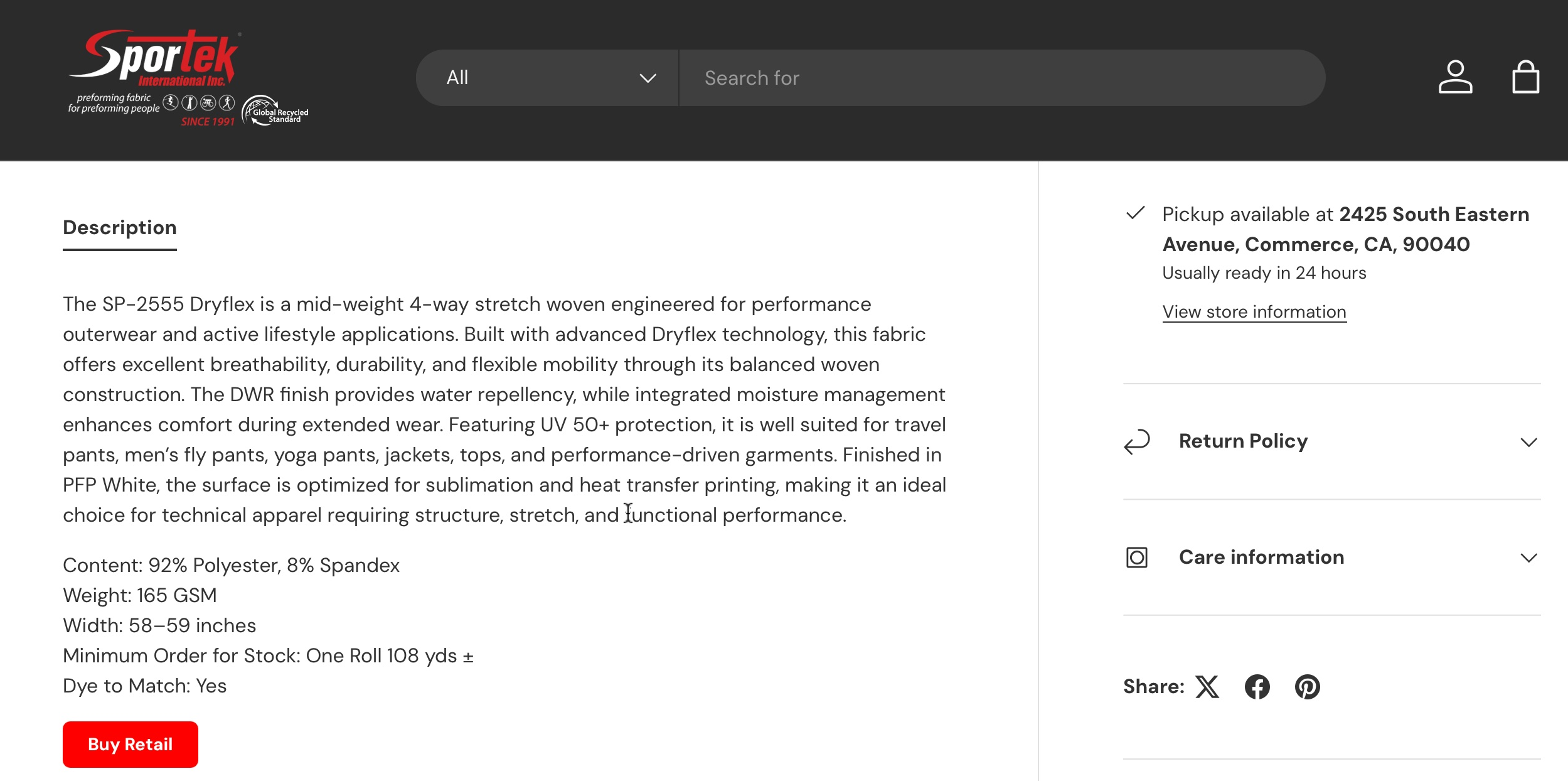
    The anchor example is a fabric listed by Sportek International, the SP-2555 Dryflex — a mid-weight, 4-way stretch woven marketed for activewear. It is worth examining precisely because it is the easy case. It is a 92% polyester / 8% spandex performance fabric sold for water repellency, and fluorine-free durable water repellent (DWR) finishes for exactly this kind of fabric are commercially established and widely adopted. There is no “no alternative existed” defense available here.

    The listing markets “advanced Dryflex technology” and states that “the DWR finish provides water repellency.” It says nothing about the chemistry of that finish — fluorinated or not. And it is offered for sale, with pickup, from a California address.

    Exhibit A  ·  Sportek SP-2555 listingCaptured May 31, 2026
    Screenshot of the Sportek International SP-2555 Dryflex product listing showing the description with DWR finish language, the fabric content of 92 percent polyester and 8 percent spandex, and a California pickup address at 2425 South Eastern Avenue, Commerce, CA 90040.
    The live listing as captured. Note the marketed “DWR finish” and water-repellency claim with no disclosure of finish chemistry, and the in-state pickup address: 2425 South Eastern Avenue, Commerce, CA 90040. Because the fabric is manufactured and offered for sale from within California, it appears to fall directly under AB 1817 at the point of sale — a question of the seller’s obligation, independent of where any finished garment is later sold.

    California’s AB 1817, the Safer Clothes and Textiles Act, has since January 1, 2025 prohibited offering for sale in the state any new textile article — activewear included — containing regulated PFAS at or above 100 ppm total organic fluorine. The same law requires the manufacturer to furnish a signed certificate of compliance to anyone offering the goods for sale. A DWR finish is precisely the use the law was written around.

    The first question was the plain one: is this PFAS-free / compliant? The reply was immediate — and it was the product’s marketing description, the same copy anyone can read on the page. When the request narrowed to the specific, un-deflectable ask — the finish chemistry and the certificate of compliance for the DWR coating — the engagement stopped. After the second request, there was only silence.

    The wall did not go up over a hard question. It went up the moment the question could no longer be answered with a brochure.

    The listing is preserved as documented because listings can be edited or removed. The product swatch card below is retained as independent backup of the same fabric and finish identity.

    Exhibit B  ·  SP-2555 swatch card (backup)
    Sportek SP-2555 swatch sheet showing PFP white front and back and black front and back fabric finishes.
    The manufacturer’s own swatch card for the SP-2555, documenting the PFP white and black finishes. Held as independent product-identity evidence should the live listing change. It documents what the fabric is — it does not, and cannot, speak to finish chemistry, which is exactly the information that was never disclosed.
    A note on what is and isn’t claimed This case study does not assert that the SP-2555 contains PFAS, nor that any seller has broken the law. No fabric was tested. The documented finding is narrower and, I would argue, more troubling: a water-repellent textile is offered for sale from California with undisclosed finish chemistry, the seller declined to substantiate compliance across two dated requests, and a compliant alternative was readily available. Where the law is referenced, the listing appears to be offered in apparent conflict with it — a question for the seller to answer, not a verdict.
    §

    The AnatomyThree layers of not-knowing

    Across the sellers contacted, the failure was not uniform refusal. It was a descending staircase of ignorance — and each step is worse than a flat “no” would have been, because each one represents good faith colliding with an absence of knowledge.

    1

    They don’t know compliance is a thing

    Not avoidance — absence. Front-line staff in sales, marketing, and customer service responded as though they had never heard the question before and did not regard it as their responsibility to answer. There was no concept that a regulation governs what they are selling.

    2

    They can’t recognize a compliance document

    When pressed, some sellers sent documents they believed were compliance proof — and the documents failed review. A recycled-content certificate, a general safety standard, a spec sheet: offered in good faith, none of them addressing PFAS. A seller who hands over the wrong document is, in a way, more revealing than one who hands over nothing. It proves they are trying, and that they have no idea what the right document even looks like.

    3

    They were never told by their own employer

    The worker fielding the question was hearing about the law, in several cases, for the first time — from a prospective customer, not from the company that employs them. The information never flowed down from the top. One New York seller’s answer captured the whole inversion: the buyer was told to purchase the fabric and have it tested themselves.

    That last exchange deserves to sit on its own. A seller, asked to substantiate a compliance claim about their own product, directed the prospective buyer to purchase the goods and pay for testing — offloading the seller’s own legal burden onto the customer, as though verifying the lawfulness of the merchandise were the shopper’s job rather than the seller’s.

    §

    The QuestionWhy don’t they know?

    Eighteen months after the law took effect, why are textile sellers operating out of California and New York — businesses physically located in, and directly regulated by, the very states whose textile laws govern them — the ones most unaware of those laws? This is the part that should astonish anyone. These are not out-of-state vendors stumbling over an unfamiliar rule from somewhere else. They are California and New York companies, selling from California and New York addresses, apparently in conflict with the textile law their own legislatures passed and that is in effect in their own state. Their sales, marketing, and customer-service staff field a basic PFAS-compliance question with no tools, no training, and no script — and a prospective customer ends up delivering the news. We cannot see inside these companies, so we will not pretend to know which explanation is true. But every explanation that can be constructed is damning.

    Every door leads to a failure

    Either leadership doesn’t know either — the regulation never registered at the top, so there was nothing to push down. The most charitable reading, and still a failure of basic regulatory diligence about the law governing your core product.

    Or leadership knows and is waiting it out — aware that active state enforcement is still years away, they’ve quietly decided not to equip anyone yet. In that reading, the uninformed front-line worker is not an oversight; they are a buffer, kept able to honestly say “I didn’t know.”

    Or leadership has nothing compliant to say — they cannot hand their staff a truthful script because the inventory itself cannot be substantiated. Silence downward is the symptom of having no compliant answer to give.

    Pick any branch. In each one, the law is in effect, liability is quietly accruing, and the people on the front line of the sale are left exposed by the organization above them. The worker is not the villain of this story. The worker is its clearest casualty — sent to field a question their employer should have prepared them for, and left to absorb the shock in real time from a stranger.

    §

    The ConsequenceThe inventory no one wants to talk about

    There is a reason this knowledge is so unwelcome, and it sits in the warehouse. AB 1817 provides no sell-through period and no grandfather clause for pre-2025 inventory. The prohibition attaches to the act of selling, not the date of purchase — and it reaches any sale within the state, which captures a California-based seller shipping out of California just as squarely as a sale into it. Stock acquired in good faith in 2023 or 2024 is still “new, not previously owned” when a seller goes to move it today — and if it contains regulated PFAS, that California seller cannot lawfully sell it, regardless of which direction the goods travel. New York’s parallel law works the same way for sellers operating out of New York.

    PFAS PASS has not audited anyone’s warehouse, and puts no number on it. But the logic is unavoidable: a binding ban with no transition window, plus a seller population that — by every contact I made — is unaware the ban exists, means the volume of stranded, unsellable inventory across the industry is almost certainly substantial. The shock encountered again and again on the front line is the leading edge of a much larger reckoning that most of these businesses have not yet had.

    This is why no one is asking about audit systems or compliant-build systems yet. You cannot sell a solution to someone who has not finished absorbing the problem.
    §

    The MeaningWhy the burden fell to the buyer

    Put the pieces together and the conclusion writes itself. The seller side of this market cannot currently carry the compliance burden — it does not know the burden exists, cannot recognize the documents that would discharge it, and has not been equipped from the top to try. So the burden has fallen, by default, to the buyer. That is exactly backwards from how the law is designed, and it is exactly the vacuum that the PFAS PASS systems are built to fill.

    The single most important takeaway for any buyer sourcing from a regulated state: do not assume a seller is compliant. “It’s for sale, so it must be legal” is the precise false assumption this entire market is leaning on — and as this case shows, a seller being located inside the regulating state is no assurance whatsoever. The burden of proof belongs to the seller, and the only way that burden actually gets carried, right now, is if the buyer refuses to let it be skipped.

    If you’re a buyer — or a seller reaching for the light

    If you are sourcing fabric, you can learn to ask the un-deflectable question, recognize a non-answer, demand the certificate the law already requires, and document the result. If you are a seller staring at inventory you’re no longer sure you can move, the first step is not panic and it is not a write-off — it is triage: finding out what is actually compliant before anything is discarded.

    That is the work: audit systems for sellers who want to know where they stand, compliant-build systems for those rebuilding, and a buyer’s field guide for everyone who has realized they can no longer assume.

    PFAS PASS™ Compliance Systems
    Case Study 25 — The Vetting Wall  ·  Compliance Build Series
    Published by PFAS PASS™ Compliance Systems
    Public inquiries via the contact form at PFASPASS.com
    This case study documents the author’s direct, dated correspondence with named and unnamed textile sellers and publicly available product listings. It does not assert that any product contains PFAS or that any seller has violated any law; no products were laboratory-tested. References to AB 1817 and to New York’s textile PFAS law describe the statutes as written and characterize listings as appearing to fall within their scope. Nothing here is legal advice. Sellers and buyers with specific compliance questions should consult qualified counsel.
  • COMPLIANCE CASE STUDY — NO. 24 – The 180-Day Shield

    COMPLIANCE CASE STUDY — NO. 24 – The 180-Day Shield

    PFAS PASS™ Compliance Case Study — No. 24

    The 180-Day Shield

    How Sellers, Resellers, and Banks Are Using Return Windows to Dodge PFAS Compliance Proof — and Why the Clock Doesn’t Apply

    PFAS PASS™ Compliance Systems  ·  PFASPASS.com  ·  May 31, 2026

    The short version

    A 180-day return window is a refund policy. PFAS compliance is a question of whether a product was legal to sell at the moment it was sold. These are two different legal questions answered by two different bodies of law. When a seller responds to a compliance challenge by citing a return deadline, they are answering a question that was never asked — and, in most cases, doing so because they cannot answer the one that was.

    1. The Situation

    PFAS PASS™ is auditing multiple production projects that incorporated textile materials and components purchased after January 1, 2025 — the date on which California’s AB 1817 and New York’s ECL § 37-0121 prohibitions on new PFAS-containing textiles and apparel took effect. These materials were purchased on the reasonable assumption that, having been sold lawfully after the effective date, they were compliant.

    On audit, that assumption could not be confirmed. The compliance picture across the projects is mixed in a revealing way:

    • Never furnished: In some projects, no Certificate of Compliance was ever provided at the point of sale, despite the statutory framework placing a documentation obligation upstream.
    • Furnished but non-probative: In others, documents were provided, but they do not actually establish compliance with the applicable Total Organic Fluorine (TOF) thresholds — they assert a conclusion without substantiating it.
    • Refused on request: In still others, sellers are now declining to produce compliance documentation when asked directly during the audit.

    All three failure modes collapse to the same endpoint: there is no provable compliance. And when the absence of proof is raised, the response from sellers, resellers, and — increasingly — the banks processing chargeback requests has been remarkably uniform:

    The recurring response

    “The laws don’t matter. You waited too long. Your return window closed at 180 days.”

    2. Why the 180-Day Window Is the Wrong Clock

    The central error — whether made innocently or strategically — is a category mistake. A 180-day return window is a private contract and policy term. It governs remorse and satisfaction returns: the buyer changed their mind, the color was wrong, the fit was off. PFAS compliance is not a satisfaction question. It is a question of statutory product legality — whether the item was lawful to sell in the jurisdiction at the moment of sale.

    These are governed by entirely different bodies of law, and they carry entirely different timelines:

    Return / Refund Window PFAS Compliance & Warranty
    Source: the seller’s private policy or platform terms. Source: state statute (AB 1817; NY ECL § 37-0121) and the Uniform Commercial Code.
    Governs: buyer’s remorse and satisfaction returns. Governs: whether the product was legal and fit for its intended use when sold.
    Typical length: 30–180 days, set by the seller. UCC § 2-725: four years from delivery for breach of warranty — and a discovery rule can extend a latent defect further.
    Can be shortened by the seller at will. Cannot be contractually shortened below what the UCC and consumer-protection statutes permit; merchantability disclaimers must be conspicuous to be effective.
    Expiry ends the remorse remedy. Expiry does nothing — a non-compliant product does not become compliant because a calendar passed.

    Bottom line: a private return clock cannot waive a statutory obligation, and it cannot extinguish a defect the buyer was structurally prevented from discovering. Citing it in response to a compliance challenge is answering the wrong question.

    3. The Strongest Theory: A Latent Defect You Were Prevented From Discovering

    This is the spine of the matter, and it is where the 180-day argument falls apart completely. The claim here is not “I want my money back because I changed my mind.” It is built on three linked points.

    3.1  The intended use was lawful sale — and the material can’t serve it

    Material purchased to be incorporated into apparel or textile articles sold in California or New York after January 1, 2025 had one intended use: lawful incorporation into products that could be legally sold in those states. A material that cannot be proven compliant cannot serve that purpose, no matter how it physically performs. That implicates the implied warranty of merchantability (UCC § 2-314 — goods must be fit for their ordinary purpose) and, where the seller knew the intended use, the implied warranty of fitness for a particular purpose (UCC § 2-315).

    3.2  Compliance was presumed at purchase — and the burden sits upstream

    Both statutes build their architecture around upstream documentation. Under AB 1817, manufacturers must provide distributors and sellers with a Certificate of Compliance, and a downstream distributor or retailer is shielded only where it relied in good faith on that certificate. New York’s law follows the same logic: sellers may rely in good faith on a manufacturer’s written assurance, and compliance certifications must be kept on-site and produced to regulators on request.

    The buyer’s good-faith assumption of compliance is therefore not naivety — it is exactly the posture the statute contemplates. The proof obligation lives upstream. When the seller cannot produce it, the good-faith shield they themselves would rely on has no foundation.

    3.3  The inability to prove compliance is itself the defect

    This is the pivot. The defect is not merely “the material may contain PFAS.” The defect is that the seller cannot substantiate the compliance that was material to a lawful transaction. And it is a latent defect by design: the buyer could not have discovered it within 180 days precisely because the documentation that would have revealed it was never furnished, was non-probative, or is now being withheld.

    The argument in one sentence

    You cannot waive, by means of a return-policy clock, a defect you were structurally prevented from discovering — because the seller withheld, never furnished, or never possessed the compliance documentation the statute expects them to hold.

    4. There Is No Expiration on a Compliance Audit

    A separate and equally important point: compliance is a fixed property of the product at the point of sale. A textile article either did or did not contain regulated PFAS above the applicable threshold when it was sold after January 1, 2025. That fact does not change, decay, or expire because time passed.

    Neither statute contains any provision under which a non-compliant product becomes compliant, or under which a seller’s furnishing and recordkeeping obligation evaporates, after any return window. It follows that:

    1. A project can be audited for compliance whenever it is built, sold, or reviewed. The obligation to have sold a lawful product attaches at sale and remains provable — or not provable — indefinitely.
    2. The return clock and the audit clock are unrelated. One governs remorse refunds; the other governs statutory legality. Confusing them is the seller’s error, not the buyer’s lateness.

    The inventory reality makes this concrete. Buying materials on sale and holding them for future production is standard, foreseeable trade practice. Material purchased in early 2025 may not enter a finished good until 2026 or later — well outside any 180-day window, and precisely when a compliance audit naturally surfaces the defect. A window that expires before the defect could reasonably be discovered is the textbook condition for latent-defect treatment.

    5. The Incentive Behind the Refusals

    Stating the pattern plainly, while staying within what the facts support: the effect of these refusals — and the incentive structure they reveal — deserves to be named.

    If a seller could prove compliance, producing the Certificate of Compliance costs them nothing and ends the dispute instantly. The document either exists or it does not. The only scenarios in which hiding behind an unrelated 180-day window is the rational move are these:

    • They cannot currently prove compliance; or
    • They never could, because the inventory was non-compliant.

    Refusing to produce documentation a seller is statutorily expected to hold, while invoking a timing rule that has no bearing on statutory legality, is behavior consistent with offloading inventory that would not survive scrutiny. If proof of compliance would force a seller to keep non-compliant stock they can no longer lawfully sell, then a refused refund quietly transfers that stranded, potentially hazardous inventory — and its downstream liability — onto the buyer.

    The shield only has value to a seller who lacks the proof

    A 180-day window used as a refund policy is ordinary commerce. A 180-day window used as a shield against producing compliance proof is something else — and that shield is worthless to any seller who can simply hand over the certificate. The refusal is the tell.

    PFAS PASS™ states this as an observed pattern and a reasonable inference, not as an allegation of intent against any specific party. The logic does not require proving anyone’s state of mind — it lets the documented conduct speak for itself.

    6. The Banks: Chargeback Denials on the Same Flawed Logic

    The pattern now extends to the financial layer. Card issuers and banks processing chargeback requests are denying them on the same category error — treating a statutory-compliance and latent-defect dispute as if it were an ordinary “goods not as described” or buyer-remorse claim subject to a short presentment window.

    A chargeback grounded in a product that cannot be proven legal to sell, and whose defect was undiscoverable within the window, is not the same as a late satisfaction return. When banks apply the short clock mechanically, they compound the seller’s error and leave the buyer carrying both the cost and the liability for non-compliant inventory. Chargeback timelines are themselves contractual and procedural — they do not, and cannot, adjudicate the underlying statutory legality of the goods.

    In one matter reviewed by PFAS PASS™, a card issuer’s written denial rested on a single stated ground: that the transaction was “not reported in the required timeframe.” The letter made no finding on whether the goods were compliant, whether they were as described, or whether the underlying compliance representation could be substantiated. The merits were never reached — the timing clock alone resolved the dispute. That is the category error in its clearest form: a procedural window standing in for a question of product legality the institution never examined.

    When the only stated reason is the clock

    A denial that turns entirely on “not reported in time” is not a determination that the product was lawful, compliant, or as described. It is a determination that the institution declined to look. The compliance question survives the denial untouched.

    7. What This Means for Buyers and Auditors

    Practical posture for any business auditing post-January-2025 purchases that have hit this wall:

    1. Reframe the demand. Stop asking for a “return.” Ask the seller to produce the Certificate of Compliance / written assurance establishing TOF-threshold compliance for the specific lot, as the statute contemplates. Put the burden where it belongs.
    2. Document the failure mode. Record precisely which of the three applies — never furnished, furnished-but-non-probative, or refused-on-request. Each is independently probative.
    3. Separate the two clocks in writing. State explicitly that the dispute concerns statutory product legality and a latent defect, not a satisfaction return, and that the return window is not the governing timeline.
    4. Preserve everything. Purchase dates, listings, any compliance representations made at sale, and all correspondence in which documentation was requested and refused.
    5. Treat refusal as evidence. A documented refusal to produce statutorily expected compliance proof is itself part of the record.

    8. Important Note

    This case study sets out a compliance and advocacy analysis from PFAS PASS™ Compliance Systems. It is not legal advice, and PFAS PASS™ is not a law firm. The interaction between PFAS restriction statutes, the UCC, consumer-protection law, and card-network chargeback rules is jurisdiction-specific and, in several respects, still developing — including the fact that some state enforcement mechanisms and penalty schedules phase in on later timelines than the sale prohibitions themselves. Businesses facing these disputes should obtain advice from qualified counsel in the relevant jurisdiction before relying on any single theory described here.

    PFAS PASS™ Compliance Systems  ·  Public inquiries via the contact form at PFASPASS.com

  • PFAS Drift™ — Why Your Purchase May Qualify for a Refund Even If You Don’t Live in a Regulated State

    PFAS Drift™ — Why Your Purchase May Qualify for a Refund Even If You Don’t Live in a Regulated State

    | PFAS PASS Compliance Systems | PFASPass.com

    What are PFAS?

    PFAS — per- and polyfluoroalkyl substances — are a class of thousands of synthetic chemicals that have been used in manufacturing since the 1940s. You may know them by their nickname: forever chemicals. They earned that name because they do not break down in the environment or in the human body. They accumulate over time in water, soil, food sources, and living tissue. Scientific research has linked PFAS exposure to increased risk of certain cancers, liver damage, immune system disruption, thyroid disease, and developmental harm in children.PFAS have been used across consumer goods manufacturing for decades — in fabric treatments, water-repellent coatings, nonstick cookware finishes, food packaging, cosmetics, children’s products, and more. They made products perform better. They also made them dangerous. Regulators in New York, California, and multiple other states have now enacted restrictions — and in many categories outright bans — on PFAS in consumer products. Those restrictions are active and enforceable now.If you have purchased consumer goods since January 2025 this affects you.

    We coined a term. Because the thing needed a name.

    In working through the case studies that led to the development of the PFAS PASS Buyer Audit Claims system, we kept running into the same problem — consumers and buyers who had purchased potentially non-compliant goods had no idea they might have a claim basis because they didn’t live in New York or California. They assumed the regulations didn’t apply to them.

    They were wrong. And the reason they were wrong needed a name.

    We’re calling it PFAS Drift™.

    PFAS Drift™ is a PFAS PASS original concept describing the two pathways by which PFAS-regulated goods move through commerce in ways that establish regulatory jurisdiction — and consumer claim rights — beyond the point of original purchase.

    There are two directions:

    PFAS Drift In™ — the pathway by which PFAS-regulated goods enter US commerce through a regulated state. Imported through California or New York ports. Warehoused or distributed from regulated state facilities. Branded, designed, or owned by companies headquartered in New York or California. When goods Drift In through a regulated state, compliance obligations attach at that entry point regardless of where the goods ultimately land or where the buyer is located.

    PFAS Drift Out™ — the pathway by which PFAS-regulated goods reach a regulated market after purchase. Sold to a New York or California customer. Shipped to a regulated state address. Gifted to someone in a regulated state. Built into finished goods sold or shipped into a regulated market. Donated, transferred, or given away into New York or California. When goods Drift Out into a regulated market, the original buyer may retain a compliance claim basis even if they no longer have the goods in their possession.

    A single purchase can involve both. Goods that Drifted In through the Port of Long Beach and then Drifted Out when you gifted them to your mother in New York at Christmas carry dual jurisdiction triggers — and one of the strongest claim bases in the system.

    We are announcing this terminology here, first, as a PFAS PASS original concept. If you see it anywhere else, it came from us.


    What this means for you — right now — before our automated system is ready

    New York and California enacted PFAS restrictions on apparel and multiple other consumer goods categories effective January 1, 2025. Similar restrictions apply to food packaging, cosmetics, cookware, children’s products, home goods, and other categories depending on jurisdiction.

    If you have purchased goods in any of these categories since January 2025 — and those goods involve either PFAS Drift In™ or PFAS Drift Out™ — you may have a basis to request a refund through your payment processor or bank.

    You do not need to wait for our automated system to launch to start this process. You can start right now. Today. With your email inbox.

    Here is exactly how.


    How to Start Your Own Buyer Audit Claim Right Now

    Step 1 — Find your order confirmation email

    Go to your email inbox and search for order confirmations, shipping notifications, or purchase receipts from January 2025 forward. Look for purchases in these categories:

    Clothing, outerwear, athletic wear, swimwear, dancewear, uniforms, costumes, children’s clothing, shoes, handbags, accessories, home textiles, bedding, rugs, cookware, food packaging, cosmetics, children’s products, pet goods, or maker and sewing supplies.

    Step 2 — Check for PFAS Drift

    Ask yourself:

    PFAS Drift In™ — does any of the following apply?

    • Is the brand headquartered in New York or California?
    • Did you buy from a New York or California based seller or marketplace — Etsy, eBay, TikTok Shop, Instagram Shop, Facebook Marketplace, or a brand with NY or CA headquarters?
    • Does the item have a country of origin label showing it was manufactured overseas — meaning it likely entered through a US port, with a high probability of entry through Los Angeles, Long Beach, or New York?
    • Did it ship from a California or New York warehouse or fulfillment center?

    PFAS Drift Out™ — does any of the following apply?

    • Do you live in New York or California?
    • Did you ship this to a New York or California address?
    • Did you gift this to someone in New York or California?
    • Did you use these materials to make something you sold or shipped to a New York or California customer?
    • Did you give away or donate these goods to someone in a regulated state?

    If you answered yes to any of these — in either direction — you may have a claim basis. Keep reading.

    Step 3 — Reply to your order confirmation

    This is the step most people don’t realize they can take.

    Hit reply on your order confirmation email — or find the seller’s contact email through the platform — and forward to send this exact message:


    Subject: PFAS Compliance Documentation Request — Order [your order number]

    Hello,

    I am writing to request PFAS compliance documentation for the following item purchased from your store:

    Item: [product name] Order Number: [order number] Purchase Date: [date]

    New York and California have enacted PFAS restrictions on apparel and other consumer goods categories effective January 1, 2025. As a buyer I am requesting a certificate of compliance, third-party laboratory test results, or equivalent documentation confirming this item meets applicable PFAS compliance requirements for the specific SKU listed above.

    Please provide this documentation within 10 business days. If documentation cannot be provided please advise on your refund process.

    Thank you.


    Copy it. Paste it. Send it. That’s it.

    Step 4 — Document everything

    Screenshot or save the email you sent. Screenshot or save any response you receive. If you receive no response after 10 business days that non-response is itself a documented finding — the seller was given the opportunity to provide compliance documentation and did not.

    Save the original order confirmation. Save the product listing if you can still access it. Note any PFAS-free or compliance claims the seller made at the time of purchase — in the listing, on the product page, on packaging, or in marketing materials.

    Step 5 — Contact your bank or payment processor

    If the seller cannot provide compliance documentation — or does not respond — contact your bank, credit card company, PayPal, or payment platform and initiate a dispute. Reference the item, the purchase date, and the fact that the seller was unable to provide documentation confirming the product meets applicable PFAS compliance requirements for the regulated market in which it was sold or delivered.

    Different payment methods have different dispute windows and processes. Credit cards generally offer the strongest dispute rights. PayPal has its own buyer protection program. Debit cards have dispute processes through your bank. Buy now pay later platforms — AfterPay, Klarna, and similar — have their own buyer protection policies.

    Step 6 — Submit your SKU to PFAS PASS

    While you are working your claim, submit your SKU to the PFAS PASS Buyer Audit Claims waitlist using the form below. Your submission:

    • Gets added to our testing database
    • Helps us calibrate the live BAC system before launch
    • Puts the seller on notice through bac@pfaspass.com that a compliance review is underway
    • Connects you to the full BAC system when it launches

    You will be notified at the email you provide when your SKU has been reviewed and when the live system is available.


    Why this works — and why more buyers means more compliance

    The PFAS PASS Buyer Audit Claims system was built after our case studies revealed a fundamental imbalance. Compliance gaps in the consumer goods supply chain significantly outnumber the regulatory enforcement resources available to close them. Regulators move slowly. Consumer purchasing power does not.

    There are more buyers than non-compliant sellers. When buyers begin requesting compliance documentation at scale — and filing payment disputes when it cannot be provided — the financial pressure on non-compliant brands becomes immediate. A regulatory letter takes years. A chargeback hits today.

    We call this the Ant Strategy. Individual buyers acting independently, each filing one claim, collectively create upstream compliance pressure the supply chain cannot ignore. A relatively small number of suppliers serve a very large number of buyers. The leverage is real. The mechanism is proven. We tested it ourselves — repeatedly — before we built the system.

    You don’t need to understand PFAS chemistry. You don’t need to be a lawyer. You don’t need to live in New York or California. You need an order confirmation email, five minutes, and the template above.


    What qualifies — a quick reference

    Categories active since January 2025: Clothing and apparel of all types, athletic and performance wear, uniforms and workwear, costumes, children’s clothing, footwear, handbags and accessories, home textiles and bedding, rugs, upholstered furniture, cookware and nonstick bakeware, food packaging and contact materials, cosmetics and personal care products, children’s products, pet goods, and maker and sewing supplies.

    Jurisdiction triggers — any one of these may qualify your purchase:

    • You live in or shipped to New York or California
    • You gifted goods to someone in New York or California
    • You used materials in goods sold or given to someone in New York or California
    • The brand is headquartered in New York or California
    • The goods were sold through a New York or California based marketplace or platform
    • The goods were imported — likely through a California or New York port
    • The goods shipped from a California or New York fulfillment center

    Purchases must be:

    • Made on or after January 1, 2025
    • New goods — not used or secondhand
    • Paid by a traceable payment method — credit card, debit card, PayPal, BNPL, or similar

    Submit Your SKU — Join the BAC Waitlist

    The PFAS PASS Buyer Audit Claims automated system is currently in development. While we build it, submit your SKU below. Your submission routes to bac@pfaspass.com, gets added to our testing database, and puts the seller on notice that a compliance review is underway. You will be notified when your SKU has been reviewed and when the live system launches.

    This form is for post-purchase review — goods you have already bought. Looking to check compliance before you buy? Visit the PFAS PASS VERIFIED system


    “`html

    BAC SKU Review — Post-Purchase Compliance Waitlist

    Submit a SKU for PFAS compliance review. Routes to bac@pfaspass.com.

    Who are you? *
    You will be notified when your SKU is reviewed and when the live BAC system launches.
    Purchase Details
    Product name or description
    Found on your receipt, order confirmation, or product tag. Leave blank if unavailable.
    Paste the product listing URL if still available.
    Retailer, marketplace, or platform name
    Must be January 2025 or later
    How did you pay? *
    PFAS Drift™
    PFAS Drift™ is a PFAS PASS original concept describing the pathways by which PFAS-regulated goods establish compliance obligations beyond the point of original purchase.
    PFAS Drift In™ — select all that apply
    PFAS Drift Out™ — select all that apply
    Seller Information
    Compliance Status
    Did the seller make any PFAS-related claims? *
    Do you have compliance documentation from the seller?
    By submitting you are joining the PFAS PASS Buyer Audit Claims waitlist. Your SKU will be reviewed by the PFAS PASS team and the seller will be notified that a compliance review is underway. You will be notified at the email provided when your SKU has been reviewed.
    “`

    PFAS PASS provides systems-based audit and documentation support. This article is for informational purposes only and does not constitute legal advice. PFAS PASS does not guarantee refund outcomes. Claim success depends on the specific facts of each transaction and the policies of the relevant payment processor, marketplace, or financial institution.

    Tags: PFAS Drift, PFAS Drift In, PFAS Drift Out, PFAS buyer audit, PFAS refund, PFAS consumer claims, PFAS regulated goods, PFAS New York, PFAS California, PFAS PASS, buyer audit claims, forever chemicals refund, PFAS chargeback, consumer PFAS rights

  • Case Study Review – What Happens When Reseller Marketplaces Operate Inside Regulated Forever Chemicals Markets?

    Case Study Review – What Happens When Reseller Marketplaces Operate Inside Regulated Forever Chemicals Markets?

    As traditional sewing and sourcing infrastructure collapses, online reseller marketplaces increasingly appear to be replacing local supply chains at the same moment PFAS textile regulations become active in regulated markets including California and New York.

    One of the most important patterns emerging through PFAS PASS investigations is that the growing compliance discussion may no longer apply only to manufacturers.

    It may increasingly apply to reseller marketplaces and redistribution systems moving textile-based goods through regulated markets.

    Following the collapse and liquidation of Joann Fabrics nationwide, large portions of the sewists and crafters shifted online in search of replacement supplies after PFAS textile restrictions became active in California and New York beginning January 2025.

    That shift appears to have accelerated reliance on redistribution systems including:

    Some of these companies do not manufacture the goods themselves. They curate and redistribute them and occasionally develop and manage their own private labeled versions.

    Increasingly, those systems appear connected to:

    • fabrics
    • trims
    • notions
    • coatings
    • foams
    • adhesives
    • transfers
    • sample development
    • prototype development
    • uniforms
    • costumes
    • theatrical wardrobe systems
    • entertainment productions
    • finished garments
    • children’s products
    • textile-based consumer goods

    If products are imported through, sourced, warehoused, sold, redistributed or shipped through regulated markets including California and New York, what documentation exists proving those goods are compliant?

    What supplier representations were collected after Jan 2025?

    What audit trails were preserved after Jan 2025?

    What visibility systems were implemented after January 2025 once PFAS textile restrictions became active?

    What unsupported or undocumented goods continued moving through redistribution systems operating inside regulated states after Jan 2025?

    One of the most important findings emerging through PFAS PASS investigations is that supplier documentation often did not appear until “why” was explained and pressure was applied.

    In multiple prior reviews, documents submitted as supporting evidence appeared insufficient to function as defensible product-level compliance verification despite being presented in good faith as proof of compliance.

    We have yet to receive ANY document that PASSED our VERIFICATION process when compared to the current PFAS Regulations in NY or CA.

    That distinction matters.

    Because the growing issue may not simply involve isolated bad actors.

    It may involve a redistribution and documentation infrastructure that evolved before regulated PFAS textile environments existed.

    That raises a growing series of operational and evidentiary questions:

    • What documentation did reseller marketplaces require BEFORE textile-based goods entered regulated markets AFTER Jan 2025?
    • What products continued shipping into California and New York without publicly visible verification systems AFTER Jan 2025?
    • What mechanisms exist to gate unsupported or undocumented goods from entering regulated states AFTER Jan 2025?
    • Were sellers instructed to stop shipping unsupported textile-based products into California or New York AFTER Jan 2025?
    • Were sourcing departments or downstream buyers notified regarding documentation limitations AFTER Jan 2025?
    • Were reseller systems distinguishing verified products from unsupported claims AFTER Jan 2025?
    • What happens once products pass through multiple redistribution layers before reaching end users AFTER Jan 2025?
    • Through which ports are textile-based goods entering the United States before redistribution through marketplace ecosystems operating inside regulated states AFTER Jan 2025?
    • What visibility currently exists between import records, redistribution systems and downstream marketplace listings AFTER 2025?
    • Were ANY new systems implemented internally by ANY organization in the supply chain AFTER Jan 2025 or has it been business as usual?

    If large-scale gating systems for unsupported textile products were already operational across regulated states, visible disruptions in seller behavior, shipping availability and sourcing access would likely already be occurring across marketplace ecosystems serving California and New York.

    Instead, many textile-based products still appear broadly accessible through redistribution systems despite the growing complexity surrounding PFAS-related regulations.

    That observation may point toward a larger operational reality emerging across the sewing, costume, apparel and textile industries:

    the reseller marketplace economy may be expanding faster than the compliance visibility infrastructure surrounding it.

    That realization directly contributed to the merger of:

    Framework is being developed in response to the growing realization that forever chemicals compliance pressure may not emerge exclusively from the supply chain downward.

    It may increasingly emerge from the end users upward.

    Case Update — May 27, 2026

    One of the central questions this review posed at publication was whether any organization within the reseller marketplace ecosystem had implemented visible compliance systems after January 2025 — or whether it had been business as usual.

    That question now has a documented written answer from one of the named platforms.

    Etsy’s Buyer Escalations team responded today to a formal compliance inquiry connected to a Pacific Trimming transaction. Both Pacific Trimming and Etsy, Inc. operate within New York State, where PFAS apparel restrictions have been in effect since January 1, 2025. The buyer is located in Florida — outside the regulated market entirely. The compliance obligation in this transaction rested with the New York seller and the New York platform, not with the out-of-state buyer.

    Etsy’s response characterized the platform as a purely third-party marketplace with no custody over seller products, offered a $30 gift credit as resolution, and cited a 180-day commercial return policy as the basis for declining financial remedy — directing that commercial policy at a buyer who was never the regulated party in this transaction.

    The response also confirmed in writing that Etsy’s own seller policies require compliance with applicable regulatory requirements. No compliance review of the seller was initiated. No documentation was requested. No verification infrastructure was referenced. No internal system for flagging regulated product categories in a regulated state was described.

    The answer to whether visible compliance systems were implemented after January 2025 is now on the record, in writing, from the platform itself.

    It is no.

    The full case documentation, regulatory notice, and bank dispute filing are recorded in Case Study 10 and Case Study 21. This review’s framing questions remain open across every other named platform and redistribution system. The Etsy response establishes the documented baseline for what marketplace compliance engagement currently looks like when directly tested by an out-of-state buyer purchasing from a regulated-state seller through a regulated-state platform.

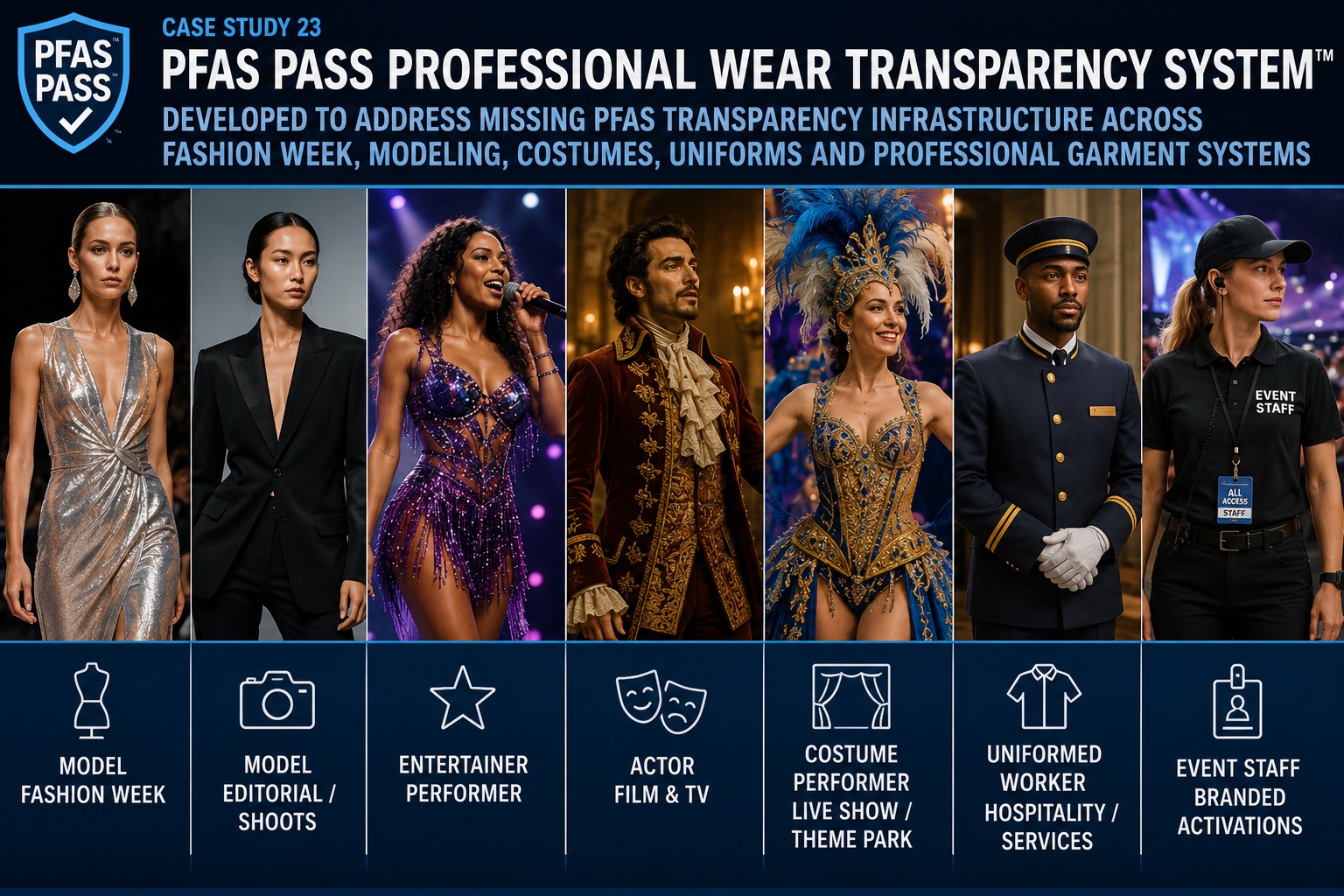
  • Case Study 23 – Professional Wear Transparency System™ Developed to Address Missing PFAS Transparency Infrastructure Across Fashion Week, Modeling, Costumes, Uniforms and Professional Garment Systems

    Case Study 23 – Professional Wear Transparency System™ Developed to Address Missing PFAS Transparency Infrastructure Across Fashion Week, Modeling, Costumes, Uniforms and Professional Garment Systems

    What began as an investigation into PFAS compliance exposure across Fashion Week events and emerging designer systems quickly revealed a much larger operational gap extending far beyond fashion.

    A real-world designer collection was clocked moving through multiple regulated fashion systems including New York Fashion Week exposure, boutique retail placement in New York City and planned expansion into Paris Fashion Week and related Paris boutique representation systems.

    The collection sourced materials through pathways connected to suppliers operating in regulated markets including New York garment district textile and trim suppliers previously documented by PFAS PASS case studies as lacking publicly visible PFAS verification systems, supplier documentation transparency or standardized compliance disclosures across many product categories.

    At the same time:

    • the collection entered public runway exposure
    • products were marketed internationally
    • boutique representation expanded into additional regulated jurisdictions
    • and repeated inquiries regarding PFAS vetting procedures received no visible response

    The investigation raised a larger systems question:

    If fashion week organizations, boutiques and emerging designer systems operating inside regulated markets do not appear to contain visible PFAS transparency infrastructure, what protections exist for the people being professionally required to wear these garments?

    That question expanded the scope of the investigation far beyond fashion retail alone.

    The Professional Garment-Use Gap

    Unlike consumer retail environments where individuals voluntarily choose products, professional garment-use systems frequently require workers, performers and contractors to wear assigned garments as a condition of:

    • employment
    • contracted work
    • runway participation
    • entertainment production
    • promotional appearances
    • branded events
    • photography
    • costume performance
    • or uniform compliance

    Often without meaningful disclosure regarding:

    • textile chemistry
    • coatings
    • synthetic treatment history
    • supplier traceability
    • PFAS compliance review
    • or material sourcing transparency

    PFAS PASS identified what appears to be a significant transparency gap across:

    • fashion week systems
    • modeling agencies
    • entertainment productions
    • costume departments
    • photography and editorial environments
    • themed entertainment
    • uniforms
    • branded events
    • hospitality systems
    • and other professional garment-use environments operating inside PFAS-regulated jurisdictions.

    “But the Garments Weren’t for Sale”

    One potential response from industry participants may be that runway garments function primarily as:

    • editorial presentation
    • artistic expression
    • sample collections
    • prototype development
    • media exposure pieces

    rather than direct retail inventory.

    PFAS PASS recognizes that runway presentation itself may occupy a complex space between artistic display, promotion, sampling and commercial activity depending on how collections are later marketed, represented or distributed.

    However, the issue identified in this case study extends beyond direct retail sales alone.

    The garments were still:

    • physically worn by workers and contracted professionals
    • used in professional environments
    • photographed and promoted publicly
    • represented internationally
    • moved through regulated jurisdictions
    • and connected to broader commercial fashion systems

    while no visible PFAS transparency or intake infrastructure could be identified at the fashion week, showroom, boutique or professional garment-use level.

    The Worker Transparency Question

    As PFAS-regulated textile laws now exist in markets including:

    • New York
    • California
    • and France

    workers and contractors operating inside these environments may have legitimate grounds to begin requesting greater material transparency regarding garments they are required to wear professionally.

    This includes:

    • models
    • performers
    • actors
    • dancers
    • stunt performers
    • costume workers
    • hospitality staff
    • convention workers
    • promotional teams
    • entertainment employees
    • themed entertainment performers
    • and uniformed workers

    particularly in systems involving:

    • synthetic textiles
    • coated fabrics
    • imported garments
    • recycled materials
    • prolonged skin contact
    • steaming and heat exposure
    • repeated backstage handling
    • and unclear supplier documentation pathways

    PFAS chemistry and microplastic shedding are not identical issues, but both contribute to broader questions regarding transparency in synthetic textile systems worn directly against the body in professional environments.

    The regulations already exist.

    The transparency systems largely do not.

    The Result: A New PFAS PASS™ Compliance System

    Case Study 23 ultimately resulted in development of a new PFAS PASS™ operational framework designed specifically to address this emerging gap.

    07- PFAS PASS Professional Wear Transparency System™

    Contract & Disclosure Framework for Professional Garment Use in Regulated Markets

    A structured disclosure and intake framework designed for industries where workers, performers, models and contractors are required to wear garments professionally in PFAS-regulated environments.

    Developed to address emerging transparency gaps across:

    • fashion week systems
    • modeling
    • entertainment
    • costumes
    • uniforms
    • photography
    • editorial environments
    • branded events
    • hospitality systems
    • themed entertainment
    • and international professional garment-use systems

    where garments may be worn without meaningful material disclosure or visible compliance review.

    Core Function:

    • Professional garment-use disclosure requests
    • Contract and employment language templates
    • Material transparency and supplier disclosure pathways
    • PFAS-related acknowledgment language
    • Intake review for assigned garments and costume systems
    • Risk classification for synthetic, coated and imported textile systems
    • Documentation request workflows for regulated markets
    • Transparency tools for workers, agencies, productions and organizations

    This system was developed to help create front-end transparency and documentation pathways for professional garment-use environments where workers may be contractually required to wear garments in regulated jurisdictions without clear visibility into material sourcing or PFAS compliance status.

    Related PFAS PASS Case Studies

    • Case Study 02 — FabricWholesaleDirect and Independent Testing Responsibility
    • Case Study 06 — Carr Textile and Supplier Documentation Gaps
    • Case Study 07 — IAAPA and the Trade Show Compliance Blind Spot
    • Case Study 11 — WAWAK and the Hidden Risk of Notions & Components
    • Case Study 15 — The Los Angeles Garment District PFAS Visibility Problem
    • Case Study 21 — One Garment. Three Suppliers. Zero Verifiable Compliance.

    Explore the full suite PFAS PASS™ Compliance Systems here:

  • CASE STUDY 22 — THREE SUPPLIERS PROVIDED PFAS COMPLIANCE DOCUMENTS. ALL THREE FAILED REVIEW.

    CASE STUDY 22 — THREE SUPPLIERS PROVIDED PFAS COMPLIANCE DOCUMENTS. ALL THREE FAILED REVIEW.

    During ongoing PFAS sourcing investigations connected to regulated-market builds, PFAS PASS identified a new and potentially significant compliance problem:

    Supplier-provided PFAS compliance documents that initially appeared credible failed structured verification review.

    Importantly, nothing in these investigations suggested intentional deception or bad faith by the suppliers involved.

    In all three cases, the documents appeared to have been shared as genuine attempts to support compliance questions in a rapidly evolving regulatory environment.

    That is what makes this discovery important.

    Most buyers, sourcing departments, costume shops, schools, brands, Etsy sellers, Amazon sellers and small businesses likely would have accepted these documents, filed them away and assumed the compliance issue had been addressed.

    PFAS PASS did not.

    Three separate suppliers.
    Three separate document types.
    Three separate failure points.

    The findings revealed a larger problem:
    documents are being interpreted as PFAS compliance evidence without independent verification of whether those documents actually satisfy the regulatory exposure attached to the product.

    CASE 01 — WAWAK / YKK ZIPPER DOCUMENT FAILURE

    Previously documented in Case Study 11 and Case Study 21, WAWAK provided PFAS-related documentation connected to a YKK zipper inquiry.

    PFAS PASS review identified a critical issue:

    FAILURE POINT DETECTED:
    Expired documentation.

    Why this matters:
    A supplier-provided document may appear legitimate while no longer supporting current compliance standing, chemistry status or regulatory applicability.

    Why third-party review matters:
    Most buyers are not trained to independently evaluate expiration relevance, regulatory timelines or whether older documentation still supports current PFAS compliance exposure.

    RESULT:
    REQUIREMENTS NOT MET

    CASE 02 — CARR TEXTILE CHINO TWILL SDS FAILURE

    Carr Textile provided a Safety Data Sheet (SDS) connected to Chino Twill fabric during a PFAS compliance inquiry.

    At first glance, the SDS appeared technical, formal and potentially supportive as compliance evidence.

    PFAS PASS review identified a different problem:

    FAILURE POINT DETECTED:
    Incorrect document type.

    The SDS did not function as product-level PFAS compliance verification evidence.

    PFAS PASS identified:
    • no product-specific PFAS verification
    • no TOF threshold testing
    • no signed certificate of compliance
    • no analytical evidence tied to the specific fabric reviewed
    • no buyer-facing verification structure for regulated market exposure

    Why this matters:
    Many buyers may reasonably assume that a technical SDS document functions as PFAS compliance evidence when it may not satisfy that purpose under current regulatory exposure.

    Why third-party review matters:
    PFAS compliance review requires evaluating not just whether a document exists, but whether the document itself is capable of supporting the compliance claim being made.

    RESULT:
    REQUIREMENTS NOT MET

    CASE 03 — FRANKLIN CHILDREN’S FOOTBALL PADDING DOCUMENT FAILURE

    PFAS PASS also reviewed documentation connected to Franklin children’s football shoulder padding labeled for Ages 4–5.

    The product appeared heavily documented at first review and included toy-related testing and supplier declarations.

    PFAS PASS identified a much more complex failure pattern.

    FAILURE POINT DETECTED:
    Regulatory scope mismatch.

    PFAS PASS identified:
    • toy protocol testing presented as PFAS compliance support
    • self-declared Letter of Guarantee lacking framework specificity
    • no direct evidence addressing California juvenile products PFAS restrictions
    • layered exposure involving children’s products, textiles and apparel frameworks
    • age labeling functioning as a regulatory trigger that was not adequately addressed

    Why this matters:
    A product may appear heavily documented while still failing to address the actual regulatory frameworks governing the product category.

    This creates one of the most dangerous compliance situations:
    the appearance of safety without verified applicability.

    PFAS PASS review further identified that California’s juvenile products PFAS restrictions became effective July 1, 2023, predating the textile bans by approximately 18 months. The supplied documentation did not directly address that framework despite the product being labeled for children ages 4–5.

    Why third-party review matters:
    Most buyers are not equipped to independently interpret overlapping regulatory systems, determine which laws apply simultaneously or identify gaps between supplier documents and actual point-of-sale exposure.

    RESULT:
    REQUIREMENTS NOT MET

    THE DISCOVERY

    The issue may no longer be the absence of documents.

    The issue may now be widespread misinterpretation of what those documents actually prove.

    In all three cases, supplier-provided documents appeared to be shared in good faith as evidence of PFAS compliance support.

    In all three cases, PFAS PASS identified critical verification gaps that many buyers, sourcing departments, costume shops, schools, brands or small businesses may have reasonably accepted without question.

    That is the compliance risk.

    Not necessarily the absence of documents but the false confidence created when documents appear credible without actually satisfying the regulatory exposure attached to the product.


    June 10, 2026 Update — A Fourth Failure Mode: An Indemnification Agreement Submitted in Place of a Compliance Document

    This case study originally documented three failure modes: an expired document, an incorrect document type, and a regulatory scope mismatch. A fourth has now been recorded, connected to Case 01 above (WAWAK / YKK).

    After the original WAWAK / YKK zipper document failed review as expired, and after a formal escalation was sent to all available WAWAK / Cleaner’s Supply contacts, a new document was produced on June 8–9, 2026: an executed Vendor Compliance Agreement and PFAS Addendum between Cleaner’s Supply Inc. and YKK (U.S.A.) Inc., e-signed by a YKK Vice President of Sales. PFAS PASS conducted a Rapid Document Review (RDR).

    FAILURE POINT DETECTED: Indemnification agreement submitted as compliance evidence.

    The document is structured as a private liability-allocation agreement — YKK agreeing to hold Cleaner’s Supply harmless from PFAS-related claims. The RDR identified:

    • no certification that any product is free of intentionally added PFAS
    • no test data, TOF results, or defined compliance threshold
    • no reference to the specific stock number or order at issue
    • no rights extended to the purchasing customer, who is not a party to the agreement
    • a “Limitation of Liability” clause capping the vendor’s obligation at fees already paid

    Why this matters: the presence of a PFAS indemnification clause indicates that PFAS exposure is being managed as a financial liability to be shifted, rather than a substance to be tested for and documented. An agreement about who is liable for a PFAS problem is not evidence that there is no PFAS problem.

    Why third-party review matters: a buyer, sourcing department, or small business receiving an official, signed, formally executed agreement of this kind could reasonably mistake it for compliance documentation, file it, and assume the matter resolved. It does not resolve the regulatory exposure. WAWAK / Cleaner’s Supply sells in and from New York under NY ECL § 37-0121; a private contract does not displace that statutory obligation or bind the downstream purchaser.

    RDR RESULT: FAIL.

    Powered by PFAS Library and PFAS PASS Rapid Document Review™ Systems.

    The findings documented in this case study directly led to the creation of:

    PFAS PASS Rapid Document Review™

    An independent third-party PASS / FAIL review system designed to identify:
    • expired documents
    • incorrect document types
    • unsupported compliance claims
    • regulatory scope mismatches
    • missing verification evidence

    Submit Supplier Documents for Review:

  • FEEDING THE MACHINE

    | PFAS PASS Compliance Build Series | PFASPASS.com

    Part One of the Feeding the Machine Series | First published May 8, 2026

    PFAS Drift In or Out™ is an original concept of PFAS PASS™. First published May 11, 2026. All rights reserved. This article constitutes independent research and does not constitute legal advice.


    Feeding the Machine

    What the petroleum crisis just revealed about everything you were sold

    You are wearing it right now.

    Not the trend. Not the label. Not the team color or the logo or the limited drop you waited in line for. The petroleum. The crude barrel. The base ingredient of the global supply chain currently in geopolitical crisis — the one the news is covering as though it has nothing to do with your closet, your child’s backpack, the jersey hanging in your hallway, the foam-filled character head your family stood in line to photograph.

    It has everything to do with all of it.

    The world is having a very public argument about oil. Energy prices were among the most volatile of 2025, swinging sharply as Middle Eastern tensions escalated, as threats to the Strait of Hormuz — the chokepoint through which nearly one-fifth of global petroleum flows — moved markets within hours. Analysts wrote forecasts. Governments responded. The price of crude became front page news.

    And almost no one connected it to your jacket.

    That omission was not an accident.

    This is the piece that connects it.

    Part One: The ordinary world — you were inside it

    You didn’t know you were in the machine because the machine was the water you swam in.

    It told you what was in style before you knew you wanted it. It made last season feel like failure without you noticing the mechanism. It installed the desire and then sold you the solution, and it did this so continuously, across so many channels, at so many price points, for so many decades, that you stopped experiencing it as persuasion and began experiencing it as taste. As identity. As self.

    That is not an accident of culture. That is a business model — and it runs, at its molecular foundation, on petroleum chemistry.

    Synthetic textiles — polyester, nylon, acrylic, spandex — are petroleum derivatives. The global fashion industry is approximately 60 percent synthetic fiber by volume. That fiber does not come from a field. It comes from a refinery. The same one currently in crisis. The same one whose price swings are dominating the financial news while the fashion industry watches from a careful distance and says nothing.

    PFAS compounds — the per- and polyfluoroalkyl substances now banned in apparel in New York, California, Maine, Minnesota, and France, with restrictions advancing across the European Union — are fluorinated petroleum chemistry. The durable water repellent on your rain jacket. The performance coating on your synthetic zipper. The stain-resistant finish on the fabric your brand sourced from a supplier who called it PFAS-free without a single document to back the claim. All of it — petroleum derivatives.

    The foam inside the helmet your child’s favorite athlete wears. The padding in the stadium seat you paid to occupy. The character costume head at the theme park — stuffed with expanded foam, clad in synthetic fabric, sold to your family as magic and manufactured from the same upstream barrel. The sets constructed for the productions you stream. The synthetic backings. The coated interfacings. The performance fabrics marketed as innovation.

    Petrochemical. Petrochemical. Petrochemical.

    The machine was always running on oil. It just never put that on the label.

    Part Two: The call — something is cracking and you can feel it

    Here is what the petroleum crisis is actually exposing, underneath the gasoline prices and the geopolitical headlines.

    The fashion industry, the sports industry, the entertainment industry, and the consumer goods machine built on top of them are as dependent on crude oil as any combustion engine ever was. The crisis is not arriving from outside the system. It is arriving from inside the foundation the system was built on.

    And now — for the first time in the history of this industry — the chemical cost of that foundation is being made legally measurable.

    New York and California enacted landmark PFAS apparel bans that took effect January 1, 2025. France followed. Maine, Minnesota, the European Union. The regulations did not land randomly. They landed in the capitals of the industries they disrupt — the fashion capitals, the entertainment capitals, the cities where the machine’s most powerful institutions have always operated.

    You can decide whether that was coincidence.

    What is not coincidence is what the regulations actually require. They require proof. Not claims — proof. Third-party laboratory documentation. Verified supply chains. Substantiated certifications. The kind of evidence that a verbal assurance from a supplier, a notation on a spec sheet, or a certification mark whose scope stops at the fabric and never reaches the zipper, the snap, the buckle, or the coated trim cannot provide.

    The machine has been running on claims for decades. The law just asked to see the receipts.

    Part Three: The road of trials — what you were not told, and who decided that

    You were not told about this by the institutions positioned to tell you.

    The garment districts of New York and Los Angeles — the physical supply chain infrastructure that thousands of independent designers and small brands depend on for fabric, trims, hardware, and notions — published no PFAS compliance guidance for tenants or customers. The laws took effect in their home states. The districts proceeded as normal.

    The trade associations that collect your membership dues, publish restricted substances lists, submit regulatory comments on your behalf, and present themselves as the voice of your industry — engaged at the lobbying level and left the small brand, the independent designer, the trim supplier, and the zipper house without a single published guidance document.

    The certification bodies whose marks appear on sustainable-branded product — the ones you trusted to tell you what was safe and what wasn’t — did not expand their scope to cover the hardware and notions supply chain where the PFAS compliance gap is deepest. The buckle on your bag. The snap on your jacket. The coated interfacing inside every structured garment. Uncertified. Unchecked. Still selling.

    The fashion press did not cover the supplier-level compliance question. Not the glossies. Not the trades. Not the sourcing publications whose specific editorial mandate is the supply chain decisions that brand founders and buyers navigate every day.

    Now — here is the part of the story where you meet the dragon.

    Women’s Wear Daily, the self-described bible of the fashion industry — and the publication most positioned to tell the sourcing community what the new regulations required of suppliers — was previously owned by a major entertainment corporation. It passed through Condé Nast on its way to Penske Media Corporation, which now owns it alongside Sourcing Journal, Variety, The Hollywood Reporter, Billboard, Rolling Stone, Deadline Hollywood, and Dick Clark Productions, including the Golden Globes and the American Music Awards.

    The company that owns both the fashion trade bible and the primary sourcing publication received its largest outside investment — more than $200 million — from the sovereign wealth fund of an oil-producing nation.

    We are not telling you what to conclude from that. We are telling you it is documented, public, and sourced. The publication most positioned to cover the PFAS compliance question in the fashion supply chain is owned by the same company that received a nine-figure investment from the fund of a petroleum state.

    Draw your own map.

    Part Four: The ordeal — you are in the cave now

    This is the part of the journey where we stop moving and you sit with what you know.

    We are going to ask you some questions. We are not going to answer them. That is not a rhetorical device — it is the point. The answer is yours. We are just the ones willing to ask out loud.

    Who had both the platform and the responsibility to publish supplier-facing PFAS compliance guidance before January 1, 2025? Write down the names. Count them. Count how many did it.

    The garment districts of New York and Los Angeles exist in the two states that enacted the landmark PFAS apparel bans. Their tenants are the suppliers. Their customers are the brands. If they don’t publish compliance guidance for their own ecosystem, what exactly is the district for?

    You wore the logo. You carried the bag. You dressed your child in the team jersey and the character ears and the foam-headed souvenir. You did it because the feeling it produced was real — belonging, arrival, inside the circle. The feeling was real. The engineering of that feeling was also real. When you understood one and not the other, who benefited?

    The luxury label on the bag was the aspiration that started the cascade. The fast fashion industry industrialized access to that aspiration — the synthetic echo of the runway, the trend cycle that refreshed every three weeks, the polyester approximation of belonging. Both tiers ran on the same petrochemical supply chain. Both went silent when the regulations came. Is that a coincidence of timing, or a coincidence of interest?

    The sports uniform on the field in California is subject to the same state regulations as the rain jacket in the boutique. The foam costume in the theme park in California is subject to the same state regulations as the children’s garment on the rack. The Broadway wardrobe assembled from garment district suppliers in New York is subject to the same state regulations as every other apparel seller in New York. Has any governing body in any of those industries published a PFAS compliance standard for their supply chain? Go look. We’ll wait.

    The petroleum crisis and the PFAS regulation wave arrived in the same period. The base ingredient of the machine is in geopolitical crisis at the same moment the chemical output of that ingredient is being regulated out of the consumer product supply chain. Two pressures on the same root. Is that a coincidence? Or is it what the end of a petrochemical era looks like from the inside?

    The brands that moved — the ones who built verified PFAS-free supply chains without waiting for institutional guidance — are now the compliant tier as enforcement windows open. The brands who waited for their association, their district, their certifier, their trade press to tell them what to do are not. The silence did not protect them. Who did the silence protect?

    And finally: If you are a small designer, an emerging brand, an independent label who trusted the garment district you source from, the certification mark on your supplier’s materials, the trade press you read every week — and none of them told you that the law changed, that your supplier’s verbal claim isn’t enough, that you are carrying liability you don’t know you have — what does that trust cost you now?

    Sit with that last one.

    Part Five: The revelation — the thread puller

    I want to tell you who I am, because at this point in the story it matters.

    I am an Emmy Award-winning seamstress. I have worked with fabric at a technical and physical level for my entire professional career. I have served over seventy celebrity clients. I was the managing partner of a green deconstruction, demolition, and salvage company — I have hazmat experience, environmental remediation experience, the kind of hands-on understanding of what toxic materials actually do in the physical world that you cannot acquire from a white paper.

    I am the founder and author of PFAS PASS Compliance Systems. I am building the DDS-BF-SNCN — Supplier Non-Compliance Notification — because brands need a formal, documented tool to put suppliers on notice that a verbal claim is not sufficient. I built the PFAS PASS Library because designers and brands deserved the same quality of compliance infrastructure that the industry’s largest players can afford to buy. I built the Verified Registry because the compliant tier needed somewhere to be recognized and the non-compliant tier needed to be able to see the distance between where they are and where the standard is.

    I built all of it because no one else was building it.

    And I built it because I understand, at the level of physical craft, what a thread does inside a constructed textile.

    A garment holds its shape because of tension — carefully managed, deliberately placed tension between threads that each carry part of the load. The structure looks permanent. It is not. Pull the right thread — the one bearing the hidden tension, the one the whole thing depends on — and the garment comes apart. Not explosively. Deliberately. One thread, chosen with knowledge, unravels what looked fixed.

    I am pulling the thread on the textile industry.

    I am the Fast Fashion Slayer and I hold that title without apology, because someone has to and I have the background, the knowledge, the standing, and frankly the fury to do it.

    The thread I am pulling is this: what is actually in what you are wearing, who was supposed to tell you, and why they didn’t.

    The petroleum crisis did not create this unraveling. It made it visible. The machine was always going to reach this moment — when the base ingredient became unstable, the regulations became enforceable, the silence became conspicuous, and the consumer looked down at what they were wearing and asked, for the first time with real stakes, what is this actually made of.

    That moment is now.

    The machine is on the floor.

    The monster has been slayed.

    If you are still reading, and you want the door — it is here.

    If you are a brand, designer, or production team: PFAS PASS Compliance Self-Assessment — the door is narrow. Come prepared to tell the truth about where you are.

    If you are plaintiff counsel, a legal researcher, or a journalist: This is Part One of an ongoing series. To download the Legal Expert Overview and request a retained expert engagement, visit the PFAS PASS Media & Press page.

    PFAS Drift In or Out™ is an original concept of PFAS PASS™. First published May 11, 2026. All rights reserved. This article constitutes independent research and does not constitute legal advice.


    The Feeding the Machine Series

    Part One — Feeding the Machine: What the Petroleum Crisis Revealed About Everything You Were Sold

    Part Two — What PFAS Litigation Has Won, What It Has Missed, and What the Laundry Pathway Changes

    Part Three — 158 Million Americans, One Washing Machine at a Time: The Science of the Laundry Pathway

    Part Four — Hazardous by Any Other Name: The Case for Reclassifying PFAS Textiles as Regulated Hazardous Material

    Part Five — Who Pays to Clean It Up: Making Fashion and Petroleum Fund the Infrastructure Their Production Model Created

    Part Six — Feeding the Machine: The Legal Case — The Petroleum Industry’s Compounded Liability

    Part Seven — Statute of Limitations vs. Expired Window: How Sellers and Banks Hide Behind Refund Timelines to Bury Post-Sale PFAS Claims

    Read the full argument. Own the book.

    The complete Feeding the Machine argument — all parts, the eight gaps, and the personal story behind it — is available in one volume. PDF, signed edition, and Amazon Kindle, paperback, and hardcover formats are linked on the series hub.

    Get the Book →

    For plaintiff counsel and litigation teams.

    PFAS PASS™ develops independent litigation research, case gap analysis, and compliance-documentation strategy. Counsel pursuing PFAS contamination, greenwashing, or post-sale compliance matters can request case gap analysis and retained-expert engagement through the litigation strategy and media kit.

    Litigation Strategy & Media Kit →

  • Solutions for 19 “Forever Chemicals” Compliance Gaps Across Fashion, Children’s Products, Costumes, Uniforms, Textiles and Their Supply Chains

    Solutions for 19 “Forever Chemicals” Compliance Gaps Across Fashion, Children’s Products, Costumes, Uniforms, Textiles and Their Supply Chains

    Nearly a year and a half after “Forever Chemicals” (PFAS) regulations took effect in January 2025, in major U.S. textile markets like California and New York, operational compliance infrastructure across the textile industry remains largely nonexistent.

    In less than 30 days of investigation, PFAS PASS was formed and identified 19 major compliance gaps affecting fashion, costumes, uniforms, footwear, home goods, children’s products, PPE systems, retail intake, supply chains and consumer protection pathways.

    No complete operational framework existed that we could find.

    So we began building one.

    The scale of the current exposure is difficult to overstate.

    Once the industry begins honestly auditing products through a PFAS-risk lens, large portions of modern inventory may immediately enter high-risk review status, including:

    • synthetic performance fabrics
    • stain-resistant textiles
    • wrinkle-resistant apparel
    • moisture-wicking garments
    • waterproof and water-resistant materials
    • weatherproof outerwear
    • technical coatings and finishes
    • foam systems and padding
    • synthetic leather and faux leather products
    • heat transfers and applied graphics
    • screen printing systems
    • adhesives and bonding materials
    • trims, elastics and notions
    • performance footwear
    • uniforms and occupational wear
    • costumes and entertainment wardrobe systems
    • outdoor textiles and gear
    • treated upholstery and soft goods
    • children’s products
    • imported low-documentation textile goods

    Anyone educating themselves on the current regulatory landscape can begin triaging large portions of modern textile systems almost immediately.

    The following gaps were identified during the development of PFAS PASS and operational solutions are now being developed to close them.

    01 — No Supply Chain Audit System or Pathways to PFAS Compliance Existed

    02 — No Third-Party PFAS Verification System to Compare Lab Reports to Regulations Existed

    03 — No Public Verification Registry for PFAS-Verified Textile Materials, Components or Products Existed

    04 — No Fashion Brand Support Existed to Audit Existing Designs Being Sold From or Into Regulated Markets or to Build New Compliant Designs

    05 — No Costume Support Existed to Audit Existing Designs in and for Regulated Markets or to Build New Compliant Designs

    06 — No Uniform or Workwear Support Existed to Audit Existing Designs in and for Regulated Markets or to Build New Compliant Designs

    07 — No Occupational or PPE Support Existed to Audit Existing Designs in and for Regulated Markets or to Build New Compliant Designs

    08 — No Home Goods Support Existed to Audit Existing Goods Being Sold From or Into Regulated Markets or to Build New Compliant Designs

    09 — No Children’s Clothing, Safety Gear or Soft Goods Systems Existed to Audit Existing Goods Being Sold From or Into Regulated Markets or to Build New Compliant Designs

    10 — No Retailer or Reseller Intake System Existed to Vet PFAS VERIFIED Brands Being Sold From or Into Regulated Markets

    11 — No Consumer-Facing Remedies Existed to File for Refunds on Non-Compliant Goods Sold From or Into Regulated Markets

    12 — No Performance Gear Support Existed for Racing, Skydive, Scuba or Other Sports Safety Systems to Audit Designs Being Sold From or Into Regulated Markets or to Build New Compliant Designs

    13 — No Footwear Guidance Existed to Audit Existing Goods Being Sold From or Into Regulated Markets or to Build New Compliant Designs

    14 — No PFAS Compliance Education Programs Exists

    15 — No Tradeshow, Convention or Industry Guidance on PFAS Compliance is Currently Being Offered

    16 — No Disposal Remedies Existed for PFAS-Contaminated Goods We Believe Should be Treated as Haz Mat

    17 — No Import, Port-of-Entry or Market-Entry Documentation Gates Exist for PFAS Compliance

    18 — No Unified Operational Infrastructure Exists Connecting Regulations, Suppliers, Testing, Documentation, Products, Retailers and Consumers

    19 — No Pet Related PFAS Guidance Exists

    Bonus (we will keep updating this section)

    20 – The Garment Industries in the Regulated States of NY and CA Have Been Silent on the Issue

    21 – Major Fashion Magazines Have Been Silent on the Issue

    22 – Textile Industry Organizations Have Been Silent on the Issue

    23 – Washing Machines Need to be Connected to the Micro Plastic Contamination in Municipal Water Supplies

    Organizations already operating on PFAS-free, restricted chemistry or transparent sourcing pathways are likely substantially closer to successful verification than organizations starting from zero.

    Brands and suppliers already pursuing PFAS-free materials, documented sourcing or restricted chemistry standards are likely the closest to becoming PFAS PASS VERIFIED.

    Every supplier, brand, retailer, costume department, uniform provider, footwear company, children’s product manufacturer, institution and textile-based organization should now be evaluating their exposure.

    The next phase requires strategic implementation partners willing to help pressure test, develop and operationalize real-world solutions.

    How to Get Involved

    PFAS PASS is currently seeking strategic partners across:

    • fabric and material suppliers
    • trims and notions suppliers
    • fashion brands
    • children’s product companies
    • costume departments and entertainment organizations
    • uniform companies
    • footwear companies
    • PPE and occupational safety systems
    • home goods companies
    • retailers and resale platforms
    • laboratories and testing organizations
    • colleges and universities
    • trade shows, expos and conventions
    • event planners and conference organizers
    • waste management and disposal innovators
    • compliance technology developers
    • media and consumer advocacy organizations

    Use the contact form below to:

    • become a strategic partner
    • begin PFAS PASS VERIFIED pathways
    • participate in pilot programs
    • request speaking or training
    • join the PFAS PASS DIY Compliance Library
    • discuss educational programs
    • develop category-specific compliance systems
    • collaborate on disposal solutions
    • discuss testing, verification or infrastructure development
    • request media interviews or press materials

    In closing, if you operate in any of the industries identified above, there are now three possible outcomes:

    Comply.
    Retire.
    Or risk being litigated out of business.

    I Want To Get Involved As:

    Strategic Partner
    Supplier
    Fashion Brand
    Children’s Product Company
    Costume / Entertainment Organization
    Uniform Company
    Footwear Company
    Retailer / Reseller
    Educator / University
    Trade Show / Event Organizer
    Media / Press

    I Am Interested In:

    Becoming PFAS PASS VERIFIED
    Strategic Partnership
    Product Audit
    DIY Compliance Library
    Education / Training
    Speaking / Workshops