PFAS PASS Investigation Series · Case Study 26
The Regulated-State Seller Problem
Two suppliers operating inside states that already restrict PFAS — and the question their own websites force us to ask: why is the education burden landing on the buyer instead of the seller?
Since this investigation began in April, PFAS PASS has issued hundreds of compliance-documentation requests to textile and apparel suppliers. As we enter June, the result is the same as it was on day one: not a single request has produced documentation that meets the applicable regulatory standard on review.
Not once. Not from a small shop, and not from a sophisticated wholesaler. And the failure is rarely a flat refusal — it’s something more revealing. In nearly every case the burden runs backwards: we have had to first educate the seller on what compliance documentation actually is, and then educate them again on why what they provided does not satisfy the requirement. A “not intentionally added” letter. A generalized certification. A confident assurance with nothing test-backed behind it. The pattern is consistent enough that it is no longer a story about individual suppliers. It is a story about an industry that has not been equipped — from the top down — to meet rules that are already in force.
The question this case study asks
These are not offshore operations beyond reach. They are sellers physically located in California and New York — states that already restrict PFAS in textiles. One would assume an in-state seller is informed and ready. So why are their own staff sent into a regulated market without the training to answer a basic compliance request? And why do their companies keep publishing articles and selling products that sit at clear, high risk under their own state’s law — still live on their websites today?
Why this is the “regulated-state” problem
Much PFAS analysis turns on tracing: where did the chemistry originate, and how do you prove it crossed into a regulated market? For an in-state seller, that question disappears. The goods are made or sold inside the jurisdiction. California’s AB 1817 took effect January 1, 2025; New York’s apparel PFAS restriction is likewise in force. There is no drift question and no traceability burden — only the simplest test: can a seller operating inside a regulated state produce, on request, the documentation that state’s law contemplates?
The two worked examples below — one a Los Angeles fabric retailer, one a Gardena, California wholesaler — are not singled out as bad actors. They are ordinary, and that is the point. They illustrate, with their own public pages, the two faces of the same gap: the seller who markets restricted chemistry without disclosure, and the seller with a genuine sustainability program that is simply silent on PFAS.
Example 1. The water-repellent finish nobody describes
A Los Angeles fabric retailer · undisclosed DWR chemistry + unsubstantiated “Eco” branding
The first subject is a Los Angeles–area fabric manufacturer and retailer selling by the yard, online, nationwide. Its own site footer places a physical store in the LA metro — which removes any jurisdictional ambiguity. California law governs the point of sale.

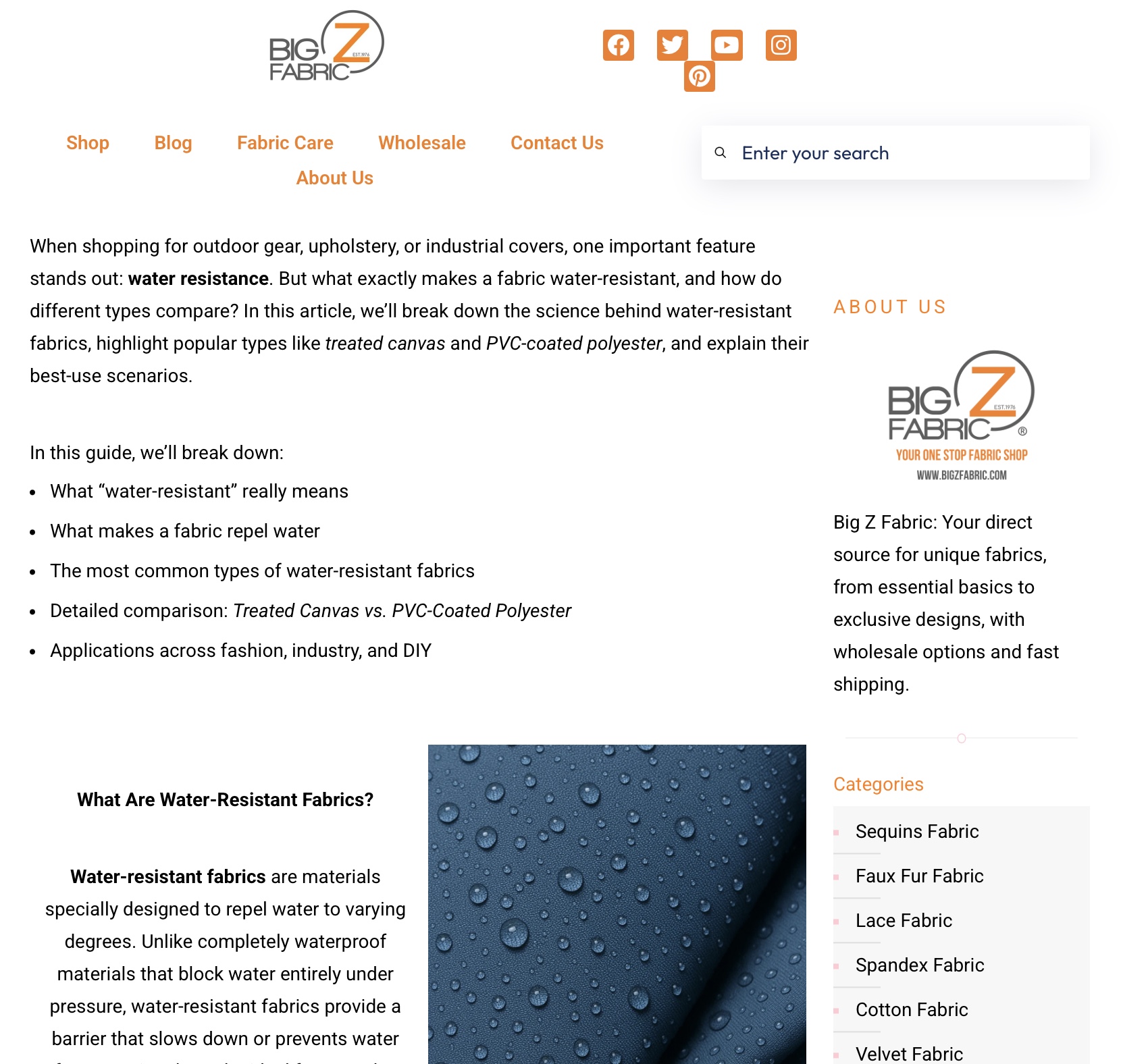
In December 2025 — eleven months into the regulated period — the seller published a how-to article on water-resistant fabrics. It lists “fluoropolymer sprays” alongside silicone and wax as ordinary water-repellency options. “Fluoropolymer” denotes PFAS chemistry. The article offers no hazard note and no reference to the fact that intentionally-added PFAS in apparel and textiles is restricted in the seller’s own state. A blog post about a restricted coating, written as if it were simply another option on the shelf.
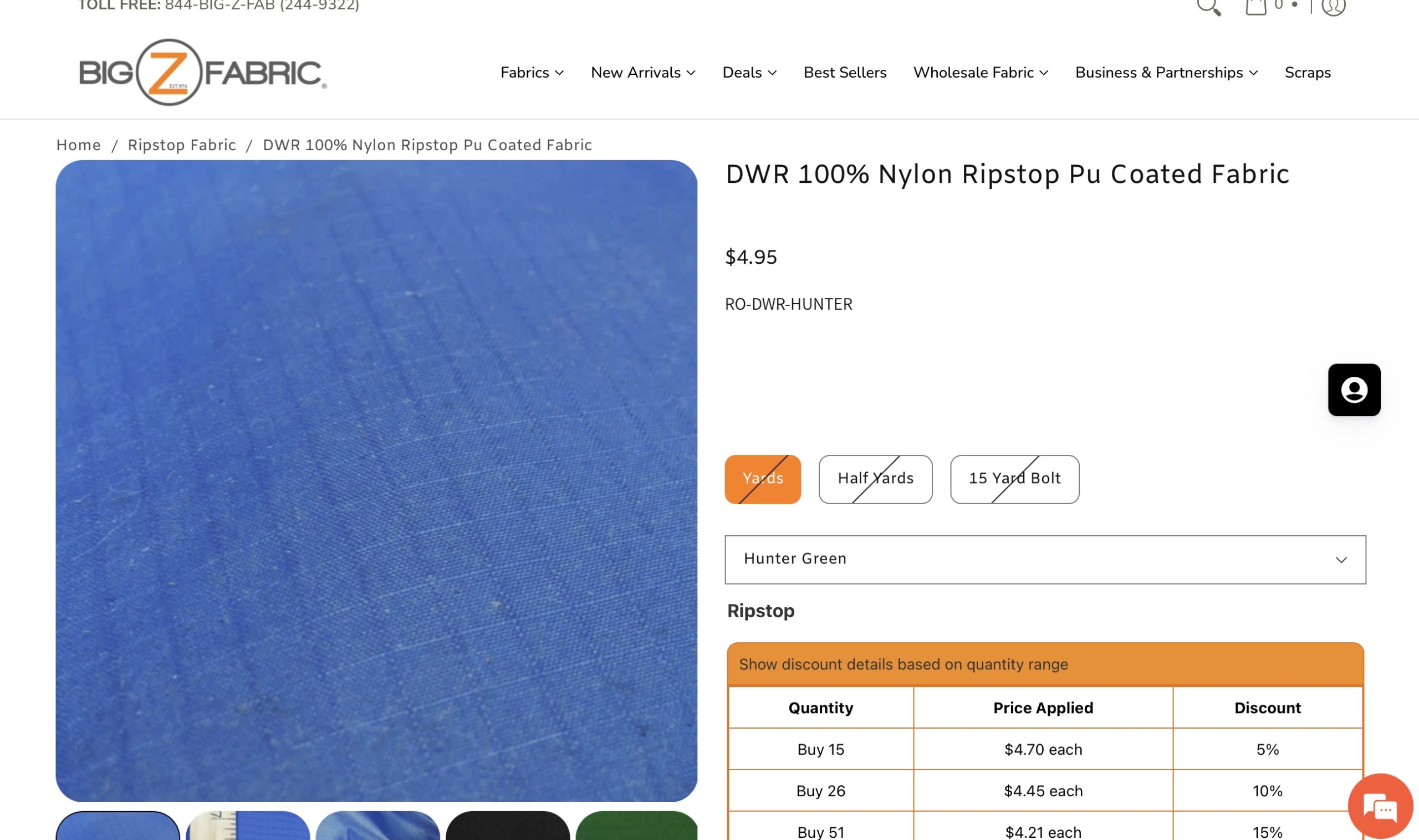
The catalog matches the marketing. A live product titled “DWR 100% Nylon Ripstop PU Coated Fabric” — DWR meaning durable water repellent — is sold for “outdoor gear, utility projects, bags, covers, jackets, and accessories.” Jackets, bags, and accessories are covered articles under AB 1817. The listing carries no statement of the DWR chemistry, no fluorine-free attestation, no certification, and no PFAS disclosure anywhere.

Precision — DWR is not the same as PU
This product lists both “DWR” and “PU coated.” The polyurethane (PU) coating is the waterproof barrier and is generally PFAS-free. The DWR is a separate surface finish of undisclosed composition. The finding is not “this fabric is PFAS” — it is that the fabric carries a DWR finish of undisclosed chemistry, on a covered article, from an in-state seller, with no fluorine-free attestation. Historically DWR meant fluorinated chemistry; a DWR claim with no chemistry statement defaults to “assume fluorinated until proven otherwise.” And a “not intentionally added” letter would not close that gap — it asserts intent rather than demonstrating absence, and is no substitute for total-fluorine (TF/TOF) test data.
The “Eco” line, and the persistence paradox
The same seller’s flagship faux fur is branded “EcoShag®” and marketed for costuming, apparel, and crafts. Its disclosed composition is 100% acrylic face over 100% polyester backing — both virgin, petroleum-derived synthetics. The only claim tied to the “Eco” branding is “ethical sourcing” (an animal-welfare statement). There is no recycled-content claim, no biodegradability claim, and no certification on the page.
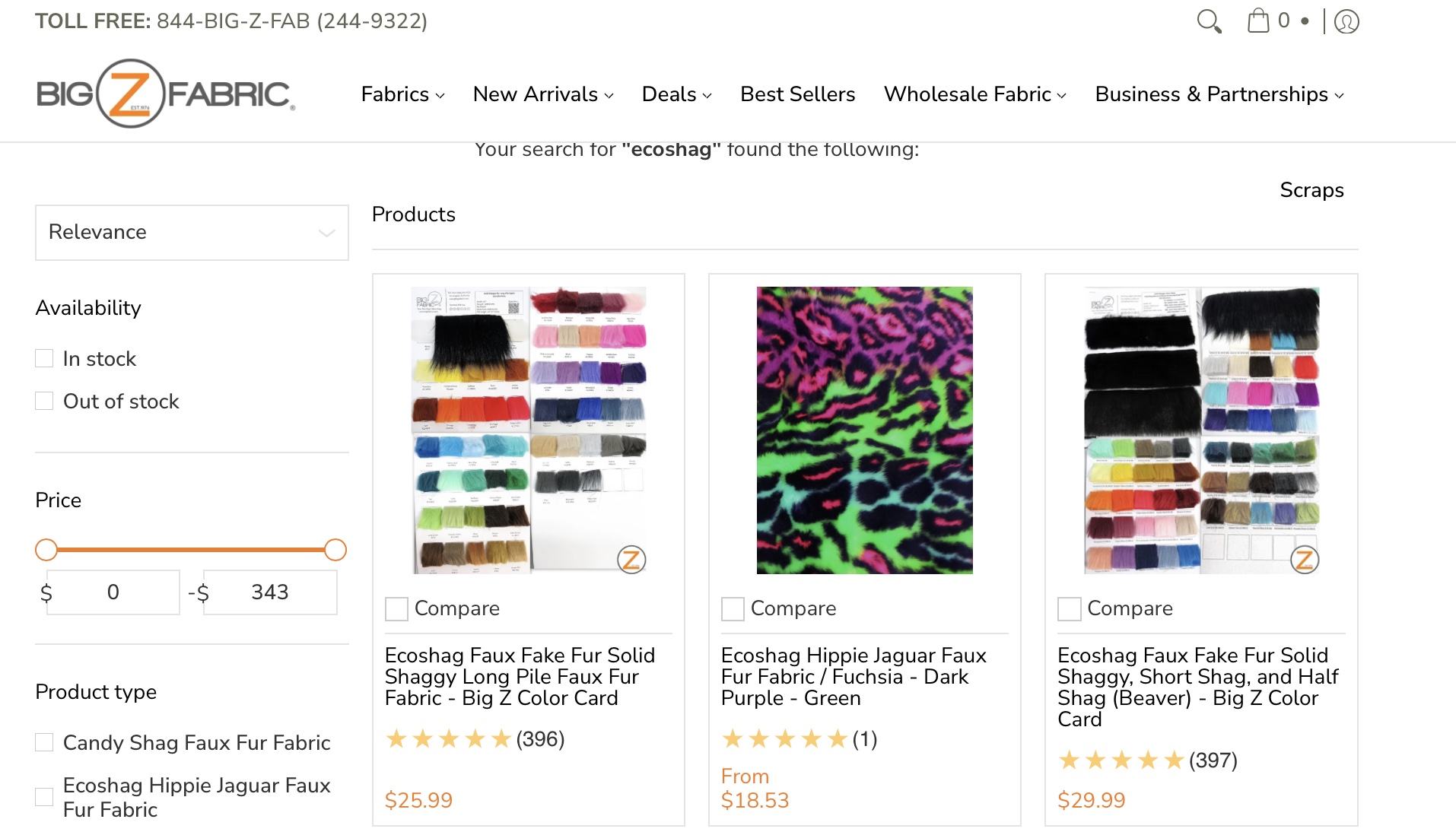
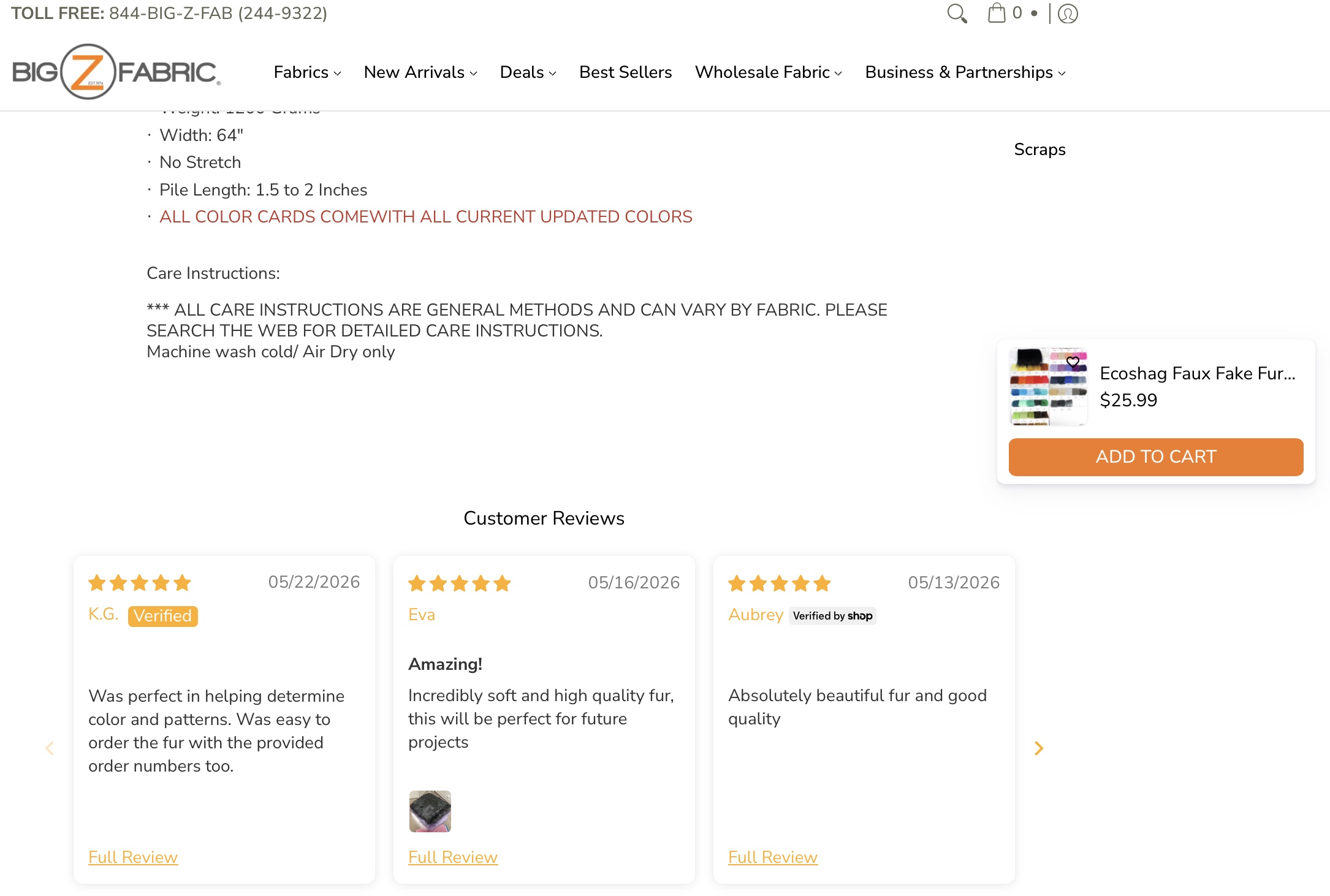
Here the irony sits in plain view. A product sold on an ethical appeal — cruelty-free, no animal fur — is among the most environmentally permanent choices on the shelf. Virgin acrylic and polyester do not biodegrade on any human timescale; they persist for centuries and shed microplastics under the very washing the care label recommends. The harm avoided (animal use) is finite; the harm created (a persistent plastic that outlasts its own fashion cycle by generations) is permanent and undisclosed. The “Eco” prefix is unsubstantiated by anything on the page — not necessarily false, but unsupported, which under the FTC Green Guides is the textbook deceptive-by-implication pattern.
A note on language
This faux fur is forever-plastic, not a forever-chemical. “Forever chemical” is a term of art reserved for PFAS. Keeping the terms distinct is what keeps the argument clean — the persistence point stands fully on its own.
Example 2. When “sustainable” says nothing about PFAS
A Gardena, California wholesaler · a substantiated green program that is silent on PFAS
The second subject is the opposite kind of seller — and that is exactly why it matters. This is a well-established Gardena, California fabric wholesaler with a sophisticated, genuinely substantiated sustainability program. Its “greenSTYLE” line spans organic cotton, BCI cotton, recycled polyester, hemp, and Tencel™ — recognized standards, not empty branding.
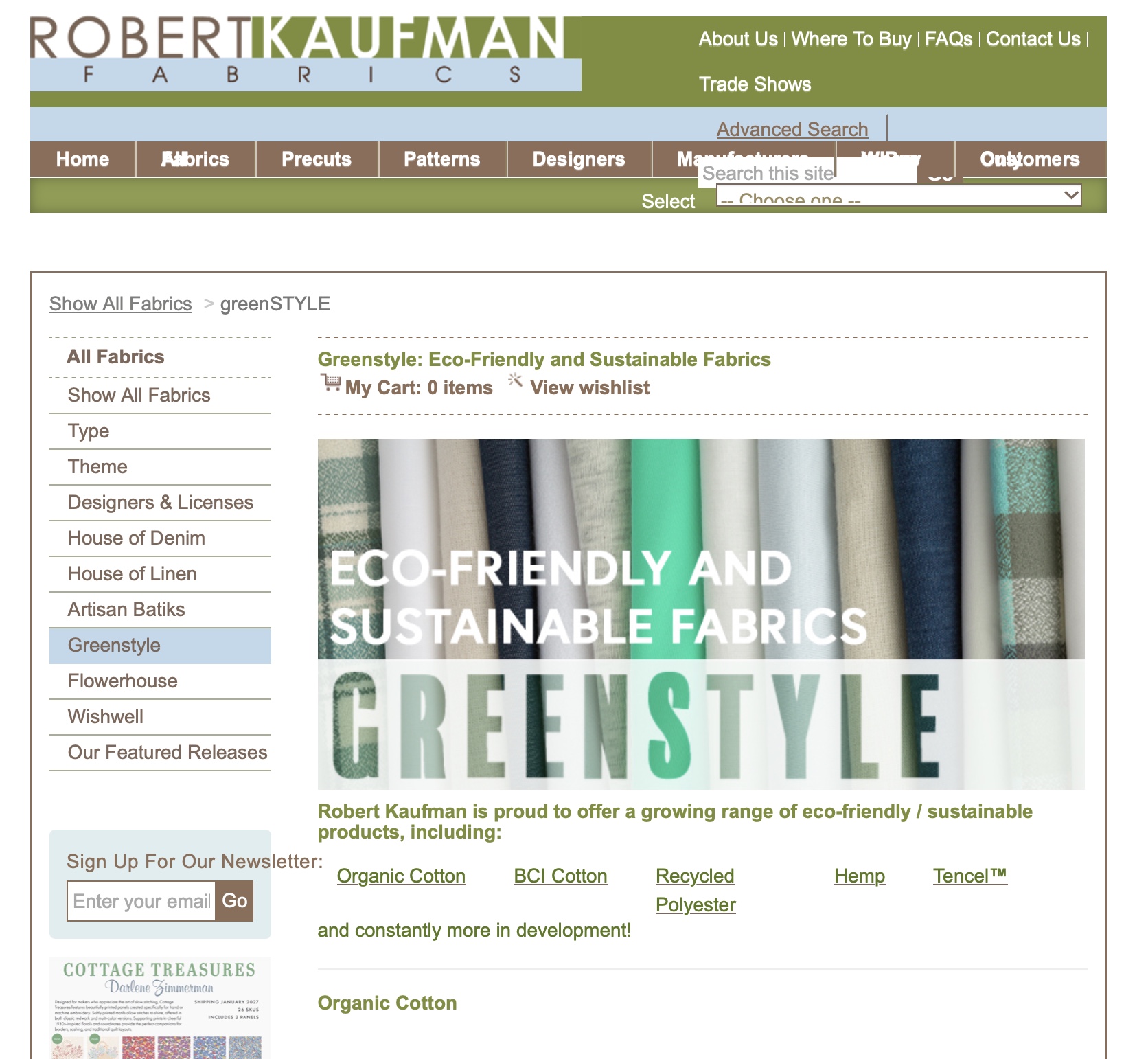
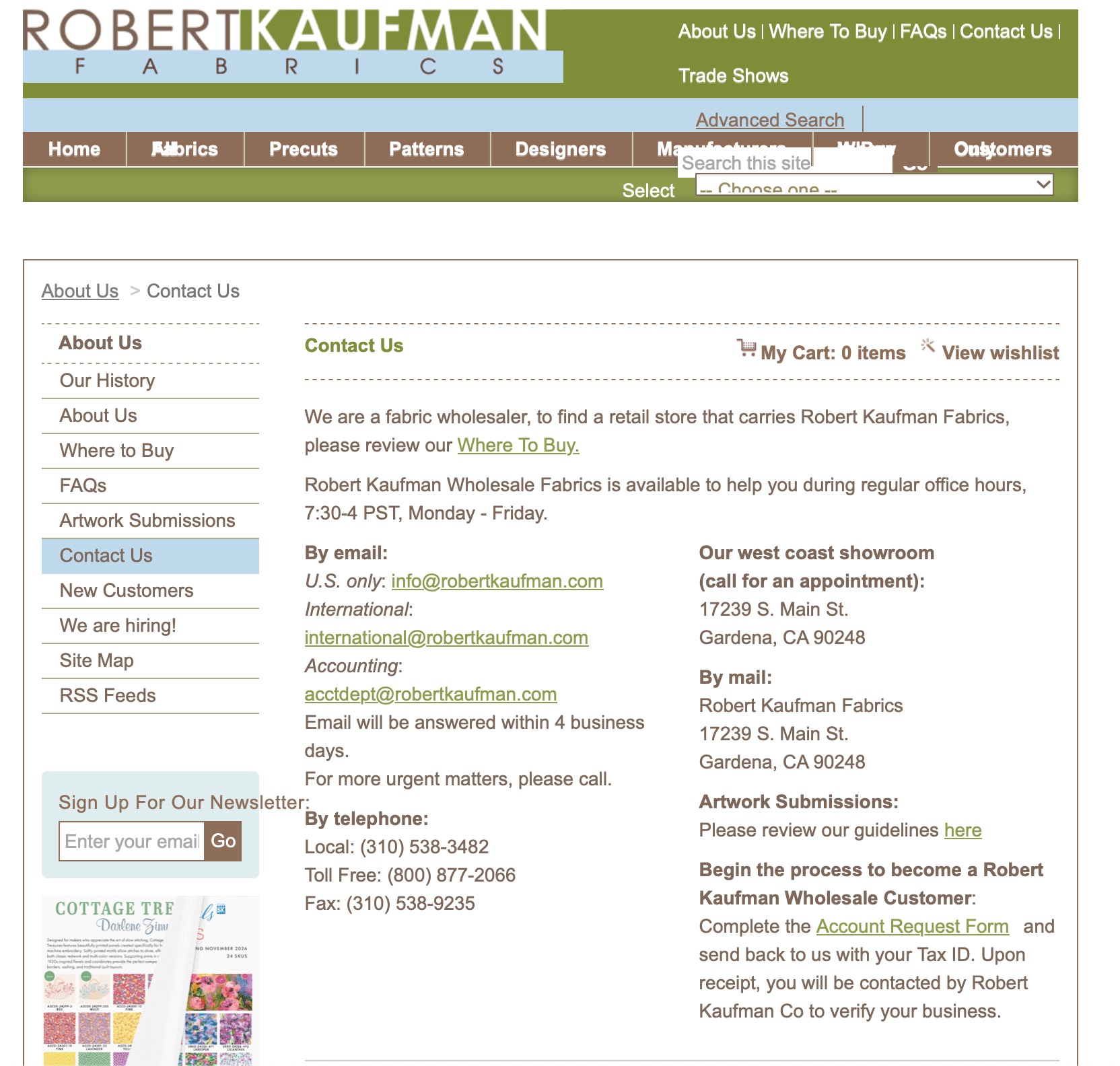
The recycled-polyester claims are real and specific — the program names REPREVE® from Unifi, made from post-consumer plastic bottles. This is not greenwashing. It is a legitimate fiber-sustainability program, run by an established in-state wholesaler whose own contact page lists a Gardena, California address. Which is precisely what makes the gap instructive.
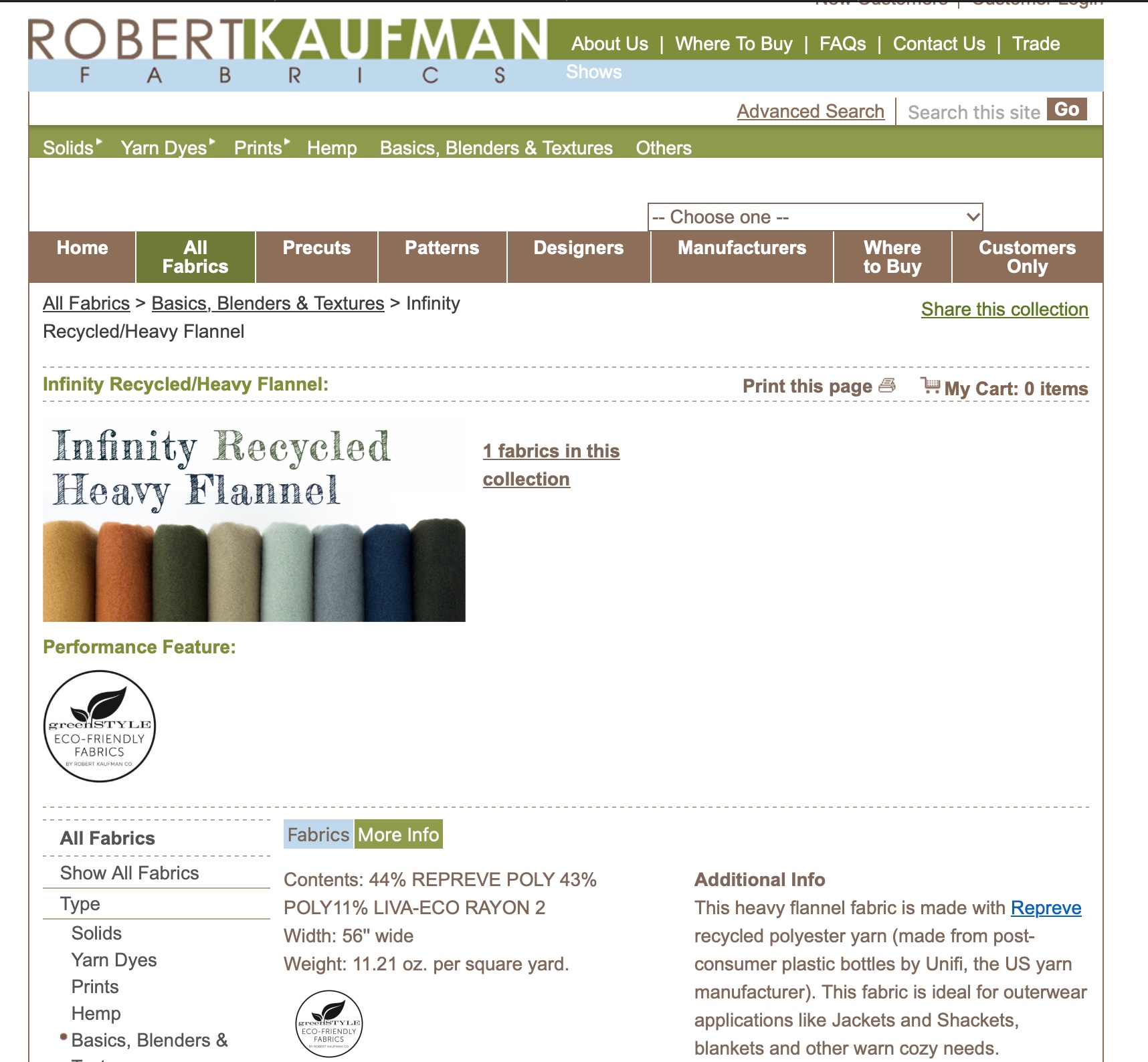
Now look at a specific product. The “Infinity Recycled/Heavy Flannel” carries the greenSTYLE “Eco-Friendly” performance badge, discloses 44% REPREVE recycled poly content (the page itself names Unifi’s post-consumer-bottle yarn), and is marketed in its own words for “outerwear applications like Jackets and Shackets, blankets.” Outerwear and jackets are covered apparel categories. The page substantiates what the fabric is made of — and says nothing whatsoever about PFAS or finishing chemistry.
The finding — two different axes
Sustainable fiber content and PFAS compliance are different questions. An “Eco-Friendly” badge answers what the yarn is made of; it says nothing about what is applied to the finished fabric. A buyer sourcing this flannel for a jacket sees “Eco-Friendly,” reasonably infers “safe,” and receives no PFAS information either way. We make no claim that this product contains PFAS — recycled flannel for “warm cozy needs” may carry no water-repellent finish at all. The point is the silence: even a sophisticated, well-intentioned sustainability program has not connected “green” to “PFAS-compliant.” Buying sustainable fabric does not discharge a buyer’s PFAS due diligence.
This is a pattern, not two anecdotes
These two sellers are the latest entries in a documented series. Across twenty-five prior PFAS PASS case studies, the same structure repeats among suppliers operating inside California and New York — the regulated states where one would most expect readiness. In each, compliance documentation was either unavailable, generalized rather than test-backed, or shifted downstream to the buyer. In the one instance where suppliers did submit documents, all three failed review.
| Prior case | Market | Documented gap (PFAS PASS findings) |
|---|---|---|
| 01 · Kiki Textiles | CA | Stated it does not carry PFAS-verified or PFAS-compliant fabrics. |
| 02 · Fabric Wholesale Direct | NY | No PFAS documentation provided; buyer advised to test independently. |
| 03 · Knix | NY CA | Removed “PFAS-free” claims, then confirmed sales into NY and CA without PFAS-verified products. |
| 06 · Carr Textile | US | “PFAS-free” claim vs. documentation reality — SDS did not support the claim. |
| 11 · Wawak | US | Thread and notions supplier with zero PFAS transparency. |
| 15 · LA Garment District | CA | A regulated market with no PFAS visibility or guidance. |
| 21 · Multi-supplier | US | One garment, three suppliers, zero verifiable compliance. |
| 22 · Document review | US | Three suppliers provided PFAS compliance documents — all three failed review. |
See the full record — all PFAS PASS case studies.
The real question: why is the burden downstream?
Put the two examples and the pattern together and a single question surfaces. In a regulated market, the seller is the party with the legal exposure and the relationship to the chemistry. Yet in hundreds of requests, the seller has never been the party ready to answer. The education has flowed the wrong way — from the investigator to the supplier — every time.
So why aren’t these companies equipping their own people? Why does an in-state retailer publish a how-to recommending a restricted coating? Why does it keep that product, and that article, live on its website today? Why does a sophisticated wholesaler build a substantiated sustainability program and never connect it to the PFAS rules of the state it ships from? The answer is not malice. It is that compliance has not yet been built into how these companies train, market, and sell — even where the law already requires it.
What compliant looks like
None of this is exotic. A compliant in-state seller of a water-repellent apparel fabric would state the DWR chemistry, provide a fluorine-free attestation backed by TF/TOF data, and reserve any “Eco” or “sustainable” claim for a substantiated, ideally certified basis — and would be able to hand a buyer that documentation on first request, without being taught what to send. That readiness is the standard. So far, across hundreds of requests, we have not seen it once.
From investigation to infrastructure
PFAS PASS was not built to document the gap alone — it was built to close it, through structured document review, verification pathways, and compliance systems for designers, brands, and suppliers operating in regulated markets.
Explore Rapid Document Review™Compliance Is Required. Verification Is Not Readily Available. PFAS PASS Is Building It.
This case study is compliance-research commentary based on public, captured web pages and on documentation requests conducted as part of the PFAS PASS investigation. It is not legal advice, a legal opinion, or an allegation of intentional wrongdoing by any named party. The “zero compliant documents” observation describes the results of PFAS PASS document requests, not a statistical survey of any company or of the industry as a whole. Regulatory characterizations reflect the analysis of PFAS PASS and should be independently verified by qualified counsel before being relied upon.
Leave a Reply
You must be logged in to post a comment.