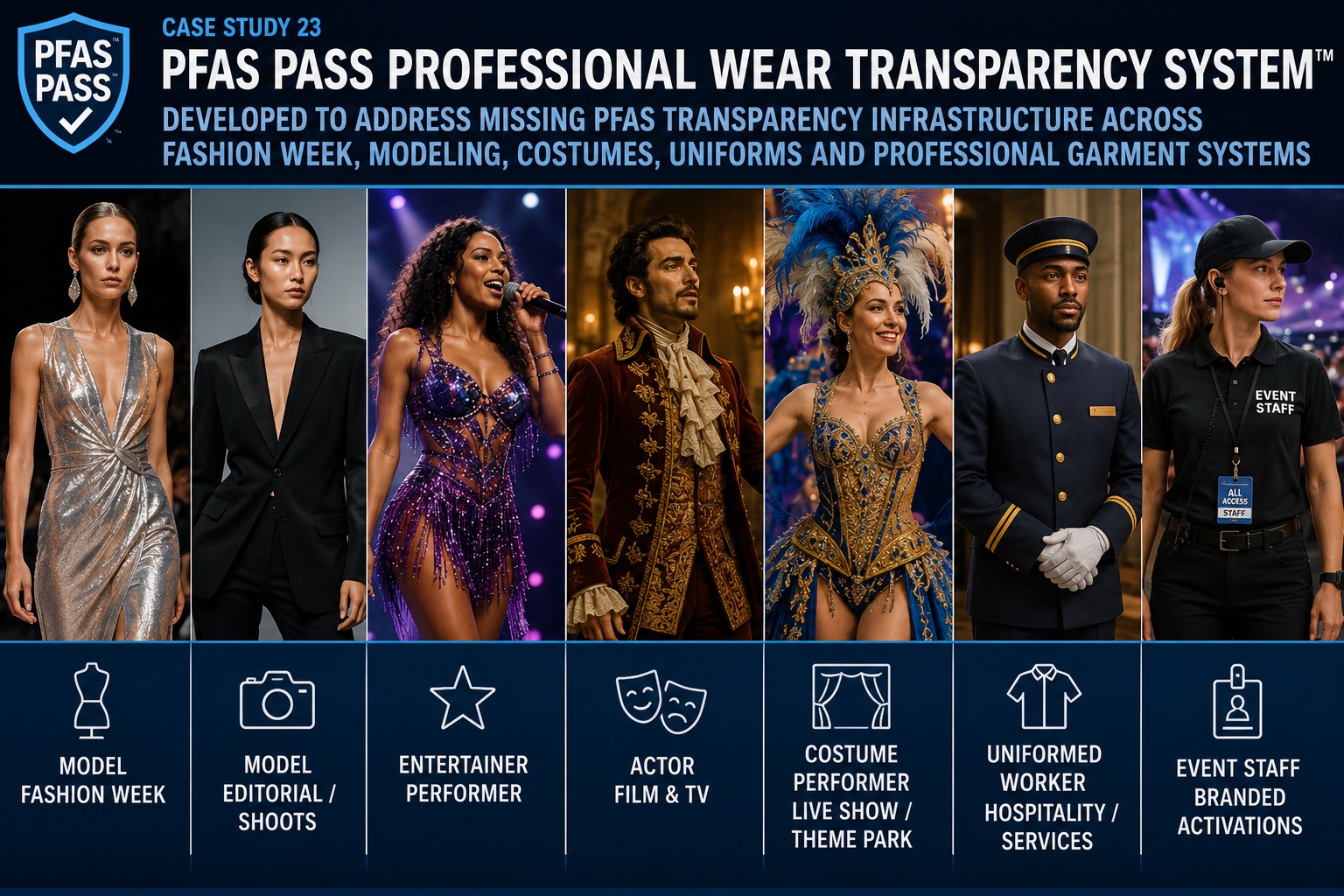
What began as an investigation into PFAS compliance exposure across Fashion Week events and emerging designer systems quickly revealed a much larger operational gap extending far beyond fashion.
A real-world designer collection was clocked moving through multiple regulated fashion systems including New York Fashion Week exposure, boutique retail placement in New York City and planned expansion into Paris Fashion Week and related Paris boutique representation systems.
The collection sourced materials through pathways connected to suppliers operating in regulated markets including New York garment district textile and trim suppliers previously documented by PFAS PASS case studies as lacking publicly visible PFAS verification systems, supplier documentation transparency or standardized compliance disclosures across many product categories.
At the same time:
the collection entered public runway exposure
products were marketed internationally
boutique representation expanded into additional regulated jurisdictions
and repeated inquiries regarding PFAS vetting procedures received no visible response
The investigation raised a larger systems question:
If fashion week organizations, boutiques and emerging designer systems operating inside regulated markets do not appear to contain visible PFAS transparency infrastructure, what protections exist for the people being professionally required to wear these garments?
That question expanded the scope of the investigation far beyond fashion retail alone.
The Professional Garment-Use Gap
Unlike consumer retail environments where individuals voluntarily choose products, professional garment-use systems frequently require workers, performers and contractors to wear assigned garments as a condition of:
employment
contracted work
runway participation
entertainment production
promotional appearances
branded events
photography
costume performance
or uniform compliance
Often without meaningful disclosure regarding:
textile chemistry
coatings
synthetic treatment history
supplier traceability
PFAS compliance review
or material sourcing transparency
PFAS PASS identified what appears to be a significant transparency gap across:
fashion week systems
modeling agencies
entertainment productions
costume departments
photography and editorial environments
themed entertainment
uniforms
branded events
hospitality systems
and other professional garment-use environments operating inside PFAS-regulated jurisdictions.
“But the Garments Weren’t for Sale”
One potential response from industry participants may be that runway garments function primarily as:
editorial presentation
artistic expression
sample collections
prototype development
media exposure pieces
rather than direct retail inventory.
PFAS PASS recognizes that runway presentation itself may occupy a complex space between artistic display, promotion, sampling and commercial activity depending on how collections are later marketed, represented or distributed.
However, the issue identified in this case study extends beyond direct retail sales alone.
The garments were still:
physically worn by workers and contracted professionals
used in professional environments
photographed and promoted publicly
represented internationally
moved through regulated jurisdictions
and connected to broader commercial fashion systems
while no visible PFAS transparency or intake infrastructure could be identified at the fashion week, showroom, boutique or professional garment-use level.
The Worker Transparency Question
As PFAS-regulated textile laws now exist in markets including:
New York
California
and France
workers and contractors operating inside these environments may have legitimate grounds to begin requesting greater material transparency regarding garments they are required to wear professionally.
This includes:
models
performers
actors
dancers
stunt performers
costume workers
hospitality staff
convention workers
promotional teams
entertainment employees
themed entertainment performers
and uniformed workers
particularly in systems involving:
synthetic textiles
coated fabrics
imported garments
recycled materials
prolonged skin contact
steaming and heat exposure
repeated backstage handling
and unclear supplier documentation pathways
PFAS chemistry and microplastic shedding are not identical issues, but both contribute to broader questions regarding transparency in synthetic textile systems worn directly against the body in professional environments.
The regulations already exist.
The transparency systems largely do not.
The Result: A New PFAS PASS™ Compliance System
Case Study 23 ultimately resulted in development of a new PFAS PASS™ operational framework designed specifically to address this emerging gap.
07- PFAS PASS Professional Wear Transparency System™
Contract & Disclosure Framework for Professional Garment Use in Regulated Markets
A structured disclosure and intake framework designed for industries where workers, performers, models and contractors are required to wear garments professionally in PFAS-regulated environments.
Developed to address emerging transparency gaps across:
fashion week systems
modeling
entertainment
costumes
uniforms
photography
editorial environments
branded events
hospitality systems
themed entertainment
and international professional garment-use systems
where garments may be worn without meaningful material disclosure or visible compliance review.
Core Function:
Professional garment-use disclosure requests
Contract and employment language templates
Material transparency and supplier disclosure pathways
PFAS-related acknowledgment language
Intake review for assigned garments and costume systems
Risk classification for synthetic, coated and imported textile systems
Documentation request workflows for regulated markets
Transparency tools for workers, agencies, productions and organizations
This system was developed to help create front-end transparency and documentation pathways for professional garment-use environments where workers may be contractually required to wear garments in regulated jurisdictions without clear visibility into material sourcing or PFAS compliance status.
I operate an Etsy store under Psycho Seamstress, selling stagewear designs that ship into regulated markets including California and New York.
These designs include materials sourced through third-party suppliers, including:
Spoonflower
Ninja Transfers
Fabric Wholesale Direct
As PFAS regulations came into effect, I initiated a standard compliance check:
Request verification documentation from suppliers
Confirm material-level compliance
Cross-check platform guidance
What I found is the gap.
Supplier Response: Partial Claims, No Documentation
Suppliers are not saying “we are non-compliant”
They are saying:
“Our inks are PFAS-free”
“We follow general safety standards”
“We cannot provide documentation”
What is missing:
Base fabric verification
Full material system testing
Client-facing compliance documentation
This creates a critical condition:
Compliance cannot be confirmed, even when intent appears aligned.
Platform Response: No Guidance, No System
I contacted Etsy directly to determine whether any systems exist to:
Flag regulated products
Restrict non-verified goods
Provide seller compliance guidance
The response:
No available information on PFAS regulations or seller requirements.
No tools No warnings No structure
This confirms:
Marketplace platforms are not currently acting as compliance intermediaries.
The Reality
The liability does not disappear.
It shifts.
From:
Supplier
Platform
To:
Designer
Maker
Small business operator
This is the exact point where most systems fail.
My Response: Live Compliance Protocol
Instead of waiting for enforcement or ignoring the issue, I implemented a real-time response:
1. Material Audit
Identified all products using third-party custom fabrics
Flagged orders shipped into regulated states
2. Customer Disclosure
Issued direct communication to affected clients
Framed as verification gap, not confirmed failure
3. Public Listing Transparency
Updated Etsy listings with the following disclosure:
Sample Public Listing Disclosure
PFAS Compliance Notice
Psycho Seamstress is actively reviewing all materials used in our designs in response to evolving PFAS regulations in states including California and New York.
Some garments in this shop are produced using custom-printed fabrics, heat press materials and fabrics sourced through third-party suppliers, including Spoonflower, Ninja Transfers, Fabric Wholesale Direct and Wawak.
At this time, while certain suppliers have provided general statements regarding PFAS-related practices (such as ink systems), full verification documentation for all material components — including base fabrics — is not consistently available across the supply chain.
This does not indicate confirmed non-compliance. It reflects an industry-wide verification gap under current regulatory expectations.
4. Replacement Pathway Development
Sourcing alternative materials
Prioritizing suppliers capable of providing buyer facing documentation
Preparing upgrade and redesign options
Why Naming Suppliers Is a Strategic Move
Most designers avoid naming suppliers.
That approach is no longer protective.
It is exposure.
Naming suppliers does three things:
1. Transfers ambiguity back to the source
You are no longer absorbing unknown risk silently
2. Creates traceability
If compliance is challenged, your sourcing path is documented
3. Applies pressure to the supply chain
Suppliers who want to retain clients must evolve toward verification
The Core Problem
Suppliers are not structured to provide:
Lab reports
Material-level verification
Public compliance documentation
Not because they are necessarily non-compliant
But because:
The system to prove compliance has not been built at scale.
Why PFAS PASS Exists
This is exactly the gap PFAS PASS is designed to solve.
Not awareness Not theory
Verification infrastructure
PFAS PASS provides:
Structured verification pathways
Documentation review systems
Supplier-to-client compliance bridging
Public registry for verified materials and products
Because right now:
Designers are being held accountable for compliance standards they have no ability to verify.
What This Case Confirms
Suppliers are operating on partial disclosures
Marketplaces are not enforcing or guiding compliance
Designers are carrying downstream liability
No unified verification system currently exists
Operational Update: May 6, 2026
After reviewing emerging PFAS compliance regulations affecting apparel and textile products in regulated markets including New York and California, I contacted Etsy Support again to determine whether sellers had the ability to restrict sales to individual US states.
Etsy Support confirmed that Etsy currently does not offer a feature allowing sellers to block sales specifically to New York or California. In response, I voluntarily deactivated my fashion and costume design listings that could potentially involve unresolved PFAS compliance concerns within current textile and trim supply chains.
I updated my shop profile with a public notice explaining that new fashion and costume builds were being paused until material sourcing and compliance verification standards become more transparent and reliable for regulated markets.
This situation further highlights the growing operational gap between evolving PFAS regulations and the current compliance tools available to independent designers, costume builders and online marketplace sellers operating across multiple jurisdictions.
Case Update — Marketplace Response – May 12, 2026
Following a request for PFAS compliance documentation connected to apparel trim purchased through Etsy from Pacific Triming, a New York-based seller and Marketplace both operating within a regulated state, Etsy Support stated that their platform could not compel the seller to provide PFAS compliance documentation and would not issue a refund outside the platform’s standard refund window.
The situation raises broader operational questions for online reseller marketplaces operating within or selling into regulated jurisdictions after PFAS apparel restrictions took effect in January 2025.
Were sellers of apparel materials, trims, notions or related components required to affirm compliance status after the regulations became active? Were legacy listings reviewed, re-certified or re-submitted under updated compliance standards? Were marketplaces maintaining any visible verification infrastructure requiring regulated product categories to retain supporting documentation tied to PFAS compliance claims?
From the buyer and downstream manufacturing perspective, no such verification system was visible at the point of sale in this case.
Etsy Support further stated that sellers are responsible for ensuring compliance with applicable laws and regulations and advised that buyers should request PFAS compliance documentation directly from sellers prior to purchase.
However, this raises a broader systems-level question now emerging within regulated markets:
Consumers generally assume they are purchasing lawful and compliant goods through lawful and compliant marketplaces.
Buyers are not typically positioned to function as chemical compliance auditors, supply chain investigators or regulatory enforcement agents at the point of sale.
If compliance documentation is required to substantiate PFAS-free or legally compliant apparel-related products entering regulated commerce, the responsibility for maintaining and producing that documentation would reasonably be expected to exist upstream within the seller, supplier and marketplace infrastructure itself — not solely as a burden shifted onto consumers after purchase.
This exchange highlights a significant operational gap now emerging across online marketplaces operating within regulated jurisdictions:
There is currently no standardized marketplace-level PFAS verification infrastructure requiring sellers to maintain or publicly provide compliance documentation for apparel materials, trims, notions or garment components entering commerce, outside of the types of structured verification and compliance framework models publicly proposed through PFAS PASS Compliance Systems Solutions for Retailers and Resellers.
Retailers, sellers and reseller marketplaces may be developing internal compliance systems in response to evolving regulations, but from a consumer and downstream manufacturing perspective, those systems are not currently visible or transparently verifiable at the point of sale.
This scenario also differs from a PFAS Drift In™ or PFAS Drift Out™ pathway analysis because both the seller and the reseller marketplace operate directly within New York, a regulated market where PFAS apparel textile restrictions are already in effect.
Irrespective of the refund eligibility window, the underlying compliance question still remains: a seller operating within a regulated market should reasonably be able to provide documentation supporting PFAS compliance claims for apparel-related components that were sold into commerce after January of 2025.
The inability to access or obtain that documentation a year and a half after the regulations took effect highlights the broader transparency and verification gap now emerging across apparel, trim, notions and component supply chains serving regulated markets.
Case Update — Etsy Buyer Escalations Response & Regulatory Notice — May 27, 2026
Following escalation through Etsy’s buyer protection process, a formal written response was received today from Jordan, a Senior Specialist on Etsy’s Buyer Escalations team, regarding order 3818555631 — the Pacific Trimming purchase at the center of this case.
The response is significant not for what it resolved, but for what it revealed.
Etsy’s escalation team characterized the platform as a purely third-party marketplace that does not manufacture, source, import, distribute, or hold physical inventory — and on that basis, asserted that Etsy has no custody over or access to products offered by its sellers. The response offered a $30.00 Etsy gift credit in lieu of a refund, citing the platform’s policy that refunds are not available after 180 days from purchase.
Both elements of that response require examination.
On the $30 gift credit:
The buyer in this transaction is located in Florida. The seller, Pacific Trimming, is located in New York. The platform, Etsy, Inc., is headquartered in Brooklyn, New York. The compliance obligation in this transaction does not rest with the buyer. It rests with the seller and the platform, both of whom are operating within a regulated state where PFAS apparel restrictions have been in effect since January 1, 2025.
A $30 store credit redeemable on a platform that has not implemented PFAS compliance infrastructure does not remediate the regulatory failure that produced this transaction. It is an offer to repeat the same unverifiable purchase. The credit has been declined.
On the 180-day refund policy:
Etsy’s 180-day refund window is a commercial policy. It governs buyer satisfaction disputes and transactional remedies within the platform’s own terms of service. It has no legal bearing on whether a transaction was compliant with New York State law in the first place.
New York’s PFAS apparel restrictions are statutory law. They do not have a 180-day window. They did not expire when Etsy’s return clock ran out. A transaction originating from a New York seller, processed through a New York platform, does not become compliant — or legally unreviewable — because an internal platform refund policy has closed.
The 180-day rule also assumes the buyer had sufficient information to identify a problem within that window. PFAS compliance failures are not visible at point of sale. There is no label, no apparent defect, no immediate signal that would trigger a standard return. The compliance gap in this transaction only became apparent when documentation was formally requested and could not be produced. A time-based commercial return policy is not a defensible mechanism for foreclosing a regulatory claim on a latent compliance issue — particularly when the compliance obligation belonged to the seller and platform, not the buyer.
On Etsy’s own policy language:
The escalation response contains this sentence:
“Third-party sellers are responsible for compliance with applicable regulatory requirements and our policies.”
That acknowledgment — made in writing, in a formal support ticket by Etsy’s own Buyer Escalations team — confirms that Etsy’s policies require seller compliance with applicable regulatory requirements. That is not a neutral administrative statement. It is a self-imposed enforcement obligation that cannot be simultaneously asserted and disclaimed in the same communication.
If sellers are required by Etsy policy to comply with applicable regulatory requirements, the operational question that follows is: what does Etsy do when a seller operating within a regulated state cannot produce compliance documentation for apparel components sold after those regulations took effect?
Based on this case, the answer is: issue a store credit to the out-of-state buyer and cite the return window.
On the component exemption question:
New York regulates PFAS in apparel. Pacific Trimming sells apparel components — trimmings, notions, and trim hardware — from within New York State. The implicit argument running through both Pacific Trimming’s position and Etsy’s response is that components are not finished apparel and therefore fall outside the scope of New York’s PFAS restrictions.
That argument, if accepted, eliminates meaningful supply chain accountability entirely.
No maker, designer, or brand can produce a PFAS-compliant finished garment from non-compliant components. The finished product restriction has no functional meaning without component-level compliance upstream.
A buyer — regardless of where they are located — who purchases apparel components from a New York seller through a New York platform is entitled to assume that transaction meets the compliance requirements of the state from which it originates. The compliance burden does not travel with the package to Florida. It remains with the seller and platform in New York.
This is not a PFAS Drift In™ or PFAS Drift Out™ scenario in the traditional analytical sense. The drift framework addresses ambiguous cross-jurisdictional pathways. This case involves no ambiguity of jurisdiction. Both the seller and the marketplace are physically located in New York. The regulation is in effect. The component feeds directly into apparel production. The question of who carries the compliance obligation has a clear answer — and it is not the buyer in Florida.
The component exemption argument is the next documented frontier of marketplace PFAS liability deflection. This case records its first formal written appearance in the PFAS PASS investigation record.
Regulatory notice submitted:
A formal response has been submitted to Etsy’s escalation team reframing this matter as a regulatory compliance issue, not a buyer satisfaction dispute, and requesting escalation to a compliance officer or legal team representative. The response requests written confirmation of whether Pacific Trimming’s shop has been reviewed for compliance with New York PFAS sales restrictions, whether Etsy maintains any process for vetting NY-based sellers against applicable state chemical safety law, and whether Etsy intends to take any action regarding this seller’s listed products.
If this matter cannot be addressed at the regulatory level internally, it will be directed to the New York State Department of Environmental Conservation and the NY Attorney General’s consumer protection division, both of which have independent jurisdiction over PFAS sales violations occurring within New York State.
Bank dispute filed:
In addition to the platform escalation, a dispute has been filed with the issuing financial institution regarding this transaction. That dispute is currently under review. When a New York seller cannot produce compliance documentation for materials sold from a regulated state after regulations took effect, and the platform that facilitated that sale declines to address the regulatory dimension, consumer financial dispute protections become a documented and available remedy for the out-of-state buyer who had no mechanism to verify compliance at point of sale. The outcome of that review will be documented here when available.
What this update confirms:
The compliance obligation in this transaction belonged to the seller and the platform — both New York entities operating under New York law.
A commercial return window does not close a statutory compliance question.
A store credit does not constitute regulatory remediation.
And a marketplace that requires seller compliance with applicable regulatory requirements in its own written policies has no clean path to simultaneously disclaim any role in enforcing that obligation when a buyer — located outside the regulated state entirely — discovers the compliance gap and asks for accountability.
Closing
This is not a failure story.
This is a systems failure being met with a systems response.
If you are a designer, manufacturer, or supplier:
You are already inside this gap.
The question is whether you acknowledge it now Or wait until enforcement forces the issue
PFAS PASS is building the infrastructure to close it.
If you are navigating this in real time, or want your materials reviewed and verified: