Tag: uniform compliance

  • Case Study Review – What Happens When Reseller Marketplaces Operate Inside Regulated Forever Chemicals Markets?

    Case Study Review – What Happens When Reseller Marketplaces Operate Inside Regulated Forever Chemicals Markets?

    As traditional sewing and sourcing infrastructure collapses, online reseller marketplaces increasingly appear to be replacing local supply chains at the same moment PFAS textile regulations become active in regulated markets including California and New York.

    One of the most important patterns emerging through PFAS PASS investigations is that the growing compliance discussion may no longer apply only to manufacturers.

    It may increasingly apply to reseller marketplaces and redistribution systems moving textile-based goods through regulated markets.

    Following the collapse and liquidation of Joann Fabrics nationwide, large portions of the sewists and crafters shifted online in search of replacement supplies after PFAS textile restrictions became active in California and New York beginning January 2025.

    That shift appears to have accelerated reliance on redistribution systems including:

    Some of these companies do not manufacture the goods themselves. They curate and redistribute them and occasionally develop and manage their own private labeled versions.

    Increasingly, those systems appear connected to:

    • fabrics
    • trims
    • notions
    • coatings
    • foams
    • adhesives
    • transfers
    • sample development
    • prototype development
    • uniforms
    • costumes
    • theatrical wardrobe systems
    • entertainment productions
    • finished garments
    • children’s products
    • textile-based consumer goods

    If products are imported through, sourced, warehoused, sold, redistributed or shipped through regulated markets including California and New York, what documentation exists proving those goods are compliant?

    What supplier representations were collected after Jan 2025?

    What audit trails were preserved after Jan 2025?

    What visibility systems were implemented after January 2025 once PFAS textile restrictions became active?

    What unsupported or undocumented goods continued moving through redistribution systems operating inside regulated states after Jan 2025?

    One of the most important findings emerging through PFAS PASS investigations is that supplier documentation often did not appear until “why” was explained and pressure was applied.

    In multiple prior reviews, documents submitted as supporting evidence appeared insufficient to function as defensible product-level compliance verification despite being presented in good faith as proof of compliance.

    We have yet to receive ANY document that PASSED our VERIFICATION process when compared to the current PFAS Regulations in NY or CA.

    That distinction matters.

    Because the growing issue may not simply involve isolated bad actors.

    It may involve a redistribution and documentation infrastructure that evolved before regulated PFAS textile environments existed.

    That raises a growing series of operational and evidentiary questions:

    • What documentation did reseller marketplaces require BEFORE textile-based goods entered regulated markets AFTER Jan 2025?
    • What products continued shipping into California and New York without publicly visible verification systems AFTER Jan 2025?
    • What mechanisms exist to gate unsupported or undocumented goods from entering regulated states AFTER Jan 2025?
    • Were sellers instructed to stop shipping unsupported textile-based products into California or New York AFTER Jan 2025?
    • Were sourcing departments or downstream buyers notified regarding documentation limitations AFTER Jan 2025?
    • Were reseller systems distinguishing verified products from unsupported claims AFTER Jan 2025?
    • What happens once products pass through multiple redistribution layers before reaching end users AFTER Jan 2025?
    • Through which ports are textile-based goods entering the United States before redistribution through marketplace ecosystems operating inside regulated states AFTER Jan 2025?
    • What visibility currently exists between import records, redistribution systems and downstream marketplace listings AFTER 2025?
    • Were ANY new systems implemented internally by ANY organization in the supply chain AFTER Jan 2025 or has it been business as usual?

    If large-scale gating systems for unsupported textile products were already operational across regulated states, visible disruptions in seller behavior, shipping availability and sourcing access would likely already be occurring across marketplace ecosystems serving California and New York.

    Instead, many textile-based products still appear broadly accessible through redistribution systems despite the growing complexity surrounding PFAS-related regulations.

    That observation may point toward a larger operational reality emerging across the sewing, costume, apparel and textile industries:

    the reseller marketplace economy may be expanding faster than the compliance visibility infrastructure surrounding it.

    That realization directly contributed to the merger of:

    Framework is being developed in response to the growing realization that forever chemicals compliance pressure may not emerge exclusively from the supply chain downward.

    It may increasingly emerge from the end users upward.

    Case Update — May 27, 2026

    One of the central questions this review posed at publication was whether any organization within the reseller marketplace ecosystem had implemented visible compliance systems after January 2025 — or whether it had been business as usual.

    That question now has a documented written answer from one of the named platforms.

    Etsy’s Buyer Escalations team responded today to a formal compliance inquiry connected to a Pacific Trimming transaction. Both Pacific Trimming and Etsy, Inc. operate within New York State, where PFAS apparel restrictions have been in effect since January 1, 2025. The buyer is located in Florida — outside the regulated market entirely. The compliance obligation in this transaction rested with the New York seller and the New York platform, not with the out-of-state buyer.

    Etsy’s response characterized the platform as a purely third-party marketplace with no custody over seller products, offered a $30 gift credit as resolution, and cited a 180-day commercial return policy as the basis for declining financial remedy — directing that commercial policy at a buyer who was never the regulated party in this transaction.

    The response also confirmed in writing that Etsy’s own seller policies require compliance with applicable regulatory requirements. No compliance review of the seller was initiated. No documentation was requested. No verification infrastructure was referenced. No internal system for flagging regulated product categories in a regulated state was described.

    The answer to whether visible compliance systems were implemented after January 2025 is now on the record, in writing, from the platform itself.

    It is no.

    The full case documentation, regulatory notice, and bank dispute filing are recorded in Case Study 10 and Case Study 21. This review’s framing questions remain open across every other named platform and redistribution system. The Etsy response establishes the documented baseline for what marketplace compliance engagement currently looks like when directly tested by an out-of-state buyer purchasing from a regulated-state seller through a regulated-state platform.
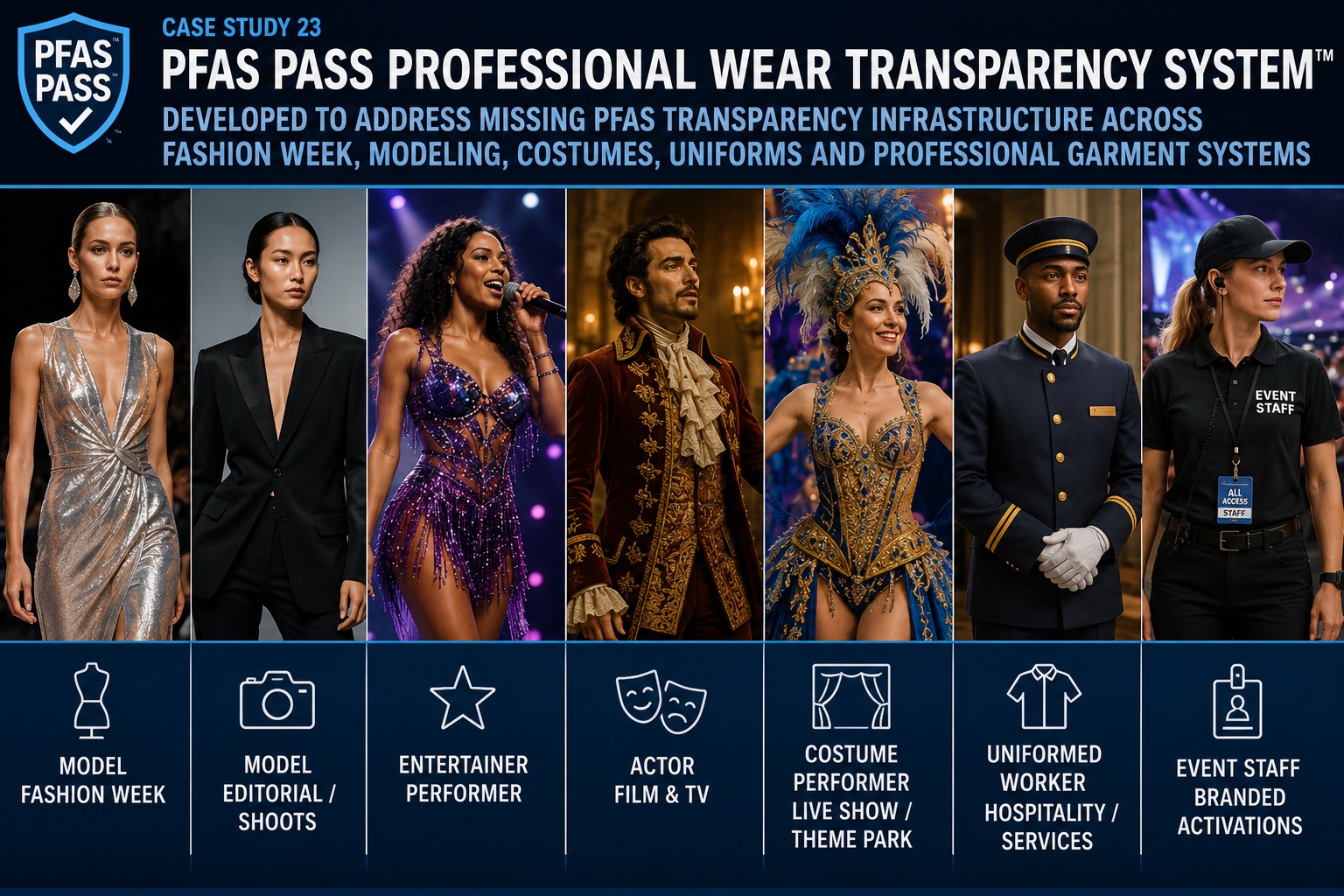
  • Case Study 23 – Professional Wear Transparency System™ Developed to Address Missing PFAS Transparency Infrastructure Across Fashion Week, Modeling, Costumes, Uniforms and Professional Garment Systems

    Case Study 23 – Professional Wear Transparency System™ Developed to Address Missing PFAS Transparency Infrastructure Across Fashion Week, Modeling, Costumes, Uniforms and Professional Garment Systems

    What began as an investigation into PFAS compliance exposure across Fashion Week events and emerging designer systems quickly revealed a much larger operational gap extending far beyond fashion.

    A real-world designer collection was clocked moving through multiple regulated fashion systems including New York Fashion Week exposure, boutique retail placement in New York City and planned expansion into Paris Fashion Week and related Paris boutique representation systems.

    The collection sourced materials through pathways connected to suppliers operating in regulated markets including New York garment district textile and trim suppliers previously documented by PFAS PASS case studies as lacking publicly visible PFAS verification systems, supplier documentation transparency or standardized compliance disclosures across many product categories.

    At the same time:

    • the collection entered public runway exposure
    • products were marketed internationally
    • boutique representation expanded into additional regulated jurisdictions
    • and repeated inquiries regarding PFAS vetting procedures received no visible response

    The investigation raised a larger systems question:

    If fashion week organizations, boutiques and emerging designer systems operating inside regulated markets do not appear to contain visible PFAS transparency infrastructure, what protections exist for the people being professionally required to wear these garments?

    That question expanded the scope of the investigation far beyond fashion retail alone.

    The Professional Garment-Use Gap

    Unlike consumer retail environments where individuals voluntarily choose products, professional garment-use systems frequently require workers, performers and contractors to wear assigned garments as a condition of:

    • employment
    • contracted work
    • runway participation
    • entertainment production
    • promotional appearances
    • branded events
    • photography
    • costume performance
    • or uniform compliance

    Often without meaningful disclosure regarding:

    • textile chemistry
    • coatings
    • synthetic treatment history
    • supplier traceability
    • PFAS compliance review
    • or material sourcing transparency

    PFAS PASS identified what appears to be a significant transparency gap across:

    • fashion week systems
    • modeling agencies
    • entertainment productions
    • costume departments
    • photography and editorial environments
    • themed entertainment
    • uniforms
    • branded events
    • hospitality systems
    • and other professional garment-use environments operating inside PFAS-regulated jurisdictions.

    “But the Garments Weren’t for Sale”

    One potential response from industry participants may be that runway garments function primarily as:

    • editorial presentation
    • artistic expression
    • sample collections
    • prototype development
    • media exposure pieces

    rather than direct retail inventory.

    PFAS PASS recognizes that runway presentation itself may occupy a complex space between artistic display, promotion, sampling and commercial activity depending on how collections are later marketed, represented or distributed.

    However, the issue identified in this case study extends beyond direct retail sales alone.

    The garments were still:

    • physically worn by workers and contracted professionals
    • used in professional environments
    • photographed and promoted publicly
    • represented internationally
    • moved through regulated jurisdictions
    • and connected to broader commercial fashion systems

    while no visible PFAS transparency or intake infrastructure could be identified at the fashion week, showroom, boutique or professional garment-use level.

    The Worker Transparency Question

    As PFAS-regulated textile laws now exist in markets including:

    • New York
    • California
    • and France

    workers and contractors operating inside these environments may have legitimate grounds to begin requesting greater material transparency regarding garments they are required to wear professionally.

    This includes:

    • models
    • performers
    • actors
    • dancers
    • stunt performers
    • costume workers
    • hospitality staff
    • convention workers
    • promotional teams
    • entertainment employees
    • themed entertainment performers
    • and uniformed workers

    particularly in systems involving:

    • synthetic textiles
    • coated fabrics
    • imported garments
    • recycled materials
    • prolonged skin contact
    • steaming and heat exposure
    • repeated backstage handling
    • and unclear supplier documentation pathways

    PFAS chemistry and microplastic shedding are not identical issues, but both contribute to broader questions regarding transparency in synthetic textile systems worn directly against the body in professional environments.

    The regulations already exist.

    The transparency systems largely do not.

    The Result: A New PFAS PASS™ Compliance System

    Case Study 23 ultimately resulted in development of a new PFAS PASS™ operational framework designed specifically to address this emerging gap.

    07- PFAS PASS Professional Wear Transparency System™

    Contract & Disclosure Framework for Professional Garment Use in Regulated Markets

    A structured disclosure and intake framework designed for industries where workers, performers, models and contractors are required to wear garments professionally in PFAS-regulated environments.

    Developed to address emerging transparency gaps across:

    • fashion week systems
    • modeling
    • entertainment
    • costumes
    • uniforms
    • photography
    • editorial environments
    • branded events
    • hospitality systems
    • themed entertainment
    • and international professional garment-use systems

    where garments may be worn without meaningful material disclosure or visible compliance review.

    Core Function:

    • Professional garment-use disclosure requests
    • Contract and employment language templates
    • Material transparency and supplier disclosure pathways
    • PFAS-related acknowledgment language
    • Intake review for assigned garments and costume systems
    • Risk classification for synthetic, coated and imported textile systems
    • Documentation request workflows for regulated markets
    • Transparency tools for workers, agencies, productions and organizations

    This system was developed to help create front-end transparency and documentation pathways for professional garment-use environments where workers may be contractually required to wear garments in regulated jurisdictions without clear visibility into material sourcing or PFAS compliance status.

    Related PFAS PASS Case Studies

    • Case Study 02 — FabricWholesaleDirect and Independent Testing Responsibility
    • Case Study 06 — Carr Textile and Supplier Documentation Gaps
    • Case Study 07 — IAAPA and the Trade Show Compliance Blind Spot
    • Case Study 11 — WAWAK and the Hidden Risk of Notions & Components
    • Case Study 15 — The Los Angeles Garment District PFAS Visibility Problem
    • Case Study 21 — One Garment. Three Suppliers. Zero Verifiable Compliance.

    Explore the full suite PFAS PASS™ Compliance Systems here:

  • CASE STUDY 22 — THREE SUPPLIERS PROVIDED PFAS COMPLIANCE DOCUMENTS. ALL THREE FAILED REVIEW.

    CASE STUDY 22 — THREE SUPPLIERS PROVIDED PFAS COMPLIANCE DOCUMENTS. ALL THREE FAILED REVIEW.

    During ongoing PFAS sourcing investigations connected to regulated-market builds, PFAS PASS identified a new and potentially significant compliance problem:

    Supplier-provided PFAS compliance documents that initially appeared credible failed structured verification review.

    Importantly, nothing in these investigations suggested intentional deception or bad faith by the suppliers involved.

    In all three cases, the documents appeared to have been shared as genuine attempts to support compliance questions in a rapidly evolving regulatory environment.

    That is what makes this discovery important.

    Most buyers, sourcing departments, costume shops, schools, brands, Etsy sellers, Amazon sellers and small businesses likely would have accepted these documents, filed them away and assumed the compliance issue had been addressed.

    PFAS PASS did not.

    Three separate suppliers.
    Three separate document types.
    Three separate failure points.

    The findings revealed a larger problem:
    documents are being interpreted as PFAS compliance evidence without independent verification of whether those documents actually satisfy the regulatory exposure attached to the product.

    CASE 01 — WAWAK / YKK ZIPPER DOCUMENT FAILURE

    Previously documented in Case Study 11 and Case Study 21, WAWAK provided PFAS-related documentation connected to a YKK zipper inquiry.

    PFAS PASS review identified a critical issue:

    FAILURE POINT DETECTED:
    Expired documentation.

    Why this matters:
    A supplier-provided document may appear legitimate while no longer supporting current compliance standing, chemistry status or regulatory applicability.

    Why third-party review matters:
    Most buyers are not trained to independently evaluate expiration relevance, regulatory timelines or whether older documentation still supports current PFAS compliance exposure.

    RESULT:
    REQUIREMENTS NOT MET

    CASE 02 — CARR TEXTILE CHINO TWILL SDS FAILURE

    Carr Textile provided a Safety Data Sheet (SDS) connected to Chino Twill fabric during a PFAS compliance inquiry.

    At first glance, the SDS appeared technical, formal and potentially supportive as compliance evidence.

    PFAS PASS review identified a different problem:

    FAILURE POINT DETECTED:
    Incorrect document type.

    The SDS did not function as product-level PFAS compliance verification evidence.

    PFAS PASS identified:
    • no product-specific PFAS verification
    • no TOF threshold testing
    • no signed certificate of compliance
    • no analytical evidence tied to the specific fabric reviewed
    • no buyer-facing verification structure for regulated market exposure

    Why this matters:
    Many buyers may reasonably assume that a technical SDS document functions as PFAS compliance evidence when it may not satisfy that purpose under current regulatory exposure.

    Why third-party review matters:
    PFAS compliance review requires evaluating not just whether a document exists, but whether the document itself is capable of supporting the compliance claim being made.

    RESULT:
    REQUIREMENTS NOT MET

    CASE 03 — FRANKLIN CHILDREN’S FOOTBALL PADDING DOCUMENT FAILURE

    PFAS PASS also reviewed documentation connected to Franklin children’s football shoulder padding labeled for Ages 4–5.

    The product appeared heavily documented at first review and included toy-related testing and supplier declarations.

    PFAS PASS identified a much more complex failure pattern.

    FAILURE POINT DETECTED:
    Regulatory scope mismatch.

    PFAS PASS identified:
    • toy protocol testing presented as PFAS compliance support
    • self-declared Letter of Guarantee lacking framework specificity
    • no direct evidence addressing California juvenile products PFAS restrictions
    • layered exposure involving children’s products, textiles and apparel frameworks
    • age labeling functioning as a regulatory trigger that was not adequately addressed

    Why this matters:
    A product may appear heavily documented while still failing to address the actual regulatory frameworks governing the product category.

    This creates one of the most dangerous compliance situations:
    the appearance of safety without verified applicability.

    PFAS PASS review further identified that California’s juvenile products PFAS restrictions became effective July 1, 2023, predating the textile bans by approximately 18 months. The supplied documentation did not directly address that framework despite the product being labeled for children ages 4–5.

    Why third-party review matters:
    Most buyers are not equipped to independently interpret overlapping regulatory systems, determine which laws apply simultaneously or identify gaps between supplier documents and actual point-of-sale exposure.

    RESULT:
    REQUIREMENTS NOT MET

    THE DISCOVERY

    The issue may no longer be the absence of documents.

    The issue may now be widespread misinterpretation of what those documents actually prove.

    In all three cases, supplier-provided documents appeared to be shared in good faith as evidence of PFAS compliance support.

    In all three cases, PFAS PASS identified critical verification gaps that many buyers, sourcing departments, costume shops, schools, brands or small businesses may have reasonably accepted without question.

    That is the compliance risk.

    Not necessarily the absence of documents but the false confidence created when documents appear credible without actually satisfying the regulatory exposure attached to the product.


    June 10, 2026 Update — A Fourth Failure Mode: An Indemnification Agreement Submitted in Place of a Compliance Document

    This case study originally documented three failure modes: an expired document, an incorrect document type, and a regulatory scope mismatch. A fourth has now been recorded, connected to Case 01 above (WAWAK / YKK).

    After the original WAWAK / YKK zipper document failed review as expired, and after a formal escalation was sent to all available WAWAK / Cleaner’s Supply contacts, a new document was produced on June 8–9, 2026: an executed Vendor Compliance Agreement and PFAS Addendum between Cleaner’s Supply Inc. and YKK (U.S.A.) Inc., e-signed by a YKK Vice President of Sales. PFAS PASS conducted a Rapid Document Review (RDR).

    FAILURE POINT DETECTED: Indemnification agreement submitted as compliance evidence.

    The document is structured as a private liability-allocation agreement — YKK agreeing to hold Cleaner’s Supply harmless from PFAS-related claims. The RDR identified:

    • no certification that any product is free of intentionally added PFAS
    • no test data, TOF results, or defined compliance threshold
    • no reference to the specific stock number or order at issue
    • no rights extended to the purchasing customer, who is not a party to the agreement
    • a “Limitation of Liability” clause capping the vendor’s obligation at fees already paid

    Why this matters: the presence of a PFAS indemnification clause indicates that PFAS exposure is being managed as a financial liability to be shifted, rather than a substance to be tested for and documented. An agreement about who is liable for a PFAS problem is not evidence that there is no PFAS problem.

    Why third-party review matters: a buyer, sourcing department, or small business receiving an official, signed, formally executed agreement of this kind could reasonably mistake it for compliance documentation, file it, and assume the matter resolved. It does not resolve the regulatory exposure. WAWAK / Cleaner’s Supply sells in and from New York under NY ECL § 37-0121; a private contract does not displace that statutory obligation or bind the downstream purchaser.

    RDR RESULT: FAIL.

    Powered by PFAS Library and PFAS PASS Rapid Document Review™ Systems.

    The findings documented in this case study directly led to the creation of:

    PFAS PASS Rapid Document Review™

    An independent third-party PASS / FAIL review system designed to identify:
    • expired documents
    • incorrect document types
    • unsupported compliance claims
    • regulatory scope mismatches
    • missing verification evidence

    Submit Supplier Documents for Review:

  • Solutions for 19 “Forever Chemicals” Compliance Gaps Across Fashion, Children’s Products, Costumes, Uniforms, Textiles and Their Supply Chains

    Solutions for 19 “Forever Chemicals” Compliance Gaps Across Fashion, Children’s Products, Costumes, Uniforms, Textiles and Their Supply Chains

    Nearly a year and a half after “Forever Chemicals” (PFAS) regulations took effect in January 2025, in major U.S. textile markets like California and New York, operational compliance infrastructure across the textile industry remains largely nonexistent.

    In less than 30 days of investigation, PFAS PASS was formed and identified 19 major compliance gaps affecting fashion, costumes, uniforms, footwear, home goods, children’s products, PPE systems, retail intake, supply chains and consumer protection pathways.

    No complete operational framework existed that we could find.

    So we began building one.

    The scale of the current exposure is difficult to overstate.

    Once the industry begins honestly auditing products through a PFAS-risk lens, large portions of modern inventory may immediately enter high-risk review status, including:

    • synthetic performance fabrics
    • stain-resistant textiles
    • wrinkle-resistant apparel
    • moisture-wicking garments
    • waterproof and water-resistant materials
    • weatherproof outerwear
    • technical coatings and finishes
    • foam systems and padding
    • synthetic leather and faux leather products
    • heat transfers and applied graphics
    • screen printing systems
    • adhesives and bonding materials
    • trims, elastics and notions
    • performance footwear
    • uniforms and occupational wear
    • costumes and entertainment wardrobe systems
    • outdoor textiles and gear
    • treated upholstery and soft goods
    • children’s products
    • imported low-documentation textile goods

    Anyone educating themselves on the current regulatory landscape can begin triaging large portions of modern textile systems almost immediately.

    The following gaps were identified during the development of PFAS PASS and operational solutions are now being developed to close them.

    01 — No Supply Chain Audit System or Pathways to PFAS Compliance Existed

    02 — No Third-Party PFAS Verification System to Compare Lab Reports to Regulations Existed

    03 — No Public Verification Registry for PFAS-Verified Textile Materials, Components or Products Existed

    04 — No Fashion Brand Support Existed to Audit Existing Designs Being Sold From or Into Regulated Markets or to Build New Compliant Designs

    05 — No Costume Support Existed to Audit Existing Designs in and for Regulated Markets or to Build New Compliant Designs

    06 — No Uniform or Workwear Support Existed to Audit Existing Designs in and for Regulated Markets or to Build New Compliant Designs

    07 — No Occupational or PPE Support Existed to Audit Existing Designs in and for Regulated Markets or to Build New Compliant Designs

    08 — No Home Goods Support Existed to Audit Existing Goods Being Sold From or Into Regulated Markets or to Build New Compliant Designs

    09 — No Children’s Clothing, Safety Gear or Soft Goods Systems Existed to Audit Existing Goods Being Sold From or Into Regulated Markets or to Build New Compliant Designs

    10 — No Retailer or Reseller Intake System Existed to Vet PFAS VERIFIED Brands Being Sold From or Into Regulated Markets

    11 — No Consumer-Facing Remedies Existed to File for Refunds on Non-Compliant Goods Sold From or Into Regulated Markets

    12 — No Performance Gear Support Existed for Racing, Skydive, Scuba or Other Sports Safety Systems to Audit Designs Being Sold From or Into Regulated Markets or to Build New Compliant Designs

    13 — No Footwear Guidance Existed to Audit Existing Goods Being Sold From or Into Regulated Markets or to Build New Compliant Designs

    14 — No PFAS Compliance Education Programs Exists

    15 — No Tradeshow, Convention or Industry Guidance on PFAS Compliance is Currently Being Offered

    16 — No Disposal Remedies Existed for PFAS-Contaminated Goods We Believe Should be Treated as Haz Mat

    17 — No Import, Port-of-Entry or Market-Entry Documentation Gates Exist for PFAS Compliance

    18 — No Unified Operational Infrastructure Exists Connecting Regulations, Suppliers, Testing, Documentation, Products, Retailers and Consumers

    19 — No Pet Related PFAS Guidance Exists

    Bonus (we will keep updating this section)

    20 – The Garment Industries in the Regulated States of NY and CA Have Been Silent on the Issue

    21 – Major Fashion Magazines Have Been Silent on the Issue

    22 – Textile Industry Organizations Have Been Silent on the Issue

    23 – Washing Machines Need to be Connected to the Micro Plastic Contamination in Municipal Water Supplies

    Organizations already operating on PFAS-free, restricted chemistry or transparent sourcing pathways are likely substantially closer to successful verification than organizations starting from zero.

    Brands and suppliers already pursuing PFAS-free materials, documented sourcing or restricted chemistry standards are likely the closest to becoming PFAS PASS VERIFIED.

    Every supplier, brand, retailer, costume department, uniform provider, footwear company, children’s product manufacturer, institution and textile-based organization should now be evaluating their exposure.

    The next phase requires strategic implementation partners willing to help pressure test, develop and operationalize real-world solutions.

    How to Get Involved

    PFAS PASS is currently seeking strategic partners across:

    • fabric and material suppliers
    • trims and notions suppliers
    • fashion brands
    • children’s product companies
    • costume departments and entertainment organizations
    • uniform companies
    • footwear companies
    • PPE and occupational safety systems
    • home goods companies
    • retailers and resale platforms
    • laboratories and testing organizations
    • colleges and universities
    • trade shows, expos and conventions
    • event planners and conference organizers
    • waste management and disposal innovators
    • compliance technology developers
    • media and consumer advocacy organizations

    Use the contact form below to:

    • become a strategic partner
    • begin PFAS PASS VERIFIED pathways
    • participate in pilot programs
    • request speaking or training
    • join the PFAS PASS DIY Compliance Library
    • discuss educational programs
    • develop category-specific compliance systems
    • collaborate on disposal solutions
    • discuss testing, verification or infrastructure development
    • request media interviews or press materials

    In closing, if you operate in any of the industries identified above, there are now three possible outcomes:

    Comply.
    Retire.
    Or risk being litigated out of business.

    I Want To Get Involved As:

    Strategic Partner
    Supplier
    Fashion Brand
    Children’s Product Company
    Costume / Entertainment Organization
    Uniform Company
    Footwear Company
    Retailer / Reseller
    Educator / University
    Trade Show / Event Organizer
    Media / Press

    I Am Interested In:

    Becoming PFAS PASS VERIFIED
    Strategic Partnership
    Product Audit
    DIY Compliance Library
    Education / Training
    Speaking / Workshops
  • What Counts as PFAS Proof — And Why Most Suppliers Can’t Provide It

    What Counts as PFAS Proof — And Why Most Suppliers Can’t Provide It

    Most suppliers claim their materials are “PFAS free.”

    Very few can prove it.

    As PFAS regulations take effect in markets like California and New York, the difference between a claim and a verifiable document is no longer optional.

    It is the difference between compliance and risk.


    What Suppliers Currently Provide

    Most responses fall into one of these categories:

    • SDS sheets (which do not test for PFAS)
    • Verbal or email assurances
    • “No intentionally added PFAS” statements
    • General certifications unrelated to PFAS

    None of these qualify as proof.


    What Real PFAS Proof Requires

    A verifiable PFAS record must include:

    • Third-party lab testing (LC-MS/MS)
    • Identified material or batch
    • Detection limits
    • Full analyte panel
    • Traceability to the actual product

    Without these elements, compliance cannot be confirmed.

    Why This Information Is Not Publicly Available

    Most suppliers and brands do not publicly publish full chemical testing data.

    This is not unusual. Laboratory reports, material specifications and testing records are typically treated as internal documents due to proprietary formulations, supplier relationships and competitive concerns.

    However, this creates a gap.

    At the same time, there is currently no standardized “PFAS Verified” mark, no unified documentation format and no widely adopted system for presenting PFAS compliance at the material or product level.

    The result is a market where:

    • Claims are common
    • Documentation is limited
    • Verification is inconsistent

    The Missing Layer

    Even when lab data exists, it does not answer:

    • Which component contains PFAS
    • Whether all materials were tested
    • Whether the finished product is compliant

    This is where most systems fail.


    Why This Matters Now

    Regulations in California and New York are already in effect.

    Products entering those markets without verifiable documentation are operating at risk.

    The supply chain has not caught up.


    The PFAS PASS™ Position

    PFAS PASS™ was developed to bridge the gap between:

    • Laboratory testing
      and
    • Real-world product verification

    By structuring data into material, component and product-level documentation, compliance becomes measurable, not assumed.


    In Closing

    No documentation means no proof.
    No proof means no compliance.

    CTA

    Submit for PFAS PASS™ Verification