Tag: textile regulations

  • Case Study Review – What Happens When Reseller Marketplaces Operate Inside Regulated Forever Chemicals Markets?

    Case Study Review – What Happens When Reseller Marketplaces Operate Inside Regulated Forever Chemicals Markets?

    As traditional sewing and sourcing infrastructure collapses, online reseller marketplaces increasingly appear to be replacing local supply chains at the same moment PFAS textile regulations become active in regulated markets including California and New York.

    One of the most important patterns emerging through PFAS PASS investigations is that the growing compliance discussion may no longer apply only to manufacturers.

    It may increasingly apply to reseller marketplaces and redistribution systems moving textile-based goods through regulated markets.

    Following the collapse and liquidation of Joann Fabrics nationwide, large portions of the sewists and crafters shifted online in search of replacement supplies after PFAS textile restrictions became active in California and New York beginning January 2025.

    That shift appears to have accelerated reliance on redistribution systems including:

    Some of these companies do not manufacture the goods themselves. They curate and redistribute them and occasionally develop and manage their own private labeled versions.

    Increasingly, those systems appear connected to:

    • fabrics
    • trims
    • notions
    • coatings
    • foams
    • adhesives
    • transfers
    • sample development
    • prototype development
    • uniforms
    • costumes
    • theatrical wardrobe systems
    • entertainment productions
    • finished garments
    • children’s products
    • textile-based consumer goods

    If products are imported through, sourced, warehoused, sold, redistributed or shipped through regulated markets including California and New York, what documentation exists proving those goods are compliant?

    What supplier representations were collected after Jan 2025?

    What audit trails were preserved after Jan 2025?

    What visibility systems were implemented after January 2025 once PFAS textile restrictions became active?

    What unsupported or undocumented goods continued moving through redistribution systems operating inside regulated states after Jan 2025?

    One of the most important findings emerging through PFAS PASS investigations is that supplier documentation often did not appear until “why” was explained and pressure was applied.

    In multiple prior reviews, documents submitted as supporting evidence appeared insufficient to function as defensible product-level compliance verification despite being presented in good faith as proof of compliance.

    We have yet to receive ANY document that PASSED our VERIFICATION process when compared to the current PFAS Regulations in NY or CA.

    That distinction matters.

    Because the growing issue may not simply involve isolated bad actors.

    It may involve a redistribution and documentation infrastructure that evolved before regulated PFAS textile environments existed.

    That raises a growing series of operational and evidentiary questions:

    • What documentation did reseller marketplaces require BEFORE textile-based goods entered regulated markets AFTER Jan 2025?
    • What products continued shipping into California and New York without publicly visible verification systems AFTER Jan 2025?
    • What mechanisms exist to gate unsupported or undocumented goods from entering regulated states AFTER Jan 2025?
    • Were sellers instructed to stop shipping unsupported textile-based products into California or New York AFTER Jan 2025?
    • Were sourcing departments or downstream buyers notified regarding documentation limitations AFTER Jan 2025?
    • Were reseller systems distinguishing verified products from unsupported claims AFTER Jan 2025?
    • What happens once products pass through multiple redistribution layers before reaching end users AFTER Jan 2025?
    • Through which ports are textile-based goods entering the United States before redistribution through marketplace ecosystems operating inside regulated states AFTER Jan 2025?
    • What visibility currently exists between import records, redistribution systems and downstream marketplace listings AFTER 2025?
    • Were ANY new systems implemented internally by ANY organization in the supply chain AFTER Jan 2025 or has it been business as usual?

    If large-scale gating systems for unsupported textile products were already operational across regulated states, visible disruptions in seller behavior, shipping availability and sourcing access would likely already be occurring across marketplace ecosystems serving California and New York.

    Instead, many textile-based products still appear broadly accessible through redistribution systems despite the growing complexity surrounding PFAS-related regulations.

    That observation may point toward a larger operational reality emerging across the sewing, costume, apparel and textile industries:

    the reseller marketplace economy may be expanding faster than the compliance visibility infrastructure surrounding it.

    That realization directly contributed to the merger of:

    Framework is being developed in response to the growing realization that forever chemicals compliance pressure may not emerge exclusively from the supply chain downward.

    It may increasingly emerge from the end users upward.

    Case Update — May 27, 2026

    One of the central questions this review posed at publication was whether any organization within the reseller marketplace ecosystem had implemented visible compliance systems after January 2025 — or whether it had been business as usual.

    That question now has a documented written answer from one of the named platforms.

    Etsy’s Buyer Escalations team responded today to a formal compliance inquiry connected to a Pacific Trimming transaction. Both Pacific Trimming and Etsy, Inc. operate within New York State, where PFAS apparel restrictions have been in effect since January 1, 2025. The buyer is located in Florida — outside the regulated market entirely. The compliance obligation in this transaction rested with the New York seller and the New York platform, not with the out-of-state buyer.

    Etsy’s response characterized the platform as a purely third-party marketplace with no custody over seller products, offered a $30 gift credit as resolution, and cited a 180-day commercial return policy as the basis for declining financial remedy — directing that commercial policy at a buyer who was never the regulated party in this transaction.

    The response also confirmed in writing that Etsy’s own seller policies require compliance with applicable regulatory requirements. No compliance review of the seller was initiated. No documentation was requested. No verification infrastructure was referenced. No internal system for flagging regulated product categories in a regulated state was described.

    The answer to whether visible compliance systems were implemented after January 2025 is now on the record, in writing, from the platform itself.

    It is no.

    The full case documentation, regulatory notice, and bank dispute filing are recorded in Case Study 10 and Case Study 21. This review’s framing questions remain open across every other named platform and redistribution system. The Etsy response establishes the documented baseline for what marketplace compliance engagement currently looks like when directly tested by an out-of-state buyer purchasing from a regulated-state seller through a regulated-state platform.

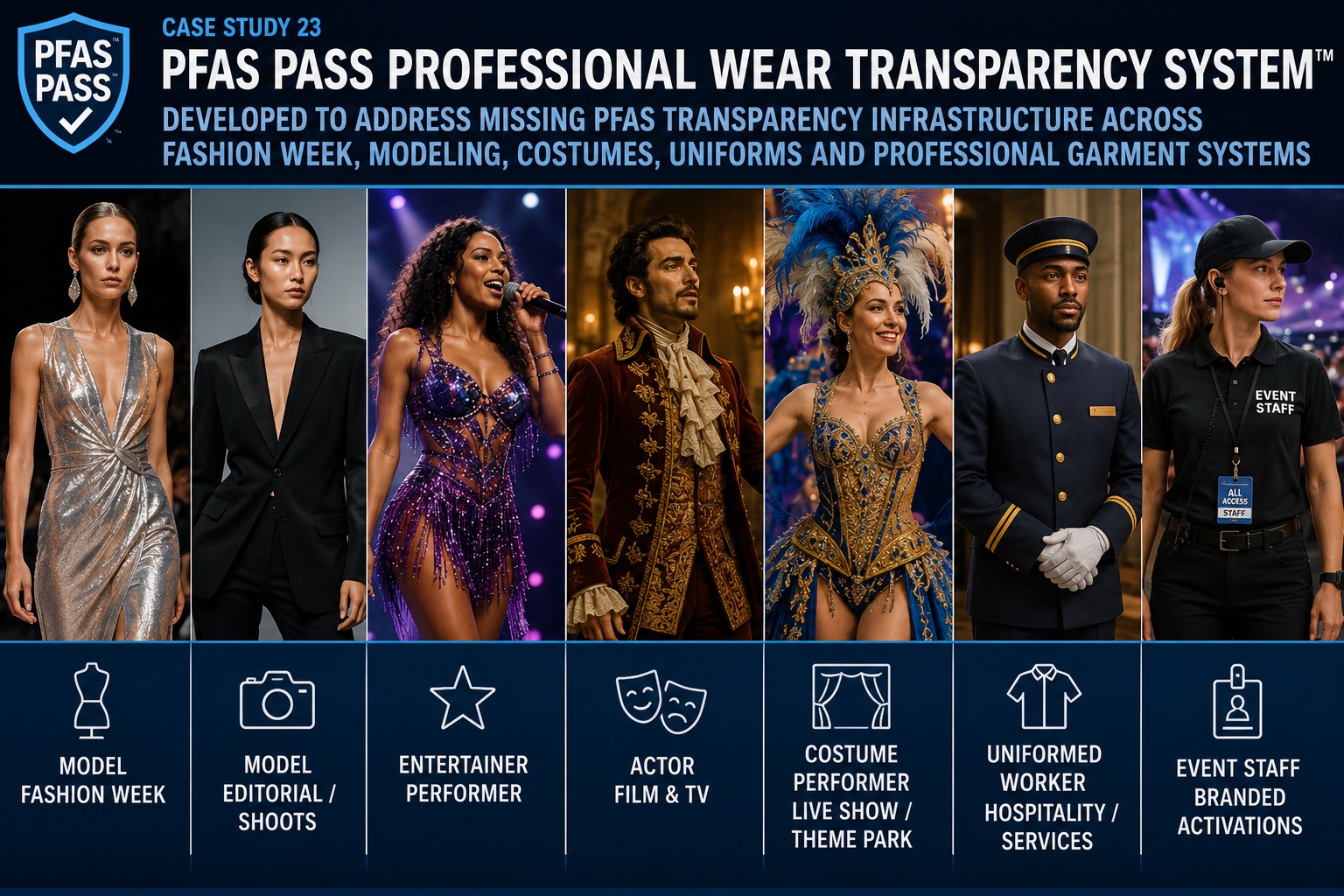
  • Case Study 23 – Professional Wear Transparency System™ Developed to Address Missing PFAS Transparency Infrastructure Across Fashion Week, Modeling, Costumes, Uniforms and Professional Garment Systems

    Case Study 23 – Professional Wear Transparency System™ Developed to Address Missing PFAS Transparency Infrastructure Across Fashion Week, Modeling, Costumes, Uniforms and Professional Garment Systems

    What began as an investigation into PFAS compliance exposure across Fashion Week events and emerging designer systems quickly revealed a much larger operational gap extending far beyond fashion.

    A real-world designer collection was clocked moving through multiple regulated fashion systems including New York Fashion Week exposure, boutique retail placement in New York City and planned expansion into Paris Fashion Week and related Paris boutique representation systems.

    The collection sourced materials through pathways connected to suppliers operating in regulated markets including New York garment district textile and trim suppliers previously documented by PFAS PASS case studies as lacking publicly visible PFAS verification systems, supplier documentation transparency or standardized compliance disclosures across many product categories.

    At the same time:

    • the collection entered public runway exposure
    • products were marketed internationally
    • boutique representation expanded into additional regulated jurisdictions
    • and repeated inquiries regarding PFAS vetting procedures received no visible response

    The investigation raised a larger systems question:

    If fashion week organizations, boutiques and emerging designer systems operating inside regulated markets do not appear to contain visible PFAS transparency infrastructure, what protections exist for the people being professionally required to wear these garments?

    That question expanded the scope of the investigation far beyond fashion retail alone.

    The Professional Garment-Use Gap

    Unlike consumer retail environments where individuals voluntarily choose products, professional garment-use systems frequently require workers, performers and contractors to wear assigned garments as a condition of:

    • employment
    • contracted work
    • runway participation
    • entertainment production
    • promotional appearances
    • branded events
    • photography
    • costume performance
    • or uniform compliance

    Often without meaningful disclosure regarding:

    • textile chemistry
    • coatings
    • synthetic treatment history
    • supplier traceability
    • PFAS compliance review
    • or material sourcing transparency

    PFAS PASS identified what appears to be a significant transparency gap across:

    • fashion week systems
    • modeling agencies
    • entertainment productions
    • costume departments
    • photography and editorial environments
    • themed entertainment
    • uniforms
    • branded events
    • hospitality systems
    • and other professional garment-use environments operating inside PFAS-regulated jurisdictions.

    “But the Garments Weren’t for Sale”

    One potential response from industry participants may be that runway garments function primarily as:

    • editorial presentation
    • artistic expression
    • sample collections
    • prototype development
    • media exposure pieces

    rather than direct retail inventory.

    PFAS PASS recognizes that runway presentation itself may occupy a complex space between artistic display, promotion, sampling and commercial activity depending on how collections are later marketed, represented or distributed.

    However, the issue identified in this case study extends beyond direct retail sales alone.

    The garments were still:

    • physically worn by workers and contracted professionals
    • used in professional environments
    • photographed and promoted publicly
    • represented internationally
    • moved through regulated jurisdictions
    • and connected to broader commercial fashion systems

    while no visible PFAS transparency or intake infrastructure could be identified at the fashion week, showroom, boutique or professional garment-use level.

    The Worker Transparency Question

    As PFAS-regulated textile laws now exist in markets including:

    • New York
    • California
    • and France

    workers and contractors operating inside these environments may have legitimate grounds to begin requesting greater material transparency regarding garments they are required to wear professionally.

    This includes:

    • models
    • performers
    • actors
    • dancers
    • stunt performers
    • costume workers
    • hospitality staff
    • convention workers
    • promotional teams
    • entertainment employees
    • themed entertainment performers
    • and uniformed workers

    particularly in systems involving:

    • synthetic textiles
    • coated fabrics
    • imported garments
    • recycled materials
    • prolonged skin contact
    • steaming and heat exposure
    • repeated backstage handling
    • and unclear supplier documentation pathways

    PFAS chemistry and microplastic shedding are not identical issues, but both contribute to broader questions regarding transparency in synthetic textile systems worn directly against the body in professional environments.

    The regulations already exist.

    The transparency systems largely do not.

    The Result: A New PFAS PASS™ Compliance System

    Case Study 23 ultimately resulted in development of a new PFAS PASS™ operational framework designed specifically to address this emerging gap.

    07- PFAS PASS Professional Wear Transparency System™

    Contract & Disclosure Framework for Professional Garment Use in Regulated Markets

    A structured disclosure and intake framework designed for industries where workers, performers, models and contractors are required to wear garments professionally in PFAS-regulated environments.

    Developed to address emerging transparency gaps across:

    • fashion week systems
    • modeling
    • entertainment
    • costumes
    • uniforms
    • photography
    • editorial environments
    • branded events
    • hospitality systems
    • themed entertainment
    • and international professional garment-use systems

    where garments may be worn without meaningful material disclosure or visible compliance review.

    Core Function:

    • Professional garment-use disclosure requests
    • Contract and employment language templates
    • Material transparency and supplier disclosure pathways
    • PFAS-related acknowledgment language
    • Intake review for assigned garments and costume systems
    • Risk classification for synthetic, coated and imported textile systems
    • Documentation request workflows for regulated markets
    • Transparency tools for workers, agencies, productions and organizations

    This system was developed to help create front-end transparency and documentation pathways for professional garment-use environments where workers may be contractually required to wear garments in regulated jurisdictions without clear visibility into material sourcing or PFAS compliance status.

    Related PFAS PASS Case Studies

    • Case Study 02 — FabricWholesaleDirect and Independent Testing Responsibility
    • Case Study 06 — Carr Textile and Supplier Documentation Gaps
    • Case Study 07 — IAAPA and the Trade Show Compliance Blind Spot
    • Case Study 11 — WAWAK and the Hidden Risk of Notions & Components
    • Case Study 15 — The Los Angeles Garment District PFAS Visibility Problem
    • Case Study 21 — One Garment. Three Suppliers. Zero Verifiable Compliance.

    Explore the full suite PFAS PASS™ Compliance Systems here:

  • FEEDING THE MACHINE

    | PFAS PASS Compliance Build Series | PFASPASS.com

    Part One of the Feeding the Machine Series | First published May 8, 2026

    PFAS Drift In or Out™ is an original concept of PFAS PASS™. First published May 11, 2026. All rights reserved. This article constitutes independent research and does not constitute legal advice.


    Feeding the Machine

    What the petroleum crisis just revealed about everything you were sold

    You are wearing it right now.

    Not the trend. Not the label. Not the team color or the logo or the limited drop you waited in line for. The petroleum. The crude barrel. The base ingredient of the global supply chain currently in geopolitical crisis — the one the news is covering as though it has nothing to do with your closet, your child’s backpack, the jersey hanging in your hallway, the foam-filled character head your family stood in line to photograph.

    It has everything to do with all of it.

    The world is having a very public argument about oil. Energy prices were among the most volatile of 2025, swinging sharply as Middle Eastern tensions escalated, as threats to the Strait of Hormuz — the chokepoint through which nearly one-fifth of global petroleum flows — moved markets within hours. Analysts wrote forecasts. Governments responded. The price of crude became front page news.

    And almost no one connected it to your jacket.

    That omission was not an accident.

    This is the piece that connects it.

    Part One: The ordinary world — you were inside it

    You didn’t know you were in the machine because the machine was the water you swam in.

    It told you what was in style before you knew you wanted it. It made last season feel like failure without you noticing the mechanism. It installed the desire and then sold you the solution, and it did this so continuously, across so many channels, at so many price points, for so many decades, that you stopped experiencing it as persuasion and began experiencing it as taste. As identity. As self.

    That is not an accident of culture. That is a business model — and it runs, at its molecular foundation, on petroleum chemistry.

    Synthetic textiles — polyester, nylon, acrylic, spandex — are petroleum derivatives. The global fashion industry is approximately 60 percent synthetic fiber by volume. That fiber does not come from a field. It comes from a refinery. The same one currently in crisis. The same one whose price swings are dominating the financial news while the fashion industry watches from a careful distance and says nothing.

    PFAS compounds — the per- and polyfluoroalkyl substances now banned in apparel in New York, California, Maine, Minnesota, and France, with restrictions advancing across the European Union — are fluorinated petroleum chemistry. The durable water repellent on your rain jacket. The performance coating on your synthetic zipper. The stain-resistant finish on the fabric your brand sourced from a supplier who called it PFAS-free without a single document to back the claim. All of it — petroleum derivatives.

    The foam inside the helmet your child’s favorite athlete wears. The padding in the stadium seat you paid to occupy. The character costume head at the theme park — stuffed with expanded foam, clad in synthetic fabric, sold to your family as magic and manufactured from the same upstream barrel. The sets constructed for the productions you stream. The synthetic backings. The coated interfacings. The performance fabrics marketed as innovation.

    Petrochemical. Petrochemical. Petrochemical.

    The machine was always running on oil. It just never put that on the label.

    Part Two: The call — something is cracking and you can feel it

    Here is what the petroleum crisis is actually exposing, underneath the gasoline prices and the geopolitical headlines.

    The fashion industry, the sports industry, the entertainment industry, and the consumer goods machine built on top of them are as dependent on crude oil as any combustion engine ever was. The crisis is not arriving from outside the system. It is arriving from inside the foundation the system was built on.

    And now — for the first time in the history of this industry — the chemical cost of that foundation is being made legally measurable.

    New York and California enacted landmark PFAS apparel bans that took effect January 1, 2025. France followed. Maine, Minnesota, the European Union. The regulations did not land randomly. They landed in the capitals of the industries they disrupt — the fashion capitals, the entertainment capitals, the cities where the machine’s most powerful institutions have always operated.

    You can decide whether that was coincidence.

    What is not coincidence is what the regulations actually require. They require proof. Not claims — proof. Third-party laboratory documentation. Verified supply chains. Substantiated certifications. The kind of evidence that a verbal assurance from a supplier, a notation on a spec sheet, or a certification mark whose scope stops at the fabric and never reaches the zipper, the snap, the buckle, or the coated trim cannot provide.

    The machine has been running on claims for decades. The law just asked to see the receipts.

    Part Three: The road of trials — what you were not told, and who decided that

    You were not told about this by the institutions positioned to tell you.

    The garment districts of New York and Los Angeles — the physical supply chain infrastructure that thousands of independent designers and small brands depend on for fabric, trims, hardware, and notions — published no PFAS compliance guidance for tenants or customers. The laws took effect in their home states. The districts proceeded as normal.

    The trade associations that collect your membership dues, publish restricted substances lists, submit regulatory comments on your behalf, and present themselves as the voice of your industry — engaged at the lobbying level and left the small brand, the independent designer, the trim supplier, and the zipper house without a single published guidance document.

    The certification bodies whose marks appear on sustainable-branded product — the ones you trusted to tell you what was safe and what wasn’t — did not expand their scope to cover the hardware and notions supply chain where the PFAS compliance gap is deepest. The buckle on your bag. The snap on your jacket. The coated interfacing inside every structured garment. Uncertified. Unchecked. Still selling.

    The fashion press did not cover the supplier-level compliance question. Not the glossies. Not the trades. Not the sourcing publications whose specific editorial mandate is the supply chain decisions that brand founders and buyers navigate every day.

    Now — here is the part of the story where you meet the dragon.

    Women’s Wear Daily, the self-described bible of the fashion industry — and the publication most positioned to tell the sourcing community what the new regulations required of suppliers — was previously owned by a major entertainment corporation. It passed through Condé Nast on its way to Penske Media Corporation, which now owns it alongside Sourcing Journal, Variety, The Hollywood Reporter, Billboard, Rolling Stone, Deadline Hollywood, and Dick Clark Productions, including the Golden Globes and the American Music Awards.

    The company that owns both the fashion trade bible and the primary sourcing publication received its largest outside investment — more than $200 million — from the sovereign wealth fund of an oil-producing nation.

    We are not telling you what to conclude from that. We are telling you it is documented, public, and sourced. The publication most positioned to cover the PFAS compliance question in the fashion supply chain is owned by the same company that received a nine-figure investment from the fund of a petroleum state.

    Draw your own map.

    Part Four: The ordeal — you are in the cave now

    This is the part of the journey where we stop moving and you sit with what you know.

    We are going to ask you some questions. We are not going to answer them. That is not a rhetorical device — it is the point. The answer is yours. We are just the ones willing to ask out loud.

    Who had both the platform and the responsibility to publish supplier-facing PFAS compliance guidance before January 1, 2025? Write down the names. Count them. Count how many did it.

    The garment districts of New York and Los Angeles exist in the two states that enacted the landmark PFAS apparel bans. Their tenants are the suppliers. Their customers are the brands. If they don’t publish compliance guidance for their own ecosystem, what exactly is the district for?

    You wore the logo. You carried the bag. You dressed your child in the team jersey and the character ears and the foam-headed souvenir. You did it because the feeling it produced was real — belonging, arrival, inside the circle. The feeling was real. The engineering of that feeling was also real. When you understood one and not the other, who benefited?

    The luxury label on the bag was the aspiration that started the cascade. The fast fashion industry industrialized access to that aspiration — the synthetic echo of the runway, the trend cycle that refreshed every three weeks, the polyester approximation of belonging. Both tiers ran on the same petrochemical supply chain. Both went silent when the regulations came. Is that a coincidence of timing, or a coincidence of interest?

    The sports uniform on the field in California is subject to the same state regulations as the rain jacket in the boutique. The foam costume in the theme park in California is subject to the same state regulations as the children’s garment on the rack. The Broadway wardrobe assembled from garment district suppliers in New York is subject to the same state regulations as every other apparel seller in New York. Has any governing body in any of those industries published a PFAS compliance standard for their supply chain? Go look. We’ll wait.

    The petroleum crisis and the PFAS regulation wave arrived in the same period. The base ingredient of the machine is in geopolitical crisis at the same moment the chemical output of that ingredient is being regulated out of the consumer product supply chain. Two pressures on the same root. Is that a coincidence? Or is it what the end of a petrochemical era looks like from the inside?

    The brands that moved — the ones who built verified PFAS-free supply chains without waiting for institutional guidance — are now the compliant tier as enforcement windows open. The brands who waited for their association, their district, their certifier, their trade press to tell them what to do are not. The silence did not protect them. Who did the silence protect?

    And finally: If you are a small designer, an emerging brand, an independent label who trusted the garment district you source from, the certification mark on your supplier’s materials, the trade press you read every week — and none of them told you that the law changed, that your supplier’s verbal claim isn’t enough, that you are carrying liability you don’t know you have — what does that trust cost you now?

    Sit with that last one.

    Part Five: The revelation — the thread puller

    I want to tell you who I am, because at this point in the story it matters.

    I am an Emmy Award-winning seamstress. I have worked with fabric at a technical and physical level for my entire professional career. I have served over seventy celebrity clients. I was the managing partner of a green deconstruction, demolition, and salvage company — I have hazmat experience, environmental remediation experience, the kind of hands-on understanding of what toxic materials actually do in the physical world that you cannot acquire from a white paper.

    I am the founder and author of PFAS PASS Compliance Systems. I am building the DDS-BF-SNCN — Supplier Non-Compliance Notification — because brands need a formal, documented tool to put suppliers on notice that a verbal claim is not sufficient. I built the PFAS PASS Library because designers and brands deserved the same quality of compliance infrastructure that the industry’s largest players can afford to buy. I built the Verified Registry because the compliant tier needed somewhere to be recognized and the non-compliant tier needed to be able to see the distance between where they are and where the standard is.

    I built all of it because no one else was building it.

    And I built it because I understand, at the level of physical craft, what a thread does inside a constructed textile.

    A garment holds its shape because of tension — carefully managed, deliberately placed tension between threads that each carry part of the load. The structure looks permanent. It is not. Pull the right thread — the one bearing the hidden tension, the one the whole thing depends on — and the garment comes apart. Not explosively. Deliberately. One thread, chosen with knowledge, unravels what looked fixed.

    I am pulling the thread on the textile industry.

    I am the Fast Fashion Slayer and I hold that title without apology, because someone has to and I have the background, the knowledge, the standing, and frankly the fury to do it.

    The thread I am pulling is this: what is actually in what you are wearing, who was supposed to tell you, and why they didn’t.

    The petroleum crisis did not create this unraveling. It made it visible. The machine was always going to reach this moment — when the base ingredient became unstable, the regulations became enforceable, the silence became conspicuous, and the consumer looked down at what they were wearing and asked, for the first time with real stakes, what is this actually made of.

    That moment is now.

    The machine is on the floor.

    The monster has been slayed.

    If you are still reading, and you want the door — it is here.

    If you are a brand, designer, or production team: PFAS PASS Compliance Self-Assessment — the door is narrow. Come prepared to tell the truth about where you are.

    If you are plaintiff counsel, a legal researcher, or a journalist: This is Part One of an ongoing series. To download the Legal Expert Overview and request a retained expert engagement, visit the PFAS PASS Media & Press page.

    PFAS Drift In or Out™ is an original concept of PFAS PASS™. First published May 11, 2026. All rights reserved. This article constitutes independent research and does not constitute legal advice.


    The Feeding the Machine Series

    Part One — Feeding the Machine: What the Petroleum Crisis Revealed About Everything You Were Sold

    Part Two — What PFAS Litigation Has Won, What It Has Missed, and What the Laundry Pathway Changes

    Part Three — 158 Million Americans, One Washing Machine at a Time: The Science of the Laundry Pathway

    Part Four — Hazardous by Any Other Name: The Case for Reclassifying PFAS Textiles as Regulated Hazardous Material

    Part Five — Who Pays to Clean It Up: Making Fashion and Petroleum Fund the Infrastructure Their Production Model Created

    Part Six — Feeding the Machine: The Legal Case — The Petroleum Industry’s Compounded Liability

    Part Seven — Statute of Limitations vs. Expired Window: How Sellers and Banks Hide Behind Refund Timelines to Bury Post-Sale PFAS Claims

    Read the full argument. Own the book.

    The complete Feeding the Machine argument — all parts, the eight gaps, and the personal story behind it — is available in one volume. PDF, signed edition, and Amazon Kindle, paperback, and hardcover formats are linked on the series hub.

    Get the Book →

    For plaintiff counsel and litigation teams.

    PFAS PASS™ develops independent litigation research, case gap analysis, and compliance-documentation strategy. Counsel pursuing PFAS contamination, greenwashing, or post-sale compliance matters can request case gap analysis and retained-expert engagement through the litigation strategy and media kit.

    Litigation Strategy & Media Kit →

  • Solutions for 19 “Forever Chemicals” Compliance Gaps Across Fashion, Children’s Products, Costumes, Uniforms, Textiles and Their Supply Chains

    Solutions for 19 “Forever Chemicals” Compliance Gaps Across Fashion, Children’s Products, Costumes, Uniforms, Textiles and Their Supply Chains

    Nearly a year and a half after “Forever Chemicals” (PFAS) regulations took effect in January 2025, in major U.S. textile markets like California and New York, operational compliance infrastructure across the textile industry remains largely nonexistent.

    In less than 30 days of investigation, PFAS PASS was formed and identified 19 major compliance gaps affecting fashion, costumes, uniforms, footwear, home goods, children’s products, PPE systems, retail intake, supply chains and consumer protection pathways.

    No complete operational framework existed that we could find.

    So we began building one.

    The scale of the current exposure is difficult to overstate.

    Once the industry begins honestly auditing products through a PFAS-risk lens, large portions of modern inventory may immediately enter high-risk review status, including:

    • synthetic performance fabrics
    • stain-resistant textiles
    • wrinkle-resistant apparel
    • moisture-wicking garments
    • waterproof and water-resistant materials
    • weatherproof outerwear
    • technical coatings and finishes
    • foam systems and padding
    • synthetic leather and faux leather products
    • heat transfers and applied graphics
    • screen printing systems
    • adhesives and bonding materials
    • trims, elastics and notions
    • performance footwear
    • uniforms and occupational wear
    • costumes and entertainment wardrobe systems
    • outdoor textiles and gear
    • treated upholstery and soft goods
    • children’s products
    • imported low-documentation textile goods

    Anyone educating themselves on the current regulatory landscape can begin triaging large portions of modern textile systems almost immediately.

    The following gaps were identified during the development of PFAS PASS and operational solutions are now being developed to close them.

    01 — No Supply Chain Audit System or Pathways to PFAS Compliance Existed

    02 — No Third-Party PFAS Verification System to Compare Lab Reports to Regulations Existed

    03 — No Public Verification Registry for PFAS-Verified Textile Materials, Components or Products Existed

    04 — No Fashion Brand Support Existed to Audit Existing Designs Being Sold From or Into Regulated Markets or to Build New Compliant Designs

    05 — No Costume Support Existed to Audit Existing Designs in and for Regulated Markets or to Build New Compliant Designs

    06 — No Uniform or Workwear Support Existed to Audit Existing Designs in and for Regulated Markets or to Build New Compliant Designs

    07 — No Occupational or PPE Support Existed to Audit Existing Designs in and for Regulated Markets or to Build New Compliant Designs

    08 — No Home Goods Support Existed to Audit Existing Goods Being Sold From or Into Regulated Markets or to Build New Compliant Designs

    09 — No Children’s Clothing, Safety Gear or Soft Goods Systems Existed to Audit Existing Goods Being Sold From or Into Regulated Markets or to Build New Compliant Designs

    10 — No Retailer or Reseller Intake System Existed to Vet PFAS VERIFIED Brands Being Sold From or Into Regulated Markets

    11 — No Consumer-Facing Remedies Existed to File for Refunds on Non-Compliant Goods Sold From or Into Regulated Markets

    12 — No Performance Gear Support Existed for Racing, Skydive, Scuba or Other Sports Safety Systems to Audit Designs Being Sold From or Into Regulated Markets or to Build New Compliant Designs

    13 — No Footwear Guidance Existed to Audit Existing Goods Being Sold From or Into Regulated Markets or to Build New Compliant Designs

    14 — No PFAS Compliance Education Programs Exists

    15 — No Tradeshow, Convention or Industry Guidance on PFAS Compliance is Currently Being Offered

    16 — No Disposal Remedies Existed for PFAS-Contaminated Goods We Believe Should be Treated as Haz Mat

    17 — No Import, Port-of-Entry or Market-Entry Documentation Gates Exist for PFAS Compliance

    18 — No Unified Operational Infrastructure Exists Connecting Regulations, Suppliers, Testing, Documentation, Products, Retailers and Consumers

    19 — No Pet Related PFAS Guidance Exists

    Bonus (we will keep updating this section)

    20 – The Garment Industries in the Regulated States of NY and CA Have Been Silent on the Issue

    21 – Major Fashion Magazines Have Been Silent on the Issue

    22 – Textile Industry Organizations Have Been Silent on the Issue

    23 – Washing Machines Need to be Connected to the Micro Plastic Contamination in Municipal Water Supplies

    Organizations already operating on PFAS-free, restricted chemistry or transparent sourcing pathways are likely substantially closer to successful verification than organizations starting from zero.

    Brands and suppliers already pursuing PFAS-free materials, documented sourcing or restricted chemistry standards are likely the closest to becoming PFAS PASS VERIFIED.

    Every supplier, brand, retailer, costume department, uniform provider, footwear company, children’s product manufacturer, institution and textile-based organization should now be evaluating their exposure.

    The next phase requires strategic implementation partners willing to help pressure test, develop and operationalize real-world solutions.

    How to Get Involved

    PFAS PASS is currently seeking strategic partners across:

    • fabric and material suppliers
    • trims and notions suppliers
    • fashion brands
    • children’s product companies
    • costume departments and entertainment organizations
    • uniform companies
    • footwear companies
    • PPE and occupational safety systems
    • home goods companies
    • retailers and resale platforms
    • laboratories and testing organizations
    • colleges and universities
    • trade shows, expos and conventions
    • event planners and conference organizers
    • waste management and disposal innovators
    • compliance technology developers
    • media and consumer advocacy organizations

    Use the contact form below to:

    • become a strategic partner
    • begin PFAS PASS VERIFIED pathways
    • participate in pilot programs
    • request speaking or training
    • join the PFAS PASS DIY Compliance Library
    • discuss educational programs
    • develop category-specific compliance systems
    • collaborate on disposal solutions
    • discuss testing, verification or infrastructure development
    • request media interviews or press materials

    In closing, if you operate in any of the industries identified above, there are now three possible outcomes:

    Comply.
    Retire.
    Or risk being litigated out of business.

    I Want To Get Involved As:

    Strategic Partner
    Supplier
    Fashion Brand
    Children’s Product Company
    Costume / Entertainment Organization
    Uniform Company
    Footwear Company
    Retailer / Reseller
    Educator / University
    Trade Show / Event Organizer
    Media / Press

    I Am Interested In:

    Becoming PFAS PASS VERIFIED
    Strategic Partnership
    Product Audit
    DIY Compliance Library
    Education / Training
    Speaking / Workshops