Overview
As part of ongoing PFAS compliance research, I contacted fabric suppliers to request documentation verifying whether their materials meet current regulatory expectations.
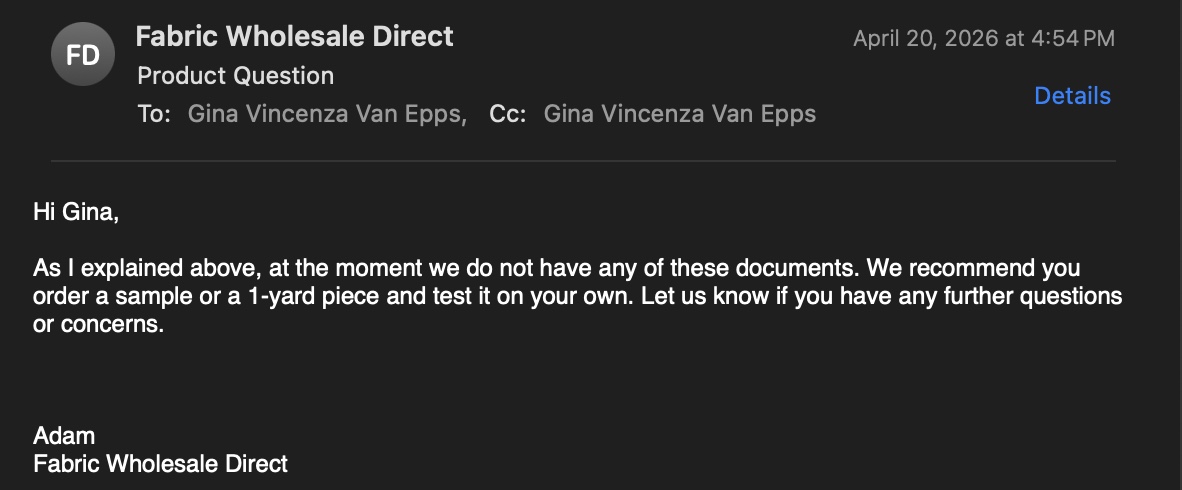
This case study documents a direct response from Adam at Fabric Wholesale Direct, a supplier based in New York.
Supplier Context
Supplier: Fabric Wholesale Direct
Representative: Adam
Location: New York, United States
Inquiry included commonly used production materials:
- Polyester/viscose blend fabrics
- 100% polyester fabrics
- Standard apparel and costume-use textiles
The request was direct:
Do you have documentation confirming PFAS compliance, testing, or chemical disclosure for these materials?
Response from Adam
“As I explained above, at the moment we do not have any of these documents. We recommend you order a sample or a 1-yard piece and test it on your own. Let us know if you have any further questions or concerns.” – Adam at Fabric Wholesale Direct – April 20, 2026
Key Observations
From this response:
- No compliance documentation was provided
- No testing data or certification was available
- Verification responsibility was directed to the buyer
Why This Matters
Fabric Wholesale Direct operates out of New York, where PFAS-related restrictions in apparel and textiles are already in effect.
In this context:
- Materials are being sold into a regulated environment
- Compliance expectations exist
- Documentation is not being provided at the point of sourcing
Instead, the recommendation is:
Independent testing by the buyer
System Gap Identified
This interaction highlights a broader structural issue:
- Suppliers may provide general claims without documentation
- Designers and production teams are expected to meet compliance standards
- Verification responsibility is pushed downstream
Without documentation at the supplier level:
Compliance cannot be confirmed at the sourcing stage
Testing Considerations
While independent testing is possible, it introduces limitations:
- Cost per material sample
- Limited scope depending on test method
- Results apply only to the specific sample tested
- No guarantee of consistency across production batches
Testing may provide insight, but it does not replace:
- Supplier disclosure
- Manufacturing transparency
- Documentation-based verification
PFAS PASS Position
This case study does not assert non-compliance.
It documents:
What information is currently being provided to designers sourcing materials in regulated markets
Outcome
Due to the absence of verifiable documentation:
- Materials remain in an unverified status
- Additional documentation or testing would be required before use in regulated applications
Next Steps
This case is part of an ongoing PFAS PASS series documenting:
- Supplier responses
- Documentation gaps
- Real-world sourcing conditions
Future updates may include:
- Additional supplier case studies
- Independent testing results
- Regulatory alignment analysis
CASE UPDATE — ADDITIONAL DISCLOSURES FROM FABRIC WHOLESALE DIRECT – May 12, 2026
Following publication of this case study and continued communication with Fabric Wholesale Direct, additional clarification was provided by Adam regarding the supplier’s position on PFAS documentation and testing.
The updated response stated that the materials in question:
- are considered “regular fabrics”
- are believed not to contain PFAS
- and “do not require any such testing or documentation”
The response further stated that:
- no PFAS-related documentation would be provided
- no testing certifications currently exist for the materials
- and that verification would instead rely on internal confirmation from the manufacturing team communicated via email
UPDATED SUPPLIER POSITION
The supplier was given specific purchased fabric order numbers post January 2026.
The supplier’s position now appears to be:
- the fabrics are believed to contain no PFAS
- but no testing, certification, supplier disclosure, or formal documentation exists to independently verify that position
The supplier additionally stated that PFAS concerns generally apply to:
- DWR coatings
- stain resistance
- oil and grease repellency
and indicated that these characteristics do not apply to the fabrics referenced in the inquiry.
KEY COMPLIANCE QUESTION IDENTIFIED
This exchange highlights an important distinction in the evolving PFAS compliance landscape:
There is a difference between:
- believing a material does not contain PFAS
and - possessing documentation capable of supporting independent compliance verification
This distinction becomes increasingly relevant when materials are:
- sold from regulated jurisdictions
- incorporated into commercial production
- or used in garments entering regulated markets
PFAS PASS OBSERVATION
PFAS compliance concerns are not limited solely to obvious water-resistant coatings or performance finishes.
Processing methods, dyes, finishing agents, manufacturing treatments, adhesives, lubricants, coatings, and chemical inputs may all affect final material composition depending on the manufacturing pathway.
For this reason, PFAS PASS documentation efforts focus on:
- what can be verified
- what cannot be verified
- and what supporting documentation exists at the point of sourcing
CURRENT STATUS OF MATERIALS
At the time of this update:
- no PFAS testing documentation has been provided
- no supplier certification has been provided
- no manufacturing disclosures have been provided
- materials remain in an unverified status within the PFAS PASS framework
BROADER INDUSTRY IMPLICATION
This case study continues to illustrate a growing gap between:
- emerging textile compliance expectations
and - the availability of documentation within the real-world fabric supply chain
We will keep you updated as this case progresses.
Closing
This is not an isolated interaction.
It reflects a broader issue:
Regulation is advancing faster than supply chain transparency
PFAS PASS\xe2\x84\xa2
Founder, PFAS PASS
PFAS compliance in textiles is not being clearly communicated at the point of sale. That changes through documentation.
If you have supplier responses, share them, comment below.
If you want a supplier investigated, name them, comment below.
This series will continue.
Leave a Reply
You must be logged in to post a comment.