Category: Uncategorized

  • PFAS PASS Case Study 26 – The Regulated State Seller Problem

    PFAS PASS Case Study 26 – The Regulated State Seller Problem

    PFAS PASS Investigation Series · Case Study 26

    The Regulated-State Seller Problem

    Two suppliers operating inside states that already restrict PFAS — and the question their own websites force us to ask: why is the education burden landing on the buyer instead of the seller?


    Since this investigation began in April, PFAS PASS has issued hundreds of compliance-documentation requests to textile and apparel suppliers. As we enter June, the result is the same as it was on day one: not a single request has produced documentation that meets the applicable regulatory standard on review.

    Not once. Not from a small shop, and not from a sophisticated wholesaler. And the failure is rarely a flat refusal — it’s something more revealing. In nearly every case the burden runs backwards: we have had to first educate the seller on what compliance documentation actually is, and then educate them again on why what they provided does not satisfy the requirement. A “not intentionally added” letter. A generalized certification. A confident assurance with nothing test-backed behind it. The pattern is consistent enough that it is no longer a story about individual suppliers. It is a story about an industry that has not been equipped — from the top down — to meet rules that are already in force.

    April→June
    Investigation window
    Hundreds
    Document requests issued
    Zero
    Met the standard on review

    Why this is the “regulated-state” problem

    Much PFAS analysis turns on tracing: where did the chemistry originate, and how do you prove it crossed into a regulated market? For an in-state seller, that question disappears. The goods are made or sold inside the jurisdiction. California’s AB 1817 took effect January 1, 2025; New York’s apparel PFAS restriction is likewise in force. There is no drift question and no traceability burden — only the simplest test: can a seller operating inside a regulated state produce, on request, the documentation that state’s law contemplates?

    The two worked examples below — one a Los Angeles fabric retailer, one a Gardena, California wholesaler — are not singled out as bad actors. They are ordinary, and that is the point. They illustrate, with their own public pages, the two faces of the same gap: the seller who markets restricted chemistry without disclosure, and the seller with a genuine sustainability program that is simply silent on PFAS.

    Example 1. The water-repellent finish nobody describes

    A Los Angeles fabric retailer · undisclosed DWR chemistry + unsubstantiated “Eco” branding

    The first subject is a Los Angeles–area fabric manufacturer and retailer selling by the yard, online, nationwide. Its own site footer places a physical store in the LA metro — which removes any jurisdictional ambiguity. California law governs the point of sale.

    Fabric retailer website footer showing a Los Angeles-area physical store on a map
    Exhibit 1A The seller’s own footer places a physical store in the Los Angeles metro — an in-state seller, where AB 1817 governs the sale. Captured May 2026.

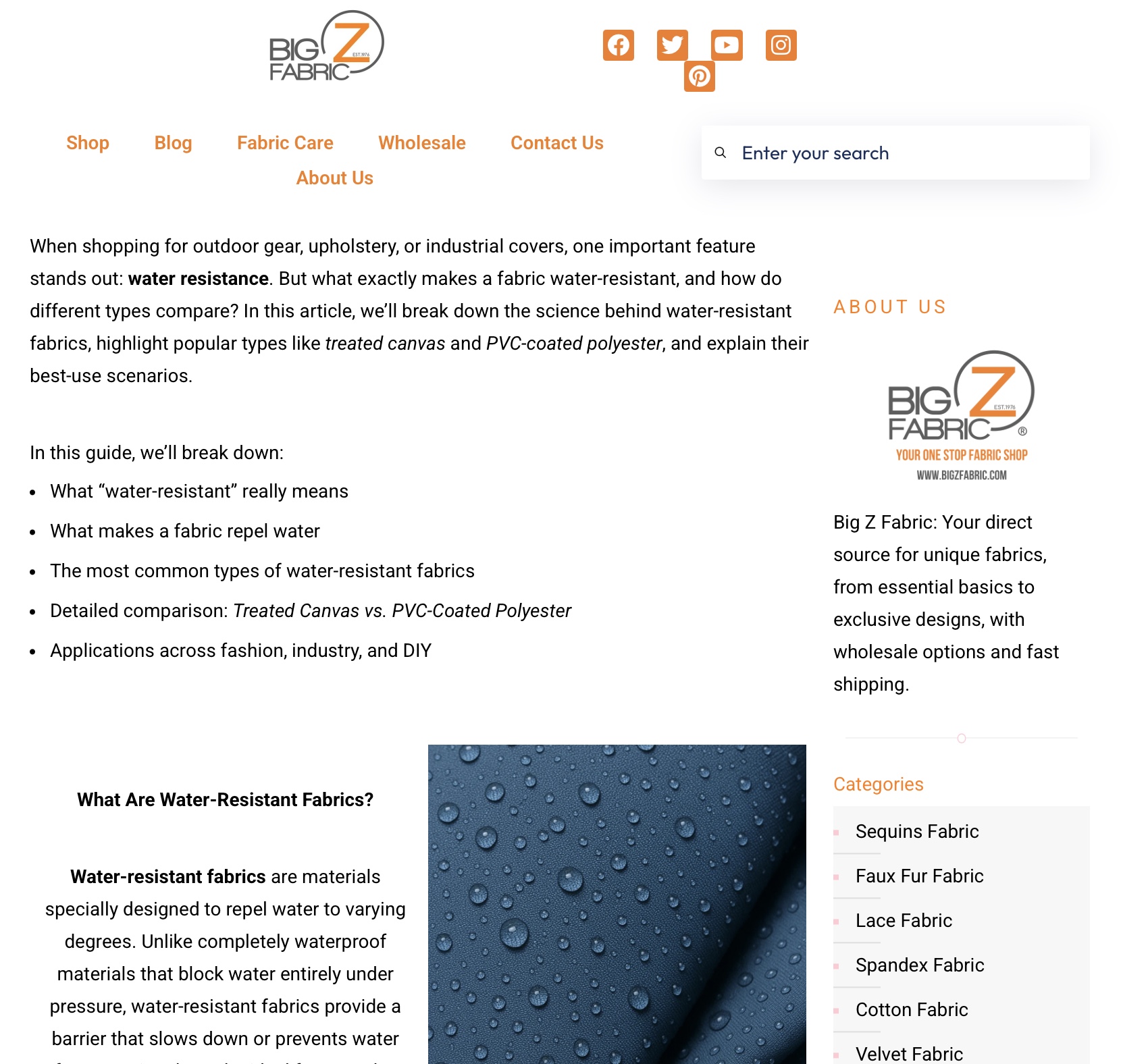
    In December 2025 — eleven months into the regulated period — the seller published a how-to article on water-resistant fabrics. It lists “fluoropolymer sprays” alongside silicone and wax as ordinary water-repellency options. “Fluoropolymer” denotes PFAS chemistry. The article offers no hazard note and no reference to the fact that intentionally-added PFAS in apparel and textiles is restricted in the seller’s own state. A blog post about a restricted coating, written as if it were simply another option on the shelf.
    Fabric retailer blog article on water-resistant fabrics, published December 2025
    Exhibit 1B A December 2025 guide to water-resistant fabrics that recommends “fluoropolymer sprays” — a PFAS chemistry — with no compliance note, published by an in-state seller eleven months into the regulated period. Captured May 2026.

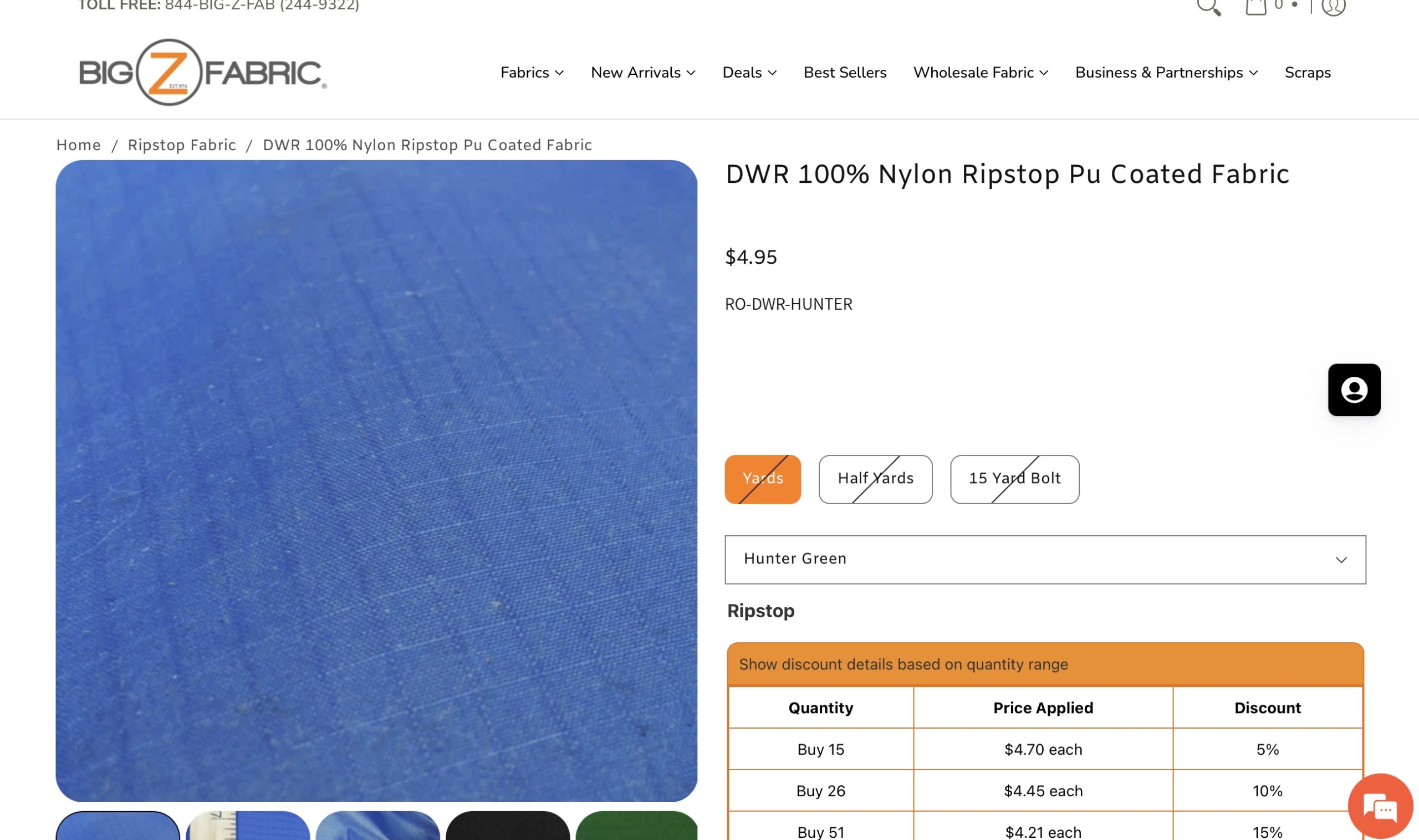
    The catalog matches the marketing. A live product titled “DWR 100% Nylon Ripstop PU Coated Fabric” — DWR meaning durable water repellent — is sold for “outdoor gear, utility projects, bags, covers, jackets, and accessories.” Jackets, bags, and accessories are covered articles under AB 1817. The listing carries no statement of the DWR chemistry, no fluorine-free attestation, no certification, and no PFAS disclosure anywhere.

    DWR 100% Nylon Ripstop PU Coated Fabric product page, priced at $4.95
    Exhibit 1C The live product page. Note what is present — “DWR” in the title, price, SKU — and what is absent: any statement of the DWR chemistry. Still for sale; captured May 2026.

    Precision — DWR is not the same as PU

    This product lists both “DWR” and “PU coated.” The polyurethane (PU) coating is the waterproof barrier and is generally PFAS-free. The DWR is a separate surface finish of undisclosed composition. The finding is not “this fabric is PFAS” — it is that the fabric carries a DWR finish of undisclosed chemistry, on a covered article, from an in-state seller, with no fluorine-free attestation. Historically DWR meant fluorinated chemistry; a DWR claim with no chemistry statement defaults to “assume fluorinated until proven otherwise.” And a “not intentionally added” letter would not close that gap — it asserts intent rather than demonstrating absence, and is no substitute for total-fluorine (TF/TOF) test data.

    The “Eco” line, and the persistence paradox

    The same seller’s flagship faux fur is branded “EcoShag®” and marketed for costuming, apparel, and crafts. Its disclosed composition is 100% acrylic face over 100% polyester backing — both virgin, petroleum-derived synthetics. The only claim tied to the “Eco” branding is “ethical sourcing” (an animal-welfare statement). There is no recycled-content claim, no biodegradability claim, and no certification on the page.
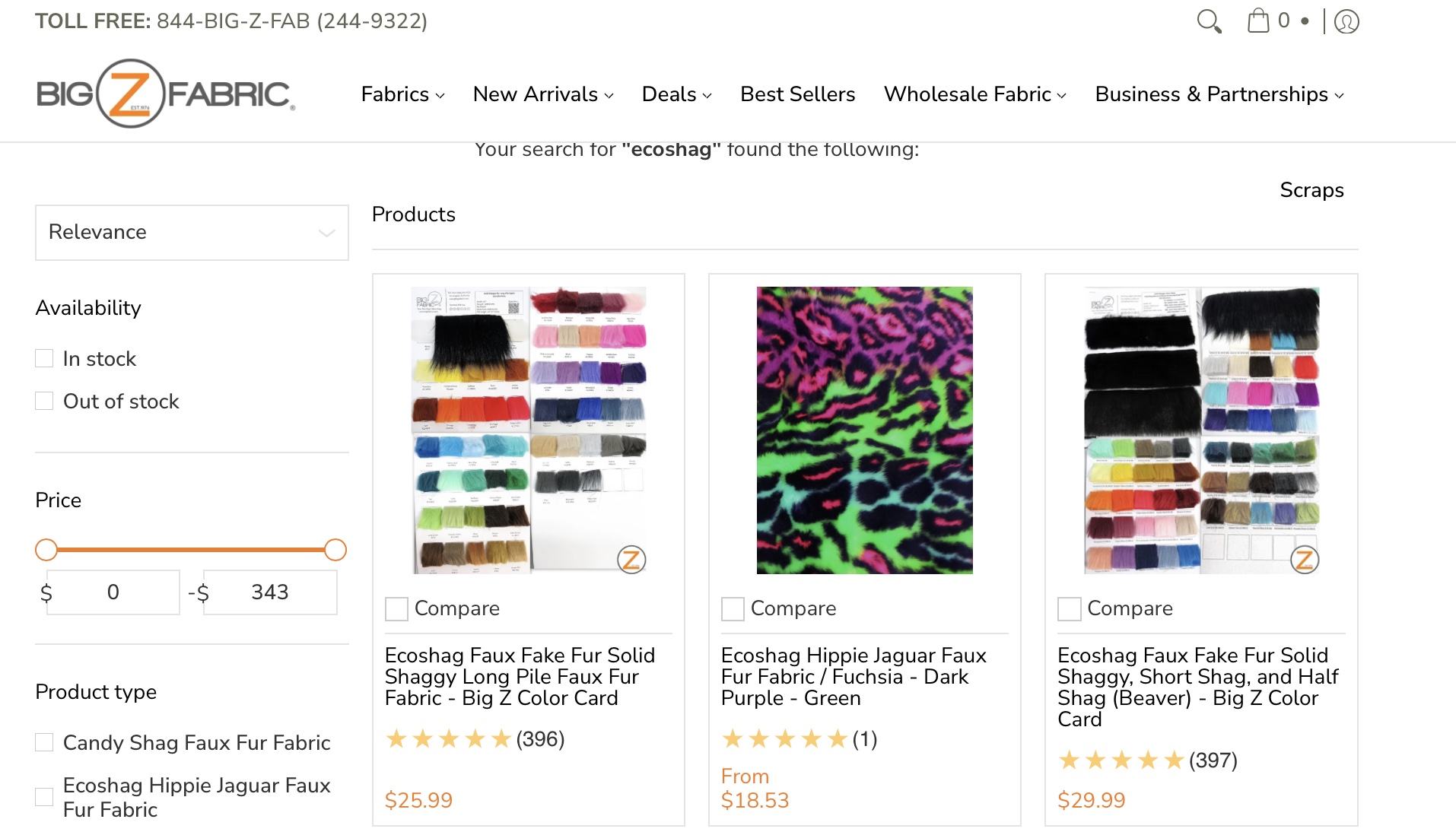

    Search results showing the EcoShag faux fur product line
    Exhibit 1D The “Eco”-branded faux fur line. Captured May 2026.
    EcoShag product detail with care instructions Machine wash cold, Air Dry only
    Exhibit 1E Product detail. The care instruction — “Machine wash cold / Air Dry only” — is the same washing that drives microplastic shedding from synthetic fibers. Captured May 2026.

    Here the irony sits in plain view. A product sold on an ethical appeal — cruelty-free, no animal fur — is among the most environmentally permanent choices on the shelf. Virgin acrylic and polyester do not biodegrade on any human timescale; they persist for centuries and shed microplastics under the very washing the care label recommends. The harm avoided (animal use) is finite; the harm created (a persistent plastic that outlasts its own fashion cycle by generations) is permanent and undisclosed. The “Eco” prefix is unsubstantiated by anything on the page — not necessarily false, but unsupported, which under the FTC Green Guides is the textbook deceptive-by-implication pattern.

    A note on language

    This faux fur is forever-plastic, not a forever-chemical. “Forever chemical” is a term of art reserved for PFAS. Keeping the terms distinct is what keeps the argument clean — the persistence point stands fully on its own.

    Example 2. When “sustainable” says nothing about PFAS

    A Gardena, California wholesaler · a substantiated green program that is silent on PFAS

    The second subject is the opposite kind of seller — and that is exactly why it matters. This is a well-established Gardena, California fabric wholesaler with a sophisticated, genuinely substantiated sustainability program. Its “greenSTYLE” line spans organic cotton, BCI cotton, recycled polyester, hemp, and Tencel™ — recognized standards, not empty branding.
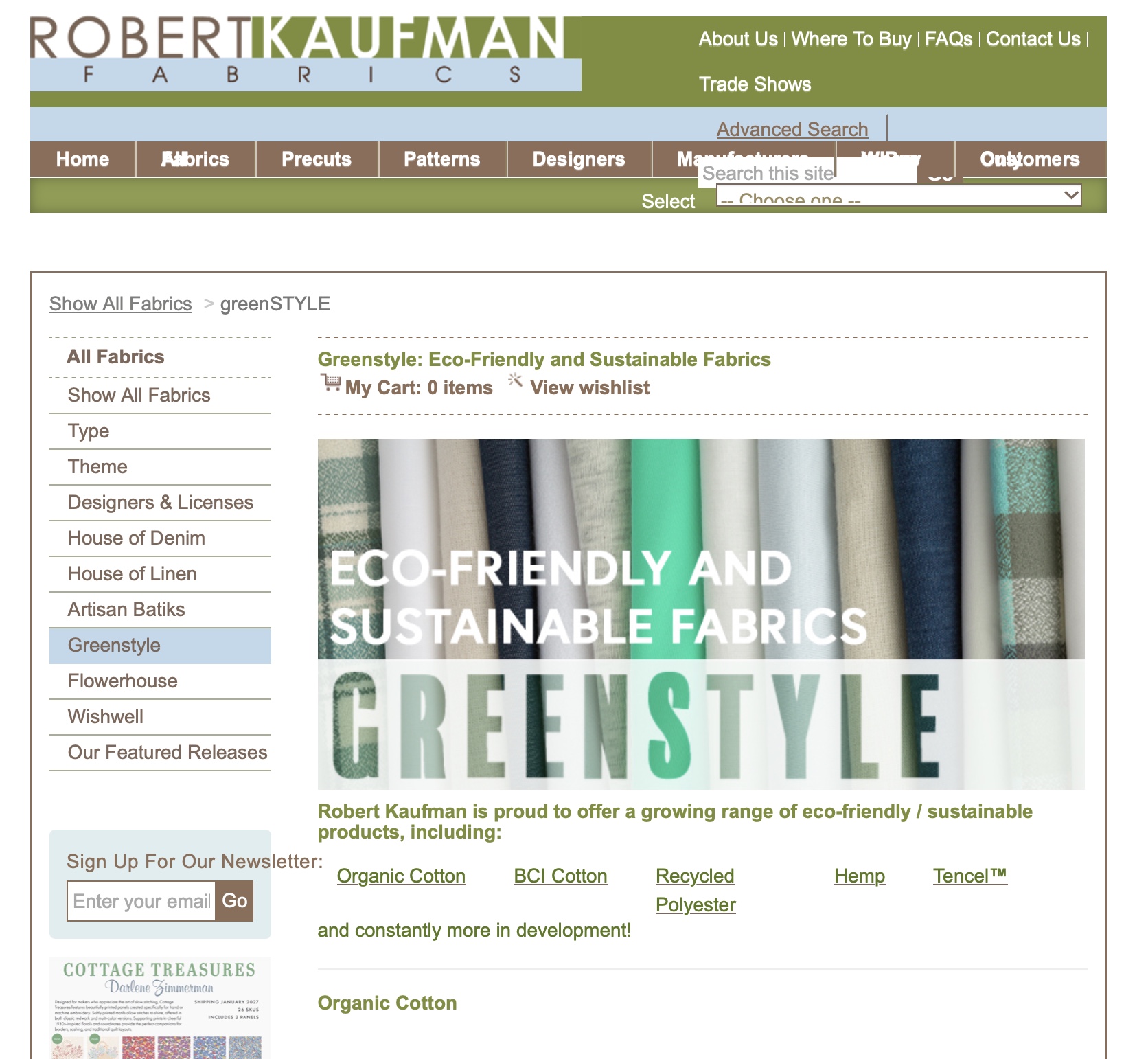
    Robert Kaufman greenSTYLE eco-friendly and sustainable fabrics landing page
    Exhibit 2A A regulated-state wholesaler’s “Eco-Friendly and Sustainable Fabrics” program, listing organic cotton, BCI cotton, recycled polyester, hemp, and Tencel™. Captured May 2026.

    The recycled-polyester claims are real and specific — the program names REPREVE® from Unifi, made from post-consumer plastic bottles. This is not greenwashing. It is a legitimate fiber-sustainability program, run by an established in-state wholesaler whose own contact page lists a Gardena, California address. Which is precisely what makes the gap instructive.

    Robert Kaufman contact page listing a Gardena, California address
    Exhibit 2B The wholesaler’s own contact page — a Gardena, California address, confirming an in-state seller where AB 1817 governs. Captured May 2026.

    Now look at a specific product. The “Infinity Recycled/Heavy Flannel” carries the greenSTYLE “Eco-Friendly” performance badge, discloses 44% REPREVE recycled poly content (the page itself names Unifi’s post-consumer-bottle yarn), and is marketed in its own words for “outerwear applications like Jackets and Shackets, blankets.” Outerwear and jackets are covered apparel categories. The page substantiates what the fabric is made of — and says nothing whatsoever about PFAS or finishing chemistry.
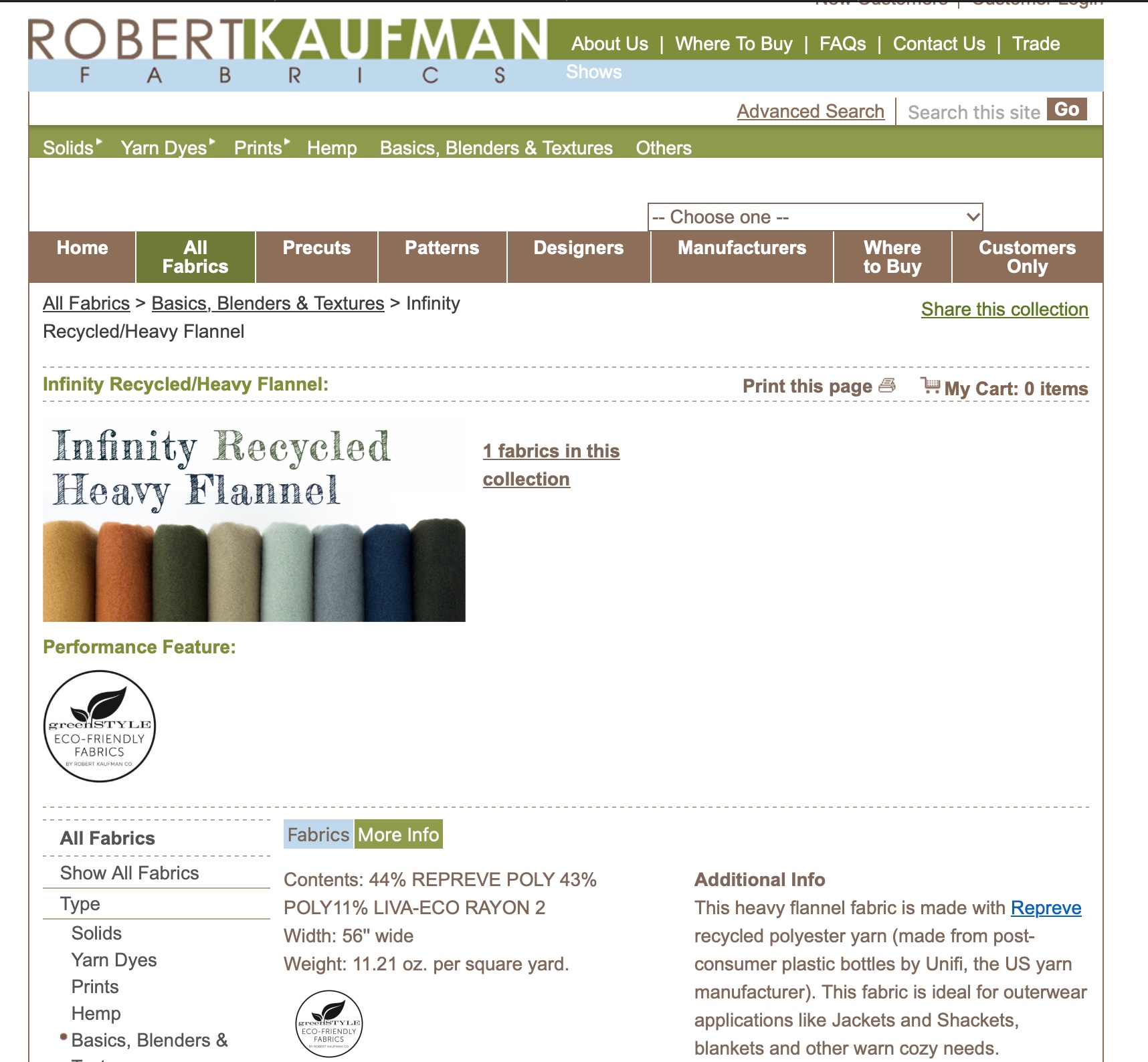
    Infinity Recycled Heavy Flannel product page with Eco-Friendly badge, recycled content, marketed for jackets and outerwear
    Exhibit 2C An “Eco-Friendly”-badged recycled flannel — REPREVE content disclosed, marketed for jackets and outerwear — with no PFAS or finishing-chemistry statement anywhere on the page. Captured May 2026.

    The finding — two different axes

    Sustainable fiber content and PFAS compliance are different questions. An “Eco-Friendly” badge answers what the yarn is made of; it says nothing about what is applied to the finished fabric. A buyer sourcing this flannel for a jacket sees “Eco-Friendly,” reasonably infers “safe,” and receives no PFAS information either way. We make no claim that this product contains PFAS — recycled flannel for “warm cozy needs” may carry no water-repellent finish at all. The point is the silence: even a sophisticated, well-intentioned sustainability program has not connected “green” to “PFAS-compliant.” Buying sustainable fabric does not discharge a buyer’s PFAS due diligence.

    This is a pattern, not two anecdotes

    These two sellers are the latest entries in a documented series. Across twenty-five prior PFAS PASS case studies, the same structure repeats among suppliers operating inside California and New York — the regulated states where one would most expect readiness. In each, compliance documentation was either unavailable, generalized rather than test-backed, or shifted downstream to the buyer. In the one instance where suppliers did submit documents, all three failed review.

    Prior caseMarketDocumented gap (PFAS PASS findings)
    01 · Kiki TextilesCAStated it does not carry PFAS-verified or PFAS-compliant fabrics.
    02 · Fabric Wholesale DirectNYNo PFAS documentation provided; buyer advised to test independently.
    03 · KnixNY CARemoved “PFAS-free” claims, then confirmed sales into NY and CA without PFAS-verified products.
    06 · Carr TextileUS“PFAS-free” claim vs. documentation reality — SDS did not support the claim.
    11 · WawakUSThread and notions supplier with zero PFAS transparency.
    15 · LA Garment DistrictCAA regulated market with no PFAS visibility or guidance.
    21 · Multi-supplierUSOne garment, three suppliers, zero verifiable compliance.
    22 · Document reviewUSThree suppliers provided PFAS compliance documents — all three failed review.

    See the full record — all PFAS PASS case studies.

    The real question: why is the burden downstream?

    Put the two examples and the pattern together and a single question surfaces. In a regulated market, the seller is the party with the legal exposure and the relationship to the chemistry. Yet in hundreds of requests, the seller has never been the party ready to answer. The education has flowed the wrong way — from the investigator to the supplier — every time.

    So why aren’t these companies equipping their own people? Why does an in-state retailer publish a how-to recommending a restricted coating? Why does it keep that product, and that article, live on its website today? Why does a sophisticated wholesaler build a substantiated sustainability program and never connect it to the PFAS rules of the state it ships from? The answer is not malice. It is that compliance has not yet been built into how these companies train, market, and sell — even where the law already requires it.

    From investigation to infrastructure

    PFAS PASS was not built to document the gap alone — it was built to close it, through structured document review, verification pathways, and compliance systems for designers, brands, and suppliers operating in regulated markets.

    Explore Rapid Document Review™

    Compliance Is Required. Verification Is Not Readily Available. PFAS PASS Is Building It.

    This case study is compliance-research commentary based on public, captured web pages and on documentation requests conducted as part of the PFAS PASS investigation. It is not legal advice, a legal opinion, or an allegation of intentional wrongdoing by any named party. The “zero compliant documents” observation describes the results of PFAS PASS document requests, not a statistical survey of any company or of the industry as a whole. Regulatory characterizations reflect the analysis of PFAS PASS and should be independently verified by qualified counsel before being relied upon.

  • “Forever Chemicals” Sewing Systems and Lifecycle Blind Spots Now Being Questioned

    “Forever Chemicals” Sewing Systems and Lifecycle Blind Spots Now Being Questioned

    The trends were temporary. The textiles were forever.

    Fashion trained consumers to replace garments seasonally while increasingly relying on synthetic material systems designed for durability, stain resistance, weather resistance, and chemical persistence.

    Consumers were encouraged to consume by industries profiting from overproduction, while being reassured through recycling and sustainability narratives that may not have fully accounted for the long-term persistence of the material systems being recirculated.

    As PFAS regulations expand across textiles and sewn products, a larger question is beginning to emerge:

    Is fabric alone enough to evaluate compliance anymore?

    Most PFAS discussions have focused on:

    • fabrics
    • waterproof coatings
    • trims
    • thread
    • intentionally added chemistry

    But garments do not exist in isolation.

    A garment moves through an entire lifecycle of contact systems before reaching the consumer and long after:

    • sewing systems
    • cutting surfaces
    • ironing systems
    • heat transfer systems
    • packaging
    • laundering
    • storage
    • shipping
    • resale
    • rental circulation
    • repairs
    • disposal systems

    Modern garment production environments now involve countless synthetic and engineered contact surfaces that rarely appear in compliance discussions:

    • plastic sewing machine beds
    • coated presser feet
    • roller feet
    • trim feeding systems
    • self-healing cutting mats
    • laminated cutting tables
    • molded plastic needle containers
    • synthetic packaging systems
    • poly bags
    • heat press transfers
    • PTFE or nonstick pressing surfaces
    • washing machines and dryers with synthetic internal components
    • dry cleaning systems
    • plastic hangers and storage systems

    This does not automatically mean these systems contain PFAS or contaminate garments.

    But it does raise an important systems-level question:

    If compliant fabrics can theoretically be invalidated by undocumented trims, coatings, packaging, or contamination pathways, where does accountability stop once the production environment itself becomes part of the discussion?

    Industries involving contamination-sensitive environments such as medical manufacturing, food systems, industrial hygiene, and cleanroom production already recognize that contact surfaces matter.

    Fashion manufacturing historically did not operate under that framework.

    The industry optimized for:

    • speed
    • scalability
    • synthetic performance
    • low friction
    • stain resistance
    • weather resistance
    • rapid turnover

    Not contamination-controlled manufacturing systems.

    As scrutiny expands beyond intentionally added chemistry into broader contamination-pathway discussions, questions may also emerge around:

    • product liability
    • insurance coverage
    • economic loss
    • consumer trust
    • greenwashing
    • recycling narratives
    • disposal responsibility
    • lifecycle accountability

    Especially as brands, suppliers, retailers, and consumers begin questioning what constitutes a “PFAS compliant” product across manufacturing, handling, packaging, laundering, reuse, and disposal environments.

    This emerging discussion is one of the reasons PFAS PASS™ is introducing:

    PFAS Lifecycle Contact Systems Evaluation™

    A structured framework designed to evaluate production, packaging, handling, consumer interaction, recirculation, and end-of-life contact systems that may influence PFAS-sensitive textile and sewn-product environments.

    The framework includes evaluation layers for:

    • production contact systems
    • packaging and distribution systems
    • consumer interaction systems
    • post-production lifecycle systems
    • reuse and recirculation systems
    • disposal and end-of-life considerations

    The goal is not to promote fear or claim that every contact surface creates contamination.

    The goal is to recognize that PFAS compliance may ultimately function less as a simple yes-or-no question and more as a lifecycle risk assessment and contamination-awareness framework.

    Because the larger issue may not simply be whether PFAS were intentionally added to a fabric.

    The larger issue may be whether modern fashion and textile systems were ever designed for chemically persistent material environments in the first place.

    The trends were temporary.

    The material systems were designed to persist.

    PFAS Compliance Systems Expert for Clothing, Costumes and Textile-Based Products

    Creator of PFAS PASS™ — a structured compliance and verification framework addressing regulatory gaps across fashion, uniforms and performance systems

  • 82 Questions Nobody Wants to Answer About PFAS “forever chemicals”, Synthetic Textiles and the Global Waste System

    82 Questions Nobody Wants to Answer About PFAS “forever chemicals”, Synthetic Textiles and the Global Waste System

    If PFAS regulation is real, then why are most consumers still completely unaware these regulations already exist in major markets including New York, California and parts of Europe?

    If PFAS contamination presents a legitimate environmental and public health concern, why are unverified textile goods still freely entering regulated markets?

    Why are PFAS compliance documents not required at ports of entry before goods are imported into regulated states and countries?

    Which agencies should already be addressing this?
    Customs?
    EPA?
    State environmental agencies?
    Consumer protection agencies?
    International trade regulators?

    If products can no longer legally be sold in certain markets due to PFAS restrictions, should those same products still be allowed to be donated, recycled, exported or redistributed elsewhere?

    If contaminated goods cannot safely remain in circulation, what are they becoming legally and operationally?

    Waste?
    Hazardous waste?
    Unregulated chemical liabilities?

    If PFAS-contaminated products are entering landfills, incinerators and recycling systems, where are the standardized global disposal protocols?

    Why are there no universal hazardous textile handling standards?

    Where are the segregation systems?
    The chain-of-custody systems?
    The disposal labeling systems?
    The contaminated inventory registries?

    If microplastics are now being investigated globally as an environmental contaminant, why is the textile industry not being openly discussed as one of the largest continuous distribution systems?

    If washing synthetic garments releases microplastics and potentially associated chemical contaminants into wastewater systems daily, who is responsible for the downstream contamination?

    Consumers?
    Municipalities?
    Wastewater facilities?
    Or the industries that designed and marketed the products?

    If wastewater systems were never designed to remove these materials at global scale, who pays for the retrofit?

    Taxpayers?
    Utility customers?
    Governments?
    Or the industries that profited from the contamination?

    If PFAS and synthetic textile contamination are now being recognized as long-term environmental risks, should resale and donation systems continue redistributing potentially contaminated goods into secondary markets?

    Should thrift stores and nonprofit organizations be expected to manage chemical compliance without infrastructure, funding or testing systems?

    If recycling contaminated synthetic textiles redistributes PFAS and microplastics into new products, was “circularity” solving pollution or recirculating it?

    Why were consumers told recycling synthetic clothing into carpets, insulation, building materials and new garments was environmentally responsible before toxicological verification systems existed?

    Did recycling systems accidentally spread contamination into entirely new product categories?

    Or were economic incentives prioritized over chemical containment concerns?

    Who funded and promoted those narratives?

    Chemical companies?
    Petroleum interests?
    Synthetic textile industries?
    ESG investment systems?
    Government sustainability grants?
    Fashion trade organizations?

    Why do so many industry sustainability conversations focus on optics, carbon language and circularity while avoiding direct discussion about PFAS, synthetic dependency and contamination pathways?

    Why are major fashion trade organizations, sourcing expos and textile conferences still largely silent about operational PFAS compliance?

    Why are textile industry associations not publicly leading large-scale compliance education initiatives?

    Why are costume industries, entertainment sectors, hospitality systems, schools, healthcare systems and uniform providers not openly discussing retrofit exposure?

    Do employers even know their workforce uniforms may already fall under regulated material scrutiny?

    Have hospitals audited their textiles?
    Have schools?
    Have airlines?
    Have theme parks?
    Have government agencies?
    Have military procurement systems?

    Who is responsible for auditing existing inventory already in circulation?

    If synthetic textiles and chemically treated materials become increasingly restricted globally, who absorbs the replacement costs for:

    • clothing
    • uniforms
    • furniture
    • upholstery
    • bedding
    • mattresses
    • footwear
    • automotive interiors
    • commercial seating
    • performance systems
    • theater and costume inventories

    Consumers?
    Employers?
    Taxpayers?
    Insurance systems?
    Or manufacturers?

    If the cost of compliance and replacement is massive, is industry silence being driven by fear of economic collapse?

    How much existing inventory globally may already be noncompliant under emerging regulations?

    What happens if governments begin enforcing import verification aggressively?

    What happens if contaminated goods begin getting rejected at ports of entry?

    Should contaminated inventory be returned to exporting nations?

    Who pays for international reverse logistics and disposal?

    What happens to countries whose economies depend heavily on synthetic textile exports if chemically verified compliance becomes mandatory?

    If REACH and emerging EU regulations are already acknowledging lifecycle chemical risks, how long before disposal and remediation frameworks expand globally?

    If PFAS regulation is accelerating internationally, why does the fashion industry still behave publicly as though this is a niche issue?

    Why are major fashion publications willing to discuss textile waste and sustainability failures while rarely directly confronting the synthetic chemical dependency underlying the system?

    Why is the public being encouraged to consume “sustainable” synthetic products while governments simultaneously investigate microplastic contamination?

    If consumers were never clearly informed about PFAS, microfiber shedding or unresolved disposal risks, was meaningful informed consent ever present?

    If contamination pathways were known or reasonably foreseeable, when did industries know?

    What internal studies exist?
    What warnings existed?
    What discussions occurred behind closed doors?

    Will future litigation eventually expose timelines similar to:

    • asbestos
    • tobacco
    • lead
    • opioids
    • firefighting foam
    • industrial chemical contamination cases

    If governments eventually determine PFAS-contaminated textiles require specialized disposal systems, who funds the remediation?

    Will taxpayers inherit another industrial cleanup burden?

    Will there be:

    • producer responsibility laws
    • remediation funds
    • import levies
    • mandatory take-back systems
    • disposal taxes
    • textile waste regulations
    • retrofit mandates
    • or class action litigation?

    If synthetic textile contamination ultimately becomes recognized as a distributed environmental hazard, could the global fashion industry face one of the largest retrofit and remediation events in modern industrial history?

    And perhaps the most important question of all:

    If these risks are serious enough to regulate quietly, why is nobody discussing them loudly?

    These 82 questions all need to be answered.

    Ask your employers.
    Ask your procurement departments.
    Ask your suppliers.
    Ask your school boards.
    Ask your hospitals.
    Ask your environmental agencies.
    Ask your wastewater authorities.
    Ask your elected representatives.
    Ask your customs agencies.
    Ask your trade organizations.
    Ask your retailers.
    Ask your governments.

    Request the documentation.
    Request the compliance records.
    Request the import verification standards.
    Request the disposal protocols.
    Request the transparency that should already exist.

    Because if PFAS regulation is real, then accountability can no longer stop at the point of sale.

    The questions have now entered the global waste system, the recycling system, the import system, the environmental system and the financial system.

    Silence is no longer an acceptable answer.

    Explore the documented case studies, compliance systems and investigative PFAS PASS DIY Library framework at PFAS PASS™.

    The conversation is already here.
    The accountability phase may be next.

  • Case Study 13: The Trade Show Blind Spot — Texworld NYC and the Absence of PFAS Compliance Infrastructure

    Case Study 13: The Trade Show Blind Spot — Texworld NYC and the Absence of PFAS Compliance Infrastructure


    Overview

    Major textile sourcing events in two regulated markets are operating without visible PFAS compliance guidance, education or verification support.

    This case examines Texworld NYC, a leading textile trade show serving the U.S. market, including New York and California where PFAS regulations are actively impacting product compliance.


    Key Finding

    A direct search of the Texworld NYC platform for “PFAS” returns:

    • No educational content
    • No exhibitor guidance
    • No compliance resources
    • No acknowledgment of regulatory impact

    This absence exists within a sourcing environment that directly feeds production pipelines into regulated jurisdictions.


    System Failure Identified

    This is not a supplier-level issue.

    This is a failure at the industry coordination layer.

    Trade shows function as:

    • Information hubs
    • Sourcing gateways
    • Industry standard translators

    In the context of PFAS regulation, they are currently operating without:

    • Compliance frameworks
    • Verification pathways
    • Buyer protection mechanisms

    Impact on Designers and Brands

    Designers sourcing through these environments are expected to meet compliance requirements without:

    • Verified supplier disclosures
    • Material-level testing access
    • Standardized documentation

    This creates a downstream liability structure where:

    • Materials are selected without proof of compliance
    • Suppliers are not required to substantiate claims
    • Responsibility shifts to the designer or brand deploying the product

    Regulatory Context

    New York and California PFAS regulations are actively reshaping material requirements across:

    • Apparel
    • Costumes
    • Performance systems
    • Textile-based products

    Despite this, core sourcing environments have not integrated compliance into their infrastructure.


    Critical Gap

    The industry is currently operating with:

    • Regulatory enforcement increasing
    • Supplier transparency inconsistent
    • No centralized verification system
    • No compliance support at the point of sourcing

    This results in a disconnect between where materials are selected and where compliance must be proven.


    PFAS PASS Position

    PFAS PASS™ is being developed to address this exact gap by providing:

    • Structured compliance frameworks
    • Verification systems
    • Supplier transparency pathways
    • Documentation standards for real-world implementation

    Conclusion

    The absence of PFAS compliance infrastructure at major textile trade shows is not a minor oversight.

    It is a structural failure that impacts every designer, brand and production team sourcing materials for regulated markets.

    Until compliance is integrated into sourcing environments, the burden of proof will remain misaligned with the point of decision-making.


    Supporting Action

    Industry outreach has been initiated to Texworld NYC representatives to determine whether PFAS compliance guidance or frameworks are currently in development.

    If you have any suggestions on situations we can turn into a Case Study, comment below.


  • Case Study 12: The Hidden Compliance Failure in Heat Press Design — Ninja Transfers and the Appliqué Risk

    Case Study 12: The Hidden Compliance Failure in Heat Press Design — Ninja Transfers and the Appliqué Risk

    PFAS Compliance Inquiry Result: No Response + No Public Disclosure

    As part of an ongoing supplier audit, we contacted Ninja Transfers to request clarification on PFAS compliance for their heat press appliqué and DTF transfer products.

    No response has been received.

    A direct search of their website for “PFAS” returns no results, with no available documentation addressing:

    • Chemical composition of transfer films
    • Adhesive systems used in application
    • Ink formulations beyond performance claims
    • PFAS testing, thresholds, or certification
    • Compliance alignment for California and New York markets

    Why This Case Matters Now

    Heat press transfers are no longer niche.

    They are rapidly becoming a primary production method for:

    • Home-based apparel businesses
    • Etsy and small-batch brands
    • Print-on-demand workflows
    • Promotional merchandise
    • Entertainment and theme park costume builds

    This creates a critical escalation:

    A method that starts in a home studio is now ending up in regulated commercial environments.


    The Failure Point: The Appliqué Itself

    A garment can be built from compliant base fabrics and still fail.

    Because compliance is not determined only by fabric.

    It is determined by every applied component.

    A heat press appliqué introduces:

    • Synthetic film layers
    • Heat-activated adhesive systems
    • Printed ink surfaces engineered for durability

    These are precisely the categories where PFAS-related chemistries may exist.

    One unverified transfer can invalidate an otherwise compliant garment.


    Real-World Production Impact

    This is not theoretical.

    These transfers are actively used in:

    • Costume fabrication pipelines
    • Touring productions
    • Branded merchandise systems
    • Theme park wardrobe builds
    • Client-based design and manufacturing

    If a designer cannot verify the appliqué, they cannot verify the finished piece.

    That means:

    • No defensible compliance position
    • Increased liability in regulated states
    • Risk exposure for clients and contracts
    • Potential product disqualification at scale

    Supplier Silence Is a System Signal

    The absence of a response is not an isolated issue.

    It reflects a broader pattern:

    • Suppliers optimized for speed and accessibility
    • No infrastructure for compliance disclosure
    • Customer support not equipped for regulatory questions
    • No standardized documentation for downstream users

    Meanwhile, adoption continues to grow.


    Key Takeaway

    Heat press is being marketed as a production solution.

    But from a compliance standpoint, it is currently:

    An unverified system embedded inside finished garments.

    If the appliqué cannot be verified, the design cannot be verified.


    System Gap Identified

    This case reinforces a critical gap:

    There is currently no accessible pathway for:

    • Verifying transfer-based components
    • Standardizing disclosure from suppliers
    • Protecting designers using third-party application systems

    This is where PFAS PASS is building infrastructure:

    • Component-level verification
    • Supplier documentation pathways
    • PFAS VERIFIED Registry inclusion for approved materials

    Call to Action

    If you are:

    • A supplier of heat press, DTF, or transfer systems
    • A maker scaling from home production into retail markets
    • A costume designer building for regulated deployment

    You cannot treat appliqués as neutral.

    PFAS PASS is actively developing systems to:

    • Verify component-level compliance
    • Close supplier transparency gaps
    • Provide defensible compliance pathways for finished garments

    Download our PFAS Compliance Playbook – Hardware, Notions & Construction Systems Deep Dive Edition

    If you have a scenario we should make a Case Study, comment below.