Tag: PFAS

  • “Forever Chemicals” Sewing Systems and Lifecycle Blind Spots Now Being Questioned

    “Forever Chemicals” Sewing Systems and Lifecycle Blind Spots Now Being Questioned

    The trends were temporary. The textiles were forever.

    Fashion trained consumers to replace garments seasonally while increasingly relying on synthetic material systems designed for durability, stain resistance, weather resistance, and chemical persistence.

    Consumers were encouraged to consume by industries profiting from overproduction, while being reassured through recycling and sustainability narratives that may not have fully accounted for the long-term persistence of the material systems being recirculated.

    As PFAS regulations expand across textiles and sewn products, a larger question is beginning to emerge:

    Is fabric alone enough to evaluate compliance anymore?

    Most PFAS discussions have focused on:

    • fabrics
    • waterproof coatings
    • trims
    • thread
    • intentionally added chemistry

    But garments do not exist in isolation.

    A garment moves through an entire lifecycle of contact systems before reaching the consumer and long after:

    • sewing systems
    • cutting surfaces
    • ironing systems
    • heat transfer systems
    • packaging
    • laundering
    • storage
    • shipping
    • resale
    • rental circulation
    • repairs
    • disposal systems

    Modern garment production environments now involve countless synthetic and engineered contact surfaces that rarely appear in compliance discussions:

    • plastic sewing machine beds
    • coated presser feet
    • roller feet
    • trim feeding systems
    • self-healing cutting mats
    • laminated cutting tables
    • molded plastic needle containers
    • synthetic packaging systems
    • poly bags
    • heat press transfers
    • PTFE or nonstick pressing surfaces
    • washing machines and dryers with synthetic internal components
    • dry cleaning systems
    • plastic hangers and storage systems

    This does not automatically mean these systems contain PFAS or contaminate garments.

    But it does raise an important systems-level question:

    If compliant fabrics can theoretically be invalidated by undocumented trims, coatings, packaging, or contamination pathways, where does accountability stop once the production environment itself becomes part of the discussion?

    Industries involving contamination-sensitive environments such as medical manufacturing, food systems, industrial hygiene, and cleanroom production already recognize that contact surfaces matter.

    Fashion manufacturing historically did not operate under that framework.

    The industry optimized for:

    • speed
    • scalability
    • synthetic performance
    • low friction
    • stain resistance
    • weather resistance
    • rapid turnover

    Not contamination-controlled manufacturing systems.

    As scrutiny expands beyond intentionally added chemistry into broader contamination-pathway discussions, questions may also emerge around:

    • product liability
    • insurance coverage
    • economic loss
    • consumer trust
    • greenwashing
    • recycling narratives
    • disposal responsibility
    • lifecycle accountability

    Especially as brands, suppliers, retailers, and consumers begin questioning what constitutes a “PFAS compliant” product across manufacturing, handling, packaging, laundering, reuse, and disposal environments.

    This emerging discussion is one of the reasons PFAS PASS™ is introducing:

    PFAS Lifecycle Contact Systems Evaluation™

    A structured framework designed to evaluate production, packaging, handling, consumer interaction, recirculation, and end-of-life contact systems that may influence PFAS-sensitive textile and sewn-product environments.

    The framework includes evaluation layers for:

    • production contact systems
    • packaging and distribution systems
    • consumer interaction systems
    • post-production lifecycle systems
    • reuse and recirculation systems
    • disposal and end-of-life considerations

    The goal is not to promote fear or claim that every contact surface creates contamination.

    The goal is to recognize that PFAS compliance may ultimately function less as a simple yes-or-no question and more as a lifecycle risk assessment and contamination-awareness framework.

    Because the larger issue may not simply be whether PFAS were intentionally added to a fabric.

    The larger issue may be whether modern fashion and textile systems were ever designed for chemically persistent material environments in the first place.

    The trends were temporary.

    The material systems were designed to persist.

    PFAS Compliance Systems Expert for Clothing, Costumes and Textile-Based Products

    Creator of PFAS PASS™ — a structured compliance and verification framework addressing regulatory gaps across fashion, uniforms and performance systems

  • PFAS Drift™ — Why Your Purchase May Qualify for a Refund Even If You Don’t Live in a Regulated State

    PFAS Drift™ — Why Your Purchase May Qualify for a Refund Even If You Don’t Live in a Regulated State

    | PFAS PASS Compliance Systems | PFASPass.com

    What are PFAS?

    PFAS — per- and polyfluoroalkyl substances — are a class of thousands of synthetic chemicals that have been used in manufacturing since the 1940s. You may know them by their nickname: forever chemicals. They earned that name because they do not break down in the environment or in the human body. They accumulate over time in water, soil, food sources, and living tissue. Scientific research has linked PFAS exposure to increased risk of certain cancers, liver damage, immune system disruption, thyroid disease, and developmental harm in children.PFAS have been used across consumer goods manufacturing for decades — in fabric treatments, water-repellent coatings, nonstick cookware finishes, food packaging, cosmetics, children’s products, and more. They made products perform better. They also made them dangerous. Regulators in New York, California, and multiple other states have now enacted restrictions — and in many categories outright bans — on PFAS in consumer products. Those restrictions are active and enforceable now.If you have purchased consumer goods since January 2025 this affects you.

    We coined a term. Because the thing needed a name.

    In working through the case studies that led to the development of the PFAS PASS Buyer Audit Claims system, we kept running into the same problem — consumers and buyers who had purchased potentially non-compliant goods had no idea they might have a claim basis because they didn’t live in New York or California. They assumed the regulations didn’t apply to them.

    They were wrong. And the reason they were wrong needed a name.

    We’re calling it PFAS Drift™.

    PFAS Drift™ is a PFAS PASS original concept describing the two pathways by which PFAS-regulated goods move through commerce in ways that establish regulatory jurisdiction — and consumer claim rights — beyond the point of original purchase.

    There are two directions:

    PFAS Drift In™ — the pathway by which PFAS-regulated goods enter US commerce through a regulated state. Imported through California or New York ports. Warehoused or distributed from regulated state facilities. Branded, designed, or owned by companies headquartered in New York or California. When goods Drift In through a regulated state, compliance obligations attach at that entry point regardless of where the goods ultimately land or where the buyer is located.

    PFAS Drift Out™ — the pathway by which PFAS-regulated goods reach a regulated market after purchase. Sold to a New York or California customer. Shipped to a regulated state address. Gifted to someone in a regulated state. Built into finished goods sold or shipped into a regulated market. Donated, transferred, or given away into New York or California. When goods Drift Out into a regulated market, the original buyer may retain a compliance claim basis even if they no longer have the goods in their possession.

    A single purchase can involve both. Goods that Drifted In through the Port of Long Beach and then Drifted Out when you gifted them to your mother in New York at Christmas carry dual jurisdiction triggers — and one of the strongest claim bases in the system.

    We are announcing this terminology here, first, as a PFAS PASS original concept. If you see it anywhere else, it came from us.


    What this means for you — right now — before our automated system is ready

    New York and California enacted PFAS restrictions on apparel and multiple other consumer goods categories effective January 1, 2025. Similar restrictions apply to food packaging, cosmetics, cookware, children’s products, home goods, and other categories depending on jurisdiction.

    If you have purchased goods in any of these categories since January 2025 — and those goods involve either PFAS Drift In™ or PFAS Drift Out™ — you may have a basis to request a refund through your payment processor or bank.

    You do not need to wait for our automated system to launch to start this process. You can start right now. Today. With your email inbox.

    Here is exactly how.


    How to Start Your Own Buyer Audit Claim Right Now

    Step 1 — Find your order confirmation email

    Go to your email inbox and search for order confirmations, shipping notifications, or purchase receipts from January 2025 forward. Look for purchases in these categories:

    Clothing, outerwear, athletic wear, swimwear, dancewear, uniforms, costumes, children’s clothing, shoes, handbags, accessories, home textiles, bedding, rugs, cookware, food packaging, cosmetics, children’s products, pet goods, or maker and sewing supplies.

    Step 2 — Check for PFAS Drift

    Ask yourself:

    PFAS Drift In™ — does any of the following apply?

    • Is the brand headquartered in New York or California?
    • Did you buy from a New York or California based seller or marketplace — Etsy, eBay, TikTok Shop, Instagram Shop, Facebook Marketplace, or a brand with NY or CA headquarters?
    • Does the item have a country of origin label showing it was manufactured overseas — meaning it likely entered through a US port, with a high probability of entry through Los Angeles, Long Beach, or New York?
    • Did it ship from a California or New York warehouse or fulfillment center?

    PFAS Drift Out™ — does any of the following apply?

    • Do you live in New York or California?
    • Did you ship this to a New York or California address?
    • Did you gift this to someone in New York or California?
    • Did you use these materials to make something you sold or shipped to a New York or California customer?
    • Did you give away or donate these goods to someone in a regulated state?

    If you answered yes to any of these — in either direction — you may have a claim basis. Keep reading.

    Step 3 — Reply to your order confirmation

    This is the step most people don’t realize they can take.

    Hit reply on your order confirmation email — or find the seller’s contact email through the platform — and forward to send this exact message:


    Subject: PFAS Compliance Documentation Request — Order [your order number]

    Hello,

    I am writing to request PFAS compliance documentation for the following item purchased from your store:

    Item: [product name] Order Number: [order number] Purchase Date: [date]

    New York and California have enacted PFAS restrictions on apparel and other consumer goods categories effective January 1, 2025. As a buyer I am requesting a certificate of compliance, third-party laboratory test results, or equivalent documentation confirming this item meets applicable PFAS compliance requirements for the specific SKU listed above.

    Please provide this documentation within 10 business days. If documentation cannot be provided please advise on your refund process.

    Thank you.


    Copy it. Paste it. Send it. That’s it.

    Step 4 — Document everything

    Screenshot or save the email you sent. Screenshot or save any response you receive. If you receive no response after 10 business days that non-response is itself a documented finding — the seller was given the opportunity to provide compliance documentation and did not.

    Save the original order confirmation. Save the product listing if you can still access it. Note any PFAS-free or compliance claims the seller made at the time of purchase — in the listing, on the product page, on packaging, or in marketing materials.

    Step 5 — Contact your bank or payment processor

    If the seller cannot provide compliance documentation — or does not respond — contact your bank, credit card company, PayPal, or payment platform and initiate a dispute. Reference the item, the purchase date, and the fact that the seller was unable to provide documentation confirming the product meets applicable PFAS compliance requirements for the regulated market in which it was sold or delivered.

    Different payment methods have different dispute windows and processes. Credit cards generally offer the strongest dispute rights. PayPal has its own buyer protection program. Debit cards have dispute processes through your bank. Buy now pay later platforms — AfterPay, Klarna, and similar — have their own buyer protection policies.

    Step 6 — Submit your SKU to PFAS PASS

    While you are working your claim, submit your SKU to the PFAS PASS Buyer Audit Claims waitlist using the form below. Your submission:

    • Gets added to our testing database
    • Helps us calibrate the live BAC system before launch
    • Puts the seller on notice through bac@pfaspass.com that a compliance review is underway
    • Connects you to the full BAC system when it launches

    You will be notified at the email you provide when your SKU has been reviewed and when the live system is available.


    Why this works — and why more buyers means more compliance

    The PFAS PASS Buyer Audit Claims system was built after our case studies revealed a fundamental imbalance. Compliance gaps in the consumer goods supply chain significantly outnumber the regulatory enforcement resources available to close them. Regulators move slowly. Consumer purchasing power does not.

    There are more buyers than non-compliant sellers. When buyers begin requesting compliance documentation at scale — and filing payment disputes when it cannot be provided — the financial pressure on non-compliant brands becomes immediate. A regulatory letter takes years. A chargeback hits today.

    We call this the Ant Strategy. Individual buyers acting independently, each filing one claim, collectively create upstream compliance pressure the supply chain cannot ignore. A relatively small number of suppliers serve a very large number of buyers. The leverage is real. The mechanism is proven. We tested it ourselves — repeatedly — before we built the system.

    You don’t need to understand PFAS chemistry. You don’t need to be a lawyer. You don’t need to live in New York or California. You need an order confirmation email, five minutes, and the template above.


    What qualifies — a quick reference

    Categories active since January 2025: Clothing and apparel of all types, athletic and performance wear, uniforms and workwear, costumes, children’s clothing, footwear, handbags and accessories, home textiles and bedding, rugs, upholstered furniture, cookware and nonstick bakeware, food packaging and contact materials, cosmetics and personal care products, children’s products, pet goods, and maker and sewing supplies.

    Jurisdiction triggers — any one of these may qualify your purchase:

    • You live in or shipped to New York or California
    • You gifted goods to someone in New York or California
    • You used materials in goods sold or given to someone in New York or California
    • The brand is headquartered in New York or California
    • The goods were sold through a New York or California based marketplace or platform
    • The goods were imported — likely through a California or New York port
    • The goods shipped from a California or New York fulfillment center

    Purchases must be:

    • Made on or after January 1, 2025
    • New goods — not used or secondhand
    • Paid by a traceable payment method — credit card, debit card, PayPal, BNPL, or similar

    Submit Your SKU — Join the BAC Waitlist

    The PFAS PASS Buyer Audit Claims automated system is currently in development. While we build it, submit your SKU below. Your submission routes to bac@pfaspass.com, gets added to our testing database, and puts the seller on notice that a compliance review is underway. You will be notified when your SKU has been reviewed and when the live system launches.

    This form is for post-purchase review — goods you have already bought. Looking to check compliance before you buy? Visit the PFAS PASS VERIFIED system


    “`html

    BAC SKU Review — Post-Purchase Compliance Waitlist

    Submit a SKU for PFAS compliance review. Routes to bac@pfaspass.com.

    Who are you? *
    You will be notified when your SKU is reviewed and when the live BAC system launches.
    Purchase Details
    Product name or description
    Found on your receipt, order confirmation, or product tag. Leave blank if unavailable.
    Paste the product listing URL if still available.
    Retailer, marketplace, or platform name
    Must be January 2025 or later
    How did you pay? *
    PFAS Drift™
    PFAS Drift™ is a PFAS PASS original concept describing the pathways by which PFAS-regulated goods establish compliance obligations beyond the point of original purchase.
    PFAS Drift In™ — select all that apply
    PFAS Drift Out™ — select all that apply
    Seller Information
    Compliance Status
    Did the seller make any PFAS-related claims? *
    Do you have compliance documentation from the seller?
    By submitting you are joining the PFAS PASS Buyer Audit Claims waitlist. Your SKU will be reviewed by the PFAS PASS team and the seller will be notified that a compliance review is underway. You will be notified at the email provided when your SKU has been reviewed.
    “`

    PFAS PASS provides systems-based audit and documentation support. This article is for informational purposes only and does not constitute legal advice. PFAS PASS does not guarantee refund outcomes. Claim success depends on the specific facts of each transaction and the policies of the relevant payment processor, marketplace, or financial institution.

    Tags: PFAS Drift, PFAS Drift In, PFAS Drift Out, PFAS buyer audit, PFAS refund, PFAS consumer claims, PFAS regulated goods, PFAS New York, PFAS California, PFAS PASS, buyer audit claims, forever chemicals refund, PFAS chargeback, consumer PFAS rights

  • Case Study Review – What Happens When Reseller Marketplaces Operate Inside Regulated Forever Chemicals Markets?

    Case Study Review – What Happens When Reseller Marketplaces Operate Inside Regulated Forever Chemicals Markets?

    As traditional sewing and sourcing infrastructure collapses, online reseller marketplaces increasingly appear to be replacing local supply chains at the same moment PFAS textile regulations become active in regulated markets including California and New York.

    One of the most important patterns emerging through PFAS PASS investigations is that the growing compliance discussion may no longer apply only to manufacturers.

    It may increasingly apply to reseller marketplaces and redistribution systems moving textile-based goods through regulated markets.

    Following the collapse and liquidation of Joann Fabrics nationwide, large portions of the sewists and crafters shifted online in search of replacement supplies after PFAS textile restrictions became active in California and New York beginning January 2025.

    That shift appears to have accelerated reliance on redistribution systems including:

    Some of these companies do not manufacture the goods themselves. They curate and redistribute them and occasionally develop and manage their own private labeled versions.

    Increasingly, those systems appear connected to:

    • fabrics
    • trims
    • notions
    • coatings
    • foams
    • adhesives
    • transfers
    • sample development
    • prototype development
    • uniforms
    • costumes
    • theatrical wardrobe systems
    • entertainment productions
    • finished garments
    • children’s products
    • textile-based consumer goods

    If products are imported through, sourced, warehoused, sold, redistributed or shipped through regulated markets including California and New York, what documentation exists proving those goods are compliant?

    What supplier representations were collected after Jan 2025?

    What audit trails were preserved after Jan 2025?

    What visibility systems were implemented after January 2025 once PFAS textile restrictions became active?

    What unsupported or undocumented goods continued moving through redistribution systems operating inside regulated states after Jan 2025?

    One of the most important findings emerging through PFAS PASS investigations is that supplier documentation often did not appear until “why” was explained and pressure was applied.

    In multiple prior reviews, documents submitted as supporting evidence appeared insufficient to function as defensible product-level compliance verification despite being presented in good faith as proof of compliance.

    We have yet to receive ANY document that PASSED our VERIFICATION process when compared to the current PFAS Regulations in NY or CA.

    That distinction matters.

    Because the growing issue may not simply involve isolated bad actors.

    It may involve a redistribution and documentation infrastructure that evolved before regulated PFAS textile environments existed.

    That raises a growing series of operational and evidentiary questions:

    • What documentation did reseller marketplaces require BEFORE textile-based goods entered regulated markets AFTER Jan 2025?
    • What products continued shipping into California and New York without publicly visible verification systems AFTER Jan 2025?
    • What mechanisms exist to gate unsupported or undocumented goods from entering regulated states AFTER Jan 2025?
    • Were sellers instructed to stop shipping unsupported textile-based products into California or New York AFTER Jan 2025?
    • Were sourcing departments or downstream buyers notified regarding documentation limitations AFTER Jan 2025?
    • Were reseller systems distinguishing verified products from unsupported claims AFTER Jan 2025?
    • What happens once products pass through multiple redistribution layers before reaching end users AFTER Jan 2025?
    • Through which ports are textile-based goods entering the United States before redistribution through marketplace ecosystems operating inside regulated states AFTER Jan 2025?
    • What visibility currently exists between import records, redistribution systems and downstream marketplace listings AFTER 2025?
    • Were ANY new systems implemented internally by ANY organization in the supply chain AFTER Jan 2025 or has it been business as usual?

    If large-scale gating systems for unsupported textile products were already operational across regulated states, visible disruptions in seller behavior, shipping availability and sourcing access would likely already be occurring across marketplace ecosystems serving California and New York.

    Instead, many textile-based products still appear broadly accessible through redistribution systems despite the growing complexity surrounding PFAS-related regulations.

    That observation may point toward a larger operational reality emerging across the sewing, costume, apparel and textile industries:

    the reseller marketplace economy may be expanding faster than the compliance visibility infrastructure surrounding it.

    That realization directly contributed to the merger of:

    Framework is being developed in response to the growing realization that forever chemicals compliance pressure may not emerge exclusively from the supply chain downward.

    It may increasingly emerge from the end users upward.

    Case Update — May 27, 2026

    One of the central questions this review posed at publication was whether any organization within the reseller marketplace ecosystem had implemented visible compliance systems after January 2025 — or whether it had been business as usual.

    That question now has a documented written answer from one of the named platforms.

    Etsy’s Buyer Escalations team responded today to a formal compliance inquiry connected to a Pacific Trimming transaction. Both Pacific Trimming and Etsy, Inc. operate within New York State, where PFAS apparel restrictions have been in effect since January 1, 2025. The buyer is located in Florida — outside the regulated market entirely. The compliance obligation in this transaction rested with the New York seller and the New York platform, not with the out-of-state buyer.

    Etsy’s response characterized the platform as a purely third-party marketplace with no custody over seller products, offered a $30 gift credit as resolution, and cited a 180-day commercial return policy as the basis for declining financial remedy — directing that commercial policy at a buyer who was never the regulated party in this transaction.

    The response also confirmed in writing that Etsy’s own seller policies require compliance with applicable regulatory requirements. No compliance review of the seller was initiated. No documentation was requested. No verification infrastructure was referenced. No internal system for flagging regulated product categories in a regulated state was described.

    The answer to whether visible compliance systems were implemented after January 2025 is now on the record, in writing, from the platform itself.

    It is no.

    The full case documentation, regulatory notice, and bank dispute filing are recorded in Case Study 10 and Case Study 21. This review’s framing questions remain open across every other named platform and redistribution system. The Etsy response establishes the documented baseline for what marketplace compliance engagement currently looks like when directly tested by an out-of-state buyer purchasing from a regulated-state seller through a regulated-state platform.

  • FEEDING THE MACHINE

    | PFAS PASS Compliance Build Series | PFASPASS.com

    Part One of the Feeding the Machine Series | First published May 8, 2026

    PFAS Drift In or Out™ is an original concept of PFAS PASS™. First published May 11, 2026. All rights reserved. This article constitutes independent research and does not constitute legal advice.


    Feeding the Machine

    What the petroleum crisis just revealed about everything you were sold

    You are wearing it right now.

    Not the trend. Not the label. Not the team color or the logo or the limited drop you waited in line for. The petroleum. The crude barrel. The base ingredient of the global supply chain currently in geopolitical crisis — the one the news is covering as though it has nothing to do with your closet, your child’s backpack, the jersey hanging in your hallway, the foam-filled character head your family stood in line to photograph.

    It has everything to do with all of it.

    The world is having a very public argument about oil. Energy prices were among the most volatile of 2025, swinging sharply as Middle Eastern tensions escalated, as threats to the Strait of Hormuz — the chokepoint through which nearly one-fifth of global petroleum flows — moved markets within hours. Analysts wrote forecasts. Governments responded. The price of crude became front page news.

    And almost no one connected it to your jacket.

    That omission was not an accident.

    This is the piece that connects it.

    Part One: The ordinary world — you were inside it

    You didn’t know you were in the machine because the machine was the water you swam in.

    It told you what was in style before you knew you wanted it. It made last season feel like failure without you noticing the mechanism. It installed the desire and then sold you the solution, and it did this so continuously, across so many channels, at so many price points, for so many decades, that you stopped experiencing it as persuasion and began experiencing it as taste. As identity. As self.

    That is not an accident of culture. That is a business model — and it runs, at its molecular foundation, on petroleum chemistry.

    Synthetic textiles — polyester, nylon, acrylic, spandex — are petroleum derivatives. The global fashion industry is approximately 60 percent synthetic fiber by volume. That fiber does not come from a field. It comes from a refinery. The same one currently in crisis. The same one whose price swings are dominating the financial news while the fashion industry watches from a careful distance and says nothing.

    PFAS compounds — the per- and polyfluoroalkyl substances now banned in apparel in New York, California, Maine, Minnesota, and France, with restrictions advancing across the European Union — are fluorinated petroleum chemistry. The durable water repellent on your rain jacket. The performance coating on your synthetic zipper. The stain-resistant finish on the fabric your brand sourced from a supplier who called it PFAS-free without a single document to back the claim. All of it — petroleum derivatives.

    The foam inside the helmet your child’s favorite athlete wears. The padding in the stadium seat you paid to occupy. The character costume head at the theme park — stuffed with expanded foam, clad in synthetic fabric, sold to your family as magic and manufactured from the same upstream barrel. The sets constructed for the productions you stream. The synthetic backings. The coated interfacings. The performance fabrics marketed as innovation.

    Petrochemical. Petrochemical. Petrochemical.

    The machine was always running on oil. It just never put that on the label.

    Part Two: The call — something is cracking and you can feel it

    Here is what the petroleum crisis is actually exposing, underneath the gasoline prices and the geopolitical headlines.

    The fashion industry, the sports industry, the entertainment industry, and the consumer goods machine built on top of them are as dependent on crude oil as any combustion engine ever was. The crisis is not arriving from outside the system. It is arriving from inside the foundation the system was built on.

    And now — for the first time in the history of this industry — the chemical cost of that foundation is being made legally measurable.

    New York and California enacted landmark PFAS apparel bans that took effect January 1, 2025. France followed. Maine, Minnesota, the European Union. The regulations did not land randomly. They landed in the capitals of the industries they disrupt — the fashion capitals, the entertainment capitals, the cities where the machine’s most powerful institutions have always operated.

    You can decide whether that was coincidence.

    What is not coincidence is what the regulations actually require. They require proof. Not claims — proof. Third-party laboratory documentation. Verified supply chains. Substantiated certifications. The kind of evidence that a verbal assurance from a supplier, a notation on a spec sheet, or a certification mark whose scope stops at the fabric and never reaches the zipper, the snap, the buckle, or the coated trim cannot provide.

    The machine has been running on claims for decades. The law just asked to see the receipts.

    Part Three: The road of trials — what you were not told, and who decided that

    You were not told about this by the institutions positioned to tell you.

    The garment districts of New York and Los Angeles — the physical supply chain infrastructure that thousands of independent designers and small brands depend on for fabric, trims, hardware, and notions — published no PFAS compliance guidance for tenants or customers. The laws took effect in their home states. The districts proceeded as normal.

    The trade associations that collect your membership dues, publish restricted substances lists, submit regulatory comments on your behalf, and present themselves as the voice of your industry — engaged at the lobbying level and left the small brand, the independent designer, the trim supplier, and the zipper house without a single published guidance document.

    The certification bodies whose marks appear on sustainable-branded product — the ones you trusted to tell you what was safe and what wasn’t — did not expand their scope to cover the hardware and notions supply chain where the PFAS compliance gap is deepest. The buckle on your bag. The snap on your jacket. The coated interfacing inside every structured garment. Uncertified. Unchecked. Still selling.

    The fashion press did not cover the supplier-level compliance question. Not the glossies. Not the trades. Not the sourcing publications whose specific editorial mandate is the supply chain decisions that brand founders and buyers navigate every day.

    Now — here is the part of the story where you meet the dragon.

    Women’s Wear Daily, the self-described bible of the fashion industry — and the publication most positioned to tell the sourcing community what the new regulations required of suppliers — was previously owned by a major entertainment corporation. It passed through Condé Nast on its way to Penske Media Corporation, which now owns it alongside Sourcing Journal, Variety, The Hollywood Reporter, Billboard, Rolling Stone, Deadline Hollywood, and Dick Clark Productions, including the Golden Globes and the American Music Awards.

    The company that owns both the fashion trade bible and the primary sourcing publication received its largest outside investment — more than $200 million — from the sovereign wealth fund of an oil-producing nation.

    We are not telling you what to conclude from that. We are telling you it is documented, public, and sourced. The publication most positioned to cover the PFAS compliance question in the fashion supply chain is owned by the same company that received a nine-figure investment from the fund of a petroleum state.

    Draw your own map.

    Part Four: The ordeal — you are in the cave now

    This is the part of the journey where we stop moving and you sit with what you know.

    We are going to ask you some questions. We are not going to answer them. That is not a rhetorical device — it is the point. The answer is yours. We are just the ones willing to ask out loud.

    Who had both the platform and the responsibility to publish supplier-facing PFAS compliance guidance before January 1, 2025? Write down the names. Count them. Count how many did it.

    The garment districts of New York and Los Angeles exist in the two states that enacted the landmark PFAS apparel bans. Their tenants are the suppliers. Their customers are the brands. If they don’t publish compliance guidance for their own ecosystem, what exactly is the district for?

    You wore the logo. You carried the bag. You dressed your child in the team jersey and the character ears and the foam-headed souvenir. You did it because the feeling it produced was real — belonging, arrival, inside the circle. The feeling was real. The engineering of that feeling was also real. When you understood one and not the other, who benefited?

    The luxury label on the bag was the aspiration that started the cascade. The fast fashion industry industrialized access to that aspiration — the synthetic echo of the runway, the trend cycle that refreshed every three weeks, the polyester approximation of belonging. Both tiers ran on the same petrochemical supply chain. Both went silent when the regulations came. Is that a coincidence of timing, or a coincidence of interest?

    The sports uniform on the field in California is subject to the same state regulations as the rain jacket in the boutique. The foam costume in the theme park in California is subject to the same state regulations as the children’s garment on the rack. The Broadway wardrobe assembled from garment district suppliers in New York is subject to the same state regulations as every other apparel seller in New York. Has any governing body in any of those industries published a PFAS compliance standard for their supply chain? Go look. We’ll wait.

    The petroleum crisis and the PFAS regulation wave arrived in the same period. The base ingredient of the machine is in geopolitical crisis at the same moment the chemical output of that ingredient is being regulated out of the consumer product supply chain. Two pressures on the same root. Is that a coincidence? Or is it what the end of a petrochemical era looks like from the inside?

    The brands that moved — the ones who built verified PFAS-free supply chains without waiting for institutional guidance — are now the compliant tier as enforcement windows open. The brands who waited for their association, their district, their certifier, their trade press to tell them what to do are not. The silence did not protect them. Who did the silence protect?

    And finally: If you are a small designer, an emerging brand, an independent label who trusted the garment district you source from, the certification mark on your supplier’s materials, the trade press you read every week — and none of them told you that the law changed, that your supplier’s verbal claim isn’t enough, that you are carrying liability you don’t know you have — what does that trust cost you now?

    Sit with that last one.

    Part Five: The revelation — the thread puller

    I want to tell you who I am, because at this point in the story it matters.

    I am an Emmy Award-winning seamstress. I have worked with fabric at a technical and physical level for my entire professional career. I have served over seventy celebrity clients. I was the managing partner of a green deconstruction, demolition, and salvage company — I have hazmat experience, environmental remediation experience, the kind of hands-on understanding of what toxic materials actually do in the physical world that you cannot acquire from a white paper.

    I am the founder and author of PFAS PASS Compliance Systems. I am building the DDS-BF-SNCN — Supplier Non-Compliance Notification — because brands need a formal, documented tool to put suppliers on notice that a verbal claim is not sufficient. I built the PFAS PASS Library because designers and brands deserved the same quality of compliance infrastructure that the industry’s largest players can afford to buy. I built the Verified Registry because the compliant tier needed somewhere to be recognized and the non-compliant tier needed to be able to see the distance between where they are and where the standard is.

    I built all of it because no one else was building it.

    And I built it because I understand, at the level of physical craft, what a thread does inside a constructed textile.

    A garment holds its shape because of tension — carefully managed, deliberately placed tension between threads that each carry part of the load. The structure looks permanent. It is not. Pull the right thread — the one bearing the hidden tension, the one the whole thing depends on — and the garment comes apart. Not explosively. Deliberately. One thread, chosen with knowledge, unravels what looked fixed.

    I am pulling the thread on the textile industry.

    I am the Fast Fashion Slayer and I hold that title without apology, because someone has to and I have the background, the knowledge, the standing, and frankly the fury to do it.

    The thread I am pulling is this: what is actually in what you are wearing, who was supposed to tell you, and why they didn’t.

    The petroleum crisis did not create this unraveling. It made it visible. The machine was always going to reach this moment — when the base ingredient became unstable, the regulations became enforceable, the silence became conspicuous, and the consumer looked down at what they were wearing and asked, for the first time with real stakes, what is this actually made of.

    That moment is now.

    The machine is on the floor.

    The monster has been slayed.

    If you are still reading, and you want the door — it is here.

    If you are a brand, designer, or production team: PFAS PASS Compliance Self-Assessment — the door is narrow. Come prepared to tell the truth about where you are.

    If you are plaintiff counsel, a legal researcher, or a journalist: This is Part One of an ongoing series. To download the Legal Expert Overview and request a retained expert engagement, visit the PFAS PASS Media & Press page.

    PFAS Drift In or Out™ is an original concept of PFAS PASS™. First published May 11, 2026. All rights reserved. This article constitutes independent research and does not constitute legal advice.


    The Feeding the Machine Series

    Part One — Feeding the Machine: What the Petroleum Crisis Revealed About Everything You Were Sold

    Part Two — What PFAS Litigation Has Won, What It Has Missed, and What the Laundry Pathway Changes

    Part Three — 158 Million Americans, One Washing Machine at a Time: The Science of the Laundry Pathway

    Part Four — Hazardous by Any Other Name: The Case for Reclassifying PFAS Textiles as Regulated Hazardous Material

    Part Five — Who Pays to Clean It Up: Making Fashion and Petroleum Fund the Infrastructure Their Production Model Created

    Part Six — Feeding the Machine: The Legal Case — The Petroleum Industry’s Compounded Liability

    Part Seven — Statute of Limitations vs. Expired Window: How Sellers and Banks Hide Behind Refund Timelines to Bury Post-Sale PFAS Claims

    Read the full argument. Own the book.

    The complete Feeding the Machine argument — all parts, the eight gaps, and the personal story behind it — is available in one volume. PDF, signed edition, and Amazon Kindle, paperback, and hardcover formats are linked on the series hub.

    Get the Book →

    For plaintiff counsel and litigation teams.

    PFAS PASS™ develops independent litigation research, case gap analysis, and compliance-documentation strategy. Counsel pursuing PFAS contamination, greenwashing, or post-sale compliance matters can request case gap analysis and retained-expert engagement through the litigation strategy and media kit.

    Litigation Strategy & Media Kit →

  • 82 Questions Nobody Wants to Answer About PFAS “forever chemicals”, Synthetic Textiles and the Global Waste System

    82 Questions Nobody Wants to Answer About PFAS “forever chemicals”, Synthetic Textiles and the Global Waste System

    If PFAS regulation is real, then why are most consumers still completely unaware these regulations already exist in major markets including New York, California and parts of Europe?

    If PFAS contamination presents a legitimate environmental and public health concern, why are unverified textile goods still freely entering regulated markets?

    Why are PFAS compliance documents not required at ports of entry before goods are imported into regulated states and countries?

    Which agencies should already be addressing this?
    Customs?
    EPA?
    State environmental agencies?
    Consumer protection agencies?
    International trade regulators?

    If products can no longer legally be sold in certain markets due to PFAS restrictions, should those same products still be allowed to be donated, recycled, exported or redistributed elsewhere?

    If contaminated goods cannot safely remain in circulation, what are they becoming legally and operationally?

    Waste?
    Hazardous waste?
    Unregulated chemical liabilities?

    If PFAS-contaminated products are entering landfills, incinerators and recycling systems, where are the standardized global disposal protocols?

    Why are there no universal hazardous textile handling standards?

    Where are the segregation systems?
    The chain-of-custody systems?
    The disposal labeling systems?
    The contaminated inventory registries?

    If microplastics are now being investigated globally as an environmental contaminant, why is the textile industry not being openly discussed as one of the largest continuous distribution systems?

    If washing synthetic garments releases microplastics and potentially associated chemical contaminants into wastewater systems daily, who is responsible for the downstream contamination?

    Consumers?
    Municipalities?
    Wastewater facilities?
    Or the industries that designed and marketed the products?

    If wastewater systems were never designed to remove these materials at global scale, who pays for the retrofit?

    Taxpayers?
    Utility customers?
    Governments?
    Or the industries that profited from the contamination?

    If PFAS and synthetic textile contamination are now being recognized as long-term environmental risks, should resale and donation systems continue redistributing potentially contaminated goods into secondary markets?

    Should thrift stores and nonprofit organizations be expected to manage chemical compliance without infrastructure, funding or testing systems?

    If recycling contaminated synthetic textiles redistributes PFAS and microplastics into new products, was “circularity” solving pollution or recirculating it?

    Why were consumers told recycling synthetic clothing into carpets, insulation, building materials and new garments was environmentally responsible before toxicological verification systems existed?

    Did recycling systems accidentally spread contamination into entirely new product categories?

    Or were economic incentives prioritized over chemical containment concerns?

    Who funded and promoted those narratives?

    Chemical companies?
    Petroleum interests?
    Synthetic textile industries?
    ESG investment systems?
    Government sustainability grants?
    Fashion trade organizations?

    Why do so many industry sustainability conversations focus on optics, carbon language and circularity while avoiding direct discussion about PFAS, synthetic dependency and contamination pathways?

    Why are major fashion trade organizations, sourcing expos and textile conferences still largely silent about operational PFAS compliance?

    Why are textile industry associations not publicly leading large-scale compliance education initiatives?

    Why are costume industries, entertainment sectors, hospitality systems, schools, healthcare systems and uniform providers not openly discussing retrofit exposure?

    Do employers even know their workforce uniforms may already fall under regulated material scrutiny?

    Have hospitals audited their textiles?
    Have schools?
    Have airlines?
    Have theme parks?
    Have government agencies?
    Have military procurement systems?

    Who is responsible for auditing existing inventory already in circulation?

    If synthetic textiles and chemically treated materials become increasingly restricted globally, who absorbs the replacement costs for:

    • clothing
    • uniforms
    • furniture
    • upholstery
    • bedding
    • mattresses
    • footwear
    • automotive interiors
    • commercial seating
    • performance systems
    • theater and costume inventories

    Consumers?
    Employers?
    Taxpayers?
    Insurance systems?
    Or manufacturers?

    If the cost of compliance and replacement is massive, is industry silence being driven by fear of economic collapse?

    How much existing inventory globally may already be noncompliant under emerging regulations?

    What happens if governments begin enforcing import verification aggressively?

    What happens if contaminated goods begin getting rejected at ports of entry?

    Should contaminated inventory be returned to exporting nations?

    Who pays for international reverse logistics and disposal?

    What happens to countries whose economies depend heavily on synthetic textile exports if chemically verified compliance becomes mandatory?

    If REACH and emerging EU regulations are already acknowledging lifecycle chemical risks, how long before disposal and remediation frameworks expand globally?

    If PFAS regulation is accelerating internationally, why does the fashion industry still behave publicly as though this is a niche issue?

    Why are major fashion publications willing to discuss textile waste and sustainability failures while rarely directly confronting the synthetic chemical dependency underlying the system?

    Why is the public being encouraged to consume “sustainable” synthetic products while governments simultaneously investigate microplastic contamination?

    If consumers were never clearly informed about PFAS, microfiber shedding or unresolved disposal risks, was meaningful informed consent ever present?

    If contamination pathways were known or reasonably foreseeable, when did industries know?

    What internal studies exist?
    What warnings existed?
    What discussions occurred behind closed doors?

    Will future litigation eventually expose timelines similar to:

    • asbestos
    • tobacco
    • lead
    • opioids
    • firefighting foam
    • industrial chemical contamination cases

    If governments eventually determine PFAS-contaminated textiles require specialized disposal systems, who funds the remediation?

    Will taxpayers inherit another industrial cleanup burden?

    Will there be:

    • producer responsibility laws
    • remediation funds
    • import levies
    • mandatory take-back systems
    • disposal taxes
    • textile waste regulations
    • retrofit mandates
    • or class action litigation?

    If synthetic textile contamination ultimately becomes recognized as a distributed environmental hazard, could the global fashion industry face one of the largest retrofit and remediation events in modern industrial history?

    And perhaps the most important question of all:

    If these risks are serious enough to regulate quietly, why is nobody discussing them loudly?

    These 82 questions all need to be answered.

    Ask your employers.
    Ask your procurement departments.
    Ask your suppliers.
    Ask your school boards.
    Ask your hospitals.
    Ask your environmental agencies.
    Ask your wastewater authorities.
    Ask your elected representatives.
    Ask your customs agencies.
    Ask your trade organizations.
    Ask your retailers.
    Ask your governments.

    Request the documentation.
    Request the compliance records.
    Request the import verification standards.
    Request the disposal protocols.
    Request the transparency that should already exist.

    Because if PFAS regulation is real, then accountability can no longer stop at the point of sale.

    The questions have now entered the global waste system, the recycling system, the import system, the environmental system and the financial system.

    Silence is no longer an acceptable answer.

    Explore the documented case studies, compliance systems and investigative PFAS PASS DIY Library framework at PFAS PASS™.

    The conversation is already here.
    The accountability phase may be next.

  • Solutions for 19 “Forever Chemicals” Compliance Gaps Across Fashion, Children’s Products, Costumes, Uniforms, Textiles and Their Supply Chains

    Solutions for 19 “Forever Chemicals” Compliance Gaps Across Fashion, Children’s Products, Costumes, Uniforms, Textiles and Their Supply Chains

    Nearly a year and a half after “Forever Chemicals” (PFAS) regulations took effect in January 2025, in major U.S. textile markets like California and New York, operational compliance infrastructure across the textile industry remains largely nonexistent.

    In less than 30 days of investigation, PFAS PASS was formed and identified 19 major compliance gaps affecting fashion, costumes, uniforms, footwear, home goods, children’s products, PPE systems, retail intake, supply chains and consumer protection pathways.

    No complete operational framework existed that we could find.

    So we began building one.

    The scale of the current exposure is difficult to overstate.

    Once the industry begins honestly auditing products through a PFAS-risk lens, large portions of modern inventory may immediately enter high-risk review status, including:

    • synthetic performance fabrics
    • stain-resistant textiles
    • wrinkle-resistant apparel
    • moisture-wicking garments
    • waterproof and water-resistant materials
    • weatherproof outerwear
    • technical coatings and finishes
    • foam systems and padding
    • synthetic leather and faux leather products
    • heat transfers and applied graphics
    • screen printing systems
    • adhesives and bonding materials
    • trims, elastics and notions
    • performance footwear
    • uniforms and occupational wear
    • costumes and entertainment wardrobe systems
    • outdoor textiles and gear
    • treated upholstery and soft goods
    • children’s products
    • imported low-documentation textile goods

    Anyone educating themselves on the current regulatory landscape can begin triaging large portions of modern textile systems almost immediately.

    The following gaps were identified during the development of PFAS PASS and operational solutions are now being developed to close them.

    01 — No Supply Chain Audit System or Pathways to PFAS Compliance Existed

    02 — No Third-Party PFAS Verification System to Compare Lab Reports to Regulations Existed

    03 — No Public Verification Registry for PFAS-Verified Textile Materials, Components or Products Existed

    04 — No Fashion Brand Support Existed to Audit Existing Designs Being Sold From or Into Regulated Markets or to Build New Compliant Designs

    05 — No Costume Support Existed to Audit Existing Designs in and for Regulated Markets or to Build New Compliant Designs

    06 — No Uniform or Workwear Support Existed to Audit Existing Designs in and for Regulated Markets or to Build New Compliant Designs

    07 — No Occupational or PPE Support Existed to Audit Existing Designs in and for Regulated Markets or to Build New Compliant Designs

    08 — No Home Goods Support Existed to Audit Existing Goods Being Sold From or Into Regulated Markets or to Build New Compliant Designs

    09 — No Children’s Clothing, Safety Gear or Soft Goods Systems Existed to Audit Existing Goods Being Sold From or Into Regulated Markets or to Build New Compliant Designs

    10 — No Retailer or Reseller Intake System Existed to Vet PFAS VERIFIED Brands Being Sold From or Into Regulated Markets

    11 — No Consumer-Facing Remedies Existed to File for Refunds on Non-Compliant Goods Sold From or Into Regulated Markets

    12 — No Performance Gear Support Existed for Racing, Skydive, Scuba or Other Sports Safety Systems to Audit Designs Being Sold From or Into Regulated Markets or to Build New Compliant Designs

    13 — No Footwear Guidance Existed to Audit Existing Goods Being Sold From or Into Regulated Markets or to Build New Compliant Designs

    14 — No PFAS Compliance Education Programs Exists

    15 — No Tradeshow, Convention or Industry Guidance on PFAS Compliance is Currently Being Offered

    16 — No Disposal Remedies Existed for PFAS-Contaminated Goods We Believe Should be Treated as Haz Mat

    17 — No Import, Port-of-Entry or Market-Entry Documentation Gates Exist for PFAS Compliance

    18 — No Unified Operational Infrastructure Exists Connecting Regulations, Suppliers, Testing, Documentation, Products, Retailers and Consumers

    19 — No Pet Related PFAS Guidance Exists

    Bonus (we will keep updating this section)

    20 – The Garment Industries in the Regulated States of NY and CA Have Been Silent on the Issue

    21 – Major Fashion Magazines Have Been Silent on the Issue

    22 – Textile Industry Organizations Have Been Silent on the Issue

    23 – Washing Machines Need to be Connected to the Micro Plastic Contamination in Municipal Water Supplies

    Organizations already operating on PFAS-free, restricted chemistry or transparent sourcing pathways are likely substantially closer to successful verification than organizations starting from zero.

    Brands and suppliers already pursuing PFAS-free materials, documented sourcing or restricted chemistry standards are likely the closest to becoming PFAS PASS VERIFIED.

    Every supplier, brand, retailer, costume department, uniform provider, footwear company, children’s product manufacturer, institution and textile-based organization should now be evaluating their exposure.

    The next phase requires strategic implementation partners willing to help pressure test, develop and operationalize real-world solutions.

    How to Get Involved

    PFAS PASS is currently seeking strategic partners across:

    • fabric and material suppliers
    • trims and notions suppliers
    • fashion brands
    • children’s product companies
    • costume departments and entertainment organizations
    • uniform companies
    • footwear companies
    • PPE and occupational safety systems
    • home goods companies
    • retailers and resale platforms
    • laboratories and testing organizations
    • colleges and universities
    • trade shows, expos and conventions
    • event planners and conference organizers
    • waste management and disposal innovators
    • compliance technology developers
    • media and consumer advocacy organizations

    Use the contact form below to:

    • become a strategic partner
    • begin PFAS PASS VERIFIED pathways
    • participate in pilot programs
    • request speaking or training
    • join the PFAS PASS DIY Compliance Library
    • discuss educational programs
    • develop category-specific compliance systems
    • collaborate on disposal solutions
    • discuss testing, verification or infrastructure development
    • request media interviews or press materials

    In closing, if you operate in any of the industries identified above, there are now three possible outcomes:

    Comply.
    Retire.
    Or risk being litigated out of business.

    I Want To Get Involved As:

    Strategic Partner
    Supplier
    Fashion Brand
    Children’s Product Company
    Costume / Entertainment Organization
    Uniform Company
    Footwear Company
    Retailer / Reseller
    Educator / University
    Trade Show / Event Organizer
    Media / Press

    I Am Interested In:

    Becoming PFAS PASS VERIFIED
    Strategic Partnership
    Product Audit
    DIY Compliance Library
    Education / Training
    Speaking / Workshops
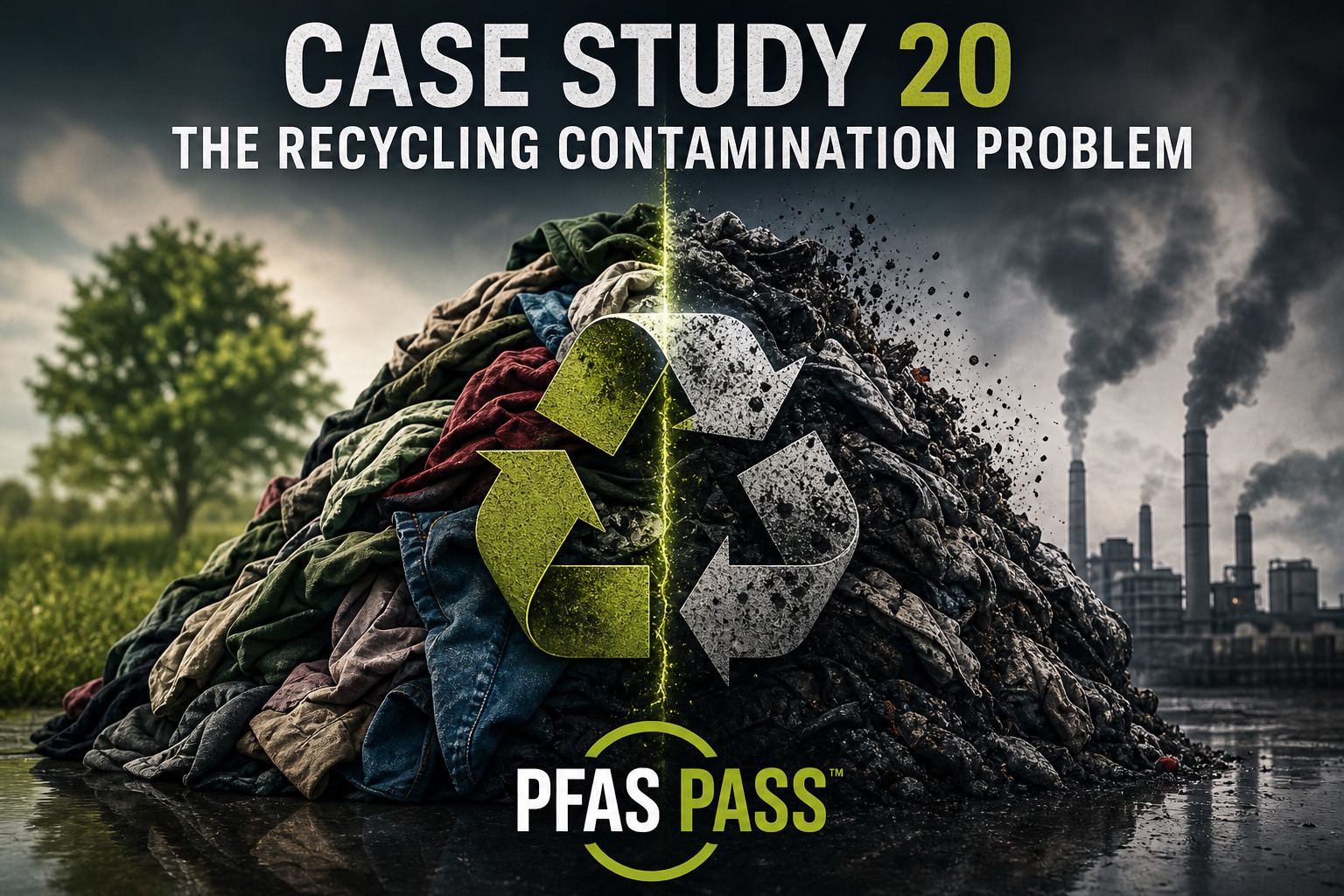
  • Case Study 20: The Recycling Contamination Problem — When Circular Fashion Becomes Liability Redistribution

    Case Study 20: The Recycling Contamination Problem — When Circular Fashion Becomes Liability Redistribution

    Core Finding

    Recycling without chemical verification is not circularity. It is redistribution of liability.

    The global fashion industry built recycling systems to manage volume, not toxicity.
    PFAS regulation is now exposing that flaw at scale.


    How We Got Here

    Modern textile recycling and “circular fashion” did not emerge as neutral environmental solutions. They were developed and promoted through systems aligned with continued material production and consumption.

    • American Chemistry Council promoted recycling and circular material flows while representing companies producing synthetic materials at industrial scale.
    • Ellen MacArthur Foundation defined and popularized the circular economy model adopted across fashion and consumer industries.
    • Sustainable Apparel Coalition operationalized sustainability metrics through tools like the Higg Index, enabling brands to measure impact without requiring chemical-level verification.

    These systems addressed:

    • Waste visibility
    • Material recovery
    • Sustainability reporting

    They did not address:

    • Persistent chemical contamination
    • Material toxicity
    • End-of-life liability

    The Assumption That Broke

    Circular fashion is built on a foundational assumption:

    Materials are safe enough to circulate.

    PFAS breaks that assumption completely.

    • It does not degrade
    • It persists through processing
    • It transfers across material streams
    • It remains present after recycling

    This creates a non-negotiable contradiction:

    If a textile is unsafe to sell, it is not made safe by shredding it.


    The EU Has Forced the Issue

    Under the European Union Ecodesign regulation:

    • Destruction of unsold textiles is restricted beginning 2026
    • Expanded enforcement will follow

    At the same time, PFAS restrictions under REACH Regulation are advancing across product categories including textiles.

    This creates a systemic collision

    Unsold inventory may now be:

    • Non-compliant for sale
    • Restricted from destruction
    • Unverified for recycling
    • Increasingly restricted from export

    Which leads to the real question:

    What happens to contaminated overproduction when none of the exit routes are viable?


    Recycling Is Not a Neutral Pathway

    Current downstream textile pathways include:

    • Mechanical recycling
    • Fiber shredding
    • Downcycling into:
      • Carpet padding
      • Insulation
      • Upholstery fill
      • Composite materials
    • Export to secondary markets

    Without chemical verification, these are not solutions.

    They are:

    contamination distribution systems

    PFAS does not disappear in these processes.
    It moves.


    The Hidden Liability Shift

    The current system distributes responsibility without resolving it:

    StageOutcome
    ProductionBrand profits
    SaleConsumer exposure
    OverstockLiquidation channels
    DonationCharitable redistribution
    RecyclingMaterial breakdown
    ExportExternalized impact
    DisposalPublic burden

    PFAS changes this dynamic.

    Because once contamination becomes traceable:

    liability does not disappear. It migrates.


    Clarifying Responsibility

    This case study does not assign brands sole responsibility for PFAS chemistry.

    It establishes a more precise position:

    Brands are responsible for the volume they produce and place into circulation.

    That includes:

    • Overproduction decisions
    • Inventory distribution strategies
    • Downstream pathways for excess goods

    Therefore:

    Brands that overproduce must be responsible for what happens next.

    Not just at the point of sale
    but at the point of disposal


    The End of Invisible Disposal

    Historically, excess inventory could be:

    • Burned
    • Dumped
    • Exported
    • Written off

    Those options are closing.

    PFAS regulation, EU anti-destruction laws and tightening waste export scrutiny are removing the industry’s ability to quietly eliminate surplus.

    There is no longer an invisible exit.


    Operational Reality: You Cannot Test Everything

    Full PFAS testing across all inventory is not operationally feasible.

    • Testing is conducted per material and component
    • A single garment may contain multiple risk points
    • Costs scale quickly across inventory

    This creates a deadlock:

    Without a system, compliance becomes either guesswork or financially unsustainable.


    The Missing Layer: Inventory Triage

    Before testing, inventory must be evaluated and sorted.

    Not all garments carry equal risk.

    Risk can be assessed using:

    • Fiber composition
    • Coatings and finishes
    • Performance claims (waterproof, stain-resistant, wrinkle-resistant)
    • Supplier transparency
    • Component-level inputs (thread, trims, appliqués, laminates)

    This allows inventory to be separated into:

    • Low-risk (likely compliant or verifiable)
    • Moderate-risk (requires documentation or selective testing)
    • High-risk (likely non-compliant or unverified)
    • Do-not-circulate (should not enter resale, donation or recycling)

    Without this step, everything downstream fails.


    Solution Pathway: 01 — PFAS PASS Audit System™

    The 01 — PFAS PASS Audit System™ was developed to address this exact gap.

    It provides a structured framework to:

    • Evaluate existing inventory using real-world garment knowledge
    • Identify PFAS risk factors without immediate testing
    • Sort inventory into actionable compliance categories
    • Document findings for internal control and defensibility
    • Reduce unnecessary testing costs by focusing on high-risk items

    This system does not replace testing.

    It makes testing targeted, strategic and financially viable.


    Why This Step Is Now Mandatory

    Under current and emerging regulatory conditions:

    • Unverified inventory cannot safely enter resale or recycling streams
    • Supplier claims without documentation are insufficient
    • Blanket testing is cost-prohibitive

    This leaves only one viable starting point:

    You must understand your inventory before you move it.


    Industry Challenge

    To the organizations that advanced the circularity model:

    • American Chemistry Council
    • Ellen MacArthur Foundation
    • Sustainable Apparel Coalition

    Where is the chemical verification layer in your circular systems?

    Because without it:

    circularity becomes a mechanism for dispersing contamination rather than eliminating it


    Conclusion

    Recycling was built to manage volume.
    It was never built to manage toxicity.

    PFAS forces the industry to confront that difference.

    The question is no longer whether circular systems work.

    The question is:

    What are you circulating — and do you have proof?

    Until chemical verification and inventory control are integrated into the textile lifecycle:

    circular fashion is not a solution.
    It is a redistribution system for risk.

    And the first step toward resolving that is not recycling.

    It is knowing exactly what you have.

  • Case Study 17 – The Tea on TEA – What the Themed Entertainment Association Doesn’t Know About PFAS — And Why It Can’t Afford Not To

    Case Study 17 – The Tea on TEA – What the Themed Entertainment Association Doesn’t Know About PFAS — And Why It Can’t Afford Not To

    CASE STUDY 17

    The Themed Entertainment Industry’s Invisible PFAS Crisis

    Published by PFAS PASS Compliance Systems | PFASPASS.com


    OVERVIEW

    The Themed Entertainment Association (TEA) — headquartered at 303 N. Glenoaks Blvd, Suite 200, Burbank, California — represents 1,500+ members worldwide engaged in the visitor attractions industry: theme parks, museums, casinos, corporate visitor centers, heritage centers, retail, hospitality, resorts and more. Its membership roster reads as a who’s-who of large-scale entertainment production: Universal Creative, Walt Disney Imagineering, Weta Workshop, and Huitt-Zollars among them. TeaconnectLinkedIn

    A search of TEA’s own website for “PFAS” returns zero results.

    This is not a minor gap. It is a systemic compliance blind spot with active legal, occupational health, and ethical dimensions — operating in plain sight, in a state that has already passed some of the strictest PFAS textile legislation in the country.


    THE REGULATORY REALITY TEA’S MEMBERS ARE ALREADY SUBJECT TO

    California is not waiting. California AB-1817 prohibits, beginning January 1, 2025, any person from manufacturing, distributing, selling, or offering for sale in the state any new textile articles that contain regulated PFAS. The statute’s definition of “textile articles” is expansive and directly applicable to the themed entertainment industry. The law explicitly names costumes, dancewear, sports uniforms, and everyday uniforms for workwear as covered categories — the exact garment types that define character costume departments, performer wardrobe, and park staff uniforms at every major theme park operation in California and beyond. CACA

    The compliance thresholds are already tightening: as of January 1, 2025, the threshold is set at or above 100 parts per million total organic fluorine within the product or product components, with that limit dropping to 50 ppm by January 1, 2027. And documentation is not optional: manufacturers are required to provide distributors or sellers in the state with certificates of compliance stating that the textile articles do not contain any regulated PFAS. Morgan LewisMorgan Lewis

    Enforcement authority is expanding in parallel. California’s AB 347 gave the Department of Toxic Substances Control (DTSC) the authority to enforce some of California’s existing PFAS laws, with DTSC enforcement beginning July 1, 2030, including minimum penalties of $10,000 for the first violation. BCLPIntertek


    THE THEMED ENTERTAINMENT PFAS EXPOSURE MAP

    Theme parks are, at their operational core, large-scale textile and costume manufacturing and deployment environments. When examined through a PFAS compliance lens, the exposure pathways are both numerous and largely undocumented:

    Character Costumes & Performer Suits — Full-body character suits worn in outdoor park environments are routinely treated for moisture, stain, and soil resistance. Workers wearing these suits for multiple hours per shift experience sustained dermal contact with potentially PFAS-treated fabrics — a documented occupational exposure pathway. California law now explicitly covers these garments, yet no industry-wide audit or guidance has been issued.

    Park Staff & Operational Uniforms — At parks the scale of Disneyland, Universal Studios Hollywood, or Knott’s Berry Farm, uniforms are procured and distributed at industrial scale. Everyday uniforms for workwear are explicitly named in AB-1817. Do these parks currently hold certificates of compliance from their uniform manufacturers? Has TEA asked that question of its member operators? CA

    Scenic Fabrication & Upholstery — Ride seat upholstery, queue furniture, and soft scenic elements are treated for durability and weather resistance. These are high-traffic guest contact surfaces with no current industry standard for PFAS content disclosure.

    Food & Beverage Packaging — Beginning January 1, 2023, the State of California prohibited the distribution and sale of food packaging containing regulated PFAS chemicals, including food and beverage containers, take-out food containers, wrappers, utensils, straws, and disposable tableware. Theme park food operations — operating at enormous volume — were subject to this law over two years ago. Has compliance been audited? Coastkeeper

    The Guest-Facing Dimension — Children interact directly with character performers wearing potentially PFAS-treated costumes. This is not a theoretical concern; it is a documented, unexamined public exposure pathway in an industry that brands itself on family safety and trust.


    THE CALIFORNIA NEXUS AND THE CROSS-STATE PROBLEM

    TEA is incorporated and headquartered in California — a state that has established a PFAS Action Plan that outlines strategies for monitoring, remediation, and public outreach, and has intensified its efforts to limit PFAS exposure, adding several PFAS chemicals to its Proposition 65 list, requiring businesses to provide warnings about significant exposures. Partner Engineering and Science

    This creates an ethical and legal question that TEA has not yet publicly addressed: if its California-based member parks are subject to AB-1817 textile compliance requirements — including certificates of compliance for costumes and uniforms — what guidance has TEA provided to those members? And critically, what guidance has it provided to member parks operating in other states, where the same supply chains and the same PFAS-treated textiles are deployed, even without the same legal mandate?

    The costumes shipped from a California fabrication house to an Orlando theme park do not shed their PFAS content at the state line. The occupational exposure experienced by a character performer in Anaheim is the same exposure experienced by a performer in Orlando, Singapore, or Paris. The regulatory trigger may currently be geographic, but the health liability is universal.

    This is the ethical gap. TEA has the convening power, the member trust, and the industry reach to lead on this. Currently, it is not.


    THE OSHA DIMENSION

    PFAS exposure in occupational settings is an emerging OSHA-level concern. Workers in costume departments, scenic fabrication shops, and wardrobe facilities handle PFAS-treated materials regularly, often without hazard disclosure. The themed entertainment industry employs thousands of such workers. Under General Duty Clause obligations, employers are required to provide workplaces free from recognized hazards — and PFAS in occupational textile settings is now a recognized hazard class. The absence of any TEA guidance on this is not a neutral position. It is a documented gap in duty of care to member organizations and their employees.


    THE THREE PILLARS OF PFAS PASS COMPLIANCE SYSTEMS

    PFAS PASS Compliance Systems, developed and authored by Gina Wilson and available in full at PFASPASS.com, offers the themed entertainment industry a structured, actionable compliance pathway built on three foundational pillars:

    PILLAR ONE: PFAS PASS LIBRARY Eleven standalone, version-controlled compliance documents (Docs 1–11), freely accessible, covering PFAS identification, supply chain documentation, certificate of compliance frameworks, occupational exposure mapping, and litigation reference standards. Doc 11 serves as the Litigation Reference document — directly applicable to industries now facing regulatory and legal exposure. The Library translates complex regulatory language into operational guidance usable by costume departments, procurement teams, and facilities managers without requiring legal expertise.

    PILLAR TWO: PFAS PASS COMPLIANCE SYSTEMS A Proof-of-Concept production standard — now emerging as the industry model for PFAS-compliant textile and costume manufacturing. This systems architecture addresses the full supply chain lifecycle: from raw material sourcing through fabrication, procurement documentation, certificate of compliance verification, worker safety protocols, and ongoing audit readiness. It is designed to be implementable by large-scale operators, production houses, and industry associations as an adoptable standard — not a one-time audit but a living compliance infrastructure.

    PILLAR THREE: PFAS PASS VERIFIED The verification and credentialing layer. PFAS PASS VERIFIED provides the evidentiary documentation framework that member organizations need to demonstrate compliance to regulators, insurers, and the public. In an era where DTSC enforcement is expanding and Proposition 65 exposure warnings attach to PFAS-containing products, PFAS PASS VERIFIED gives organizations a defensible, documented compliance record — and gives associations like TEA a standard they can recommend, endorse, and build programming around.


    CONCLUSION

    The Themed Entertainment Association arrives in Orlando for Theme Park Central with zero published guidance on PFAS — in costumes, uniforms, fabrication materials, food packaging, or worker safety. This is not a criticism. It is an opportunity.

    The regulatory clock in California is already running. The ethical obligation to member workers and guests does not wait for enforcement timelines. And the industry’s reputation for safety, imagination, and trust demands that it lead on this issue rather than react to it.

    PFAS PASS Compliance Systems is ready to help TEA lead.

    If you have any suggestions on what we should cover next, comment below.

  • Case Study 16: The Industry Platform Blind Spot — MAGIC (SOURCING by Informa) and the Complete Absence of PFAS Compliance in Fashion’s Most Influential Trade Ecosystem

    Case Study 16: The Industry Platform Blind Spot — MAGIC (SOURCING by Informa) and the Complete Absence of PFAS Compliance in Fashion’s Most Influential Trade Ecosystem

    PFAS PASS Investigation Series


    The Organization

    MAGIC — formally operating as SOURCING by Informa under the Fashion by Informa / MMGNET Group umbrella — is the most recognized and attended fashion trade show ecosystem in the United States.

    Produced by Informa PLC, one of the world’s largest events and publishing companies, MAGIC and its co-located shows draw tens of thousands of industry professionals to the Las Vegas Convention Center biannually, and operate additional marquee events at the Jacob K. Javits Convention Center in New York City.

    The scale is not incidental to this case study. It is central to it.

    MAGIC connects:

    • Global manufacturers and fabric suppliers
    • Trim, component, and notions vendors
    • Apparel brands and private label buyers
    • Sourcing executives and production managers
    • Fashion technology and compliance solution providers
    • Designers, retailers, and merchandising teams

    By their own figures: 36,000+ attendees. 3,500+ exhibitors. 26+ countries represented.

    This is not a niche platform. This is the infrastructure of the U.S. fashion supply chain — assembled twice a year in one place.


    The Regulatory Position of This Organization

    This is where the facts become impossible to ignore.

    MAGIC’s organizer is headquartered in Santa Monica, California. California is a regulated state. As of January 1, 2025, California prohibits the manufacture, distribution, or sale of any textile article containing intentionally added PFAS or total organic fluorine exceeding 100 ppm. By January 1, 2027, that threshold drops to 50 ppm. Manufacturers are required by law to provide certificates of compliance to sellers and distributors.

    MAGIC stages events at the Jacob K. Javits Convention Center in New York City. New York is a regulated state. As of January 1, 2025, New York prohibits the sale of any apparel containing PFAS as intentionally added chemicals. By January 1, 2028, the ban extends to outdoor apparel for severe wet conditions. Compliance certification requirements apply to anyone selling or offering apparel for sale in the state.

    To be precise:

    • The organization that runs MAGIC is based in a regulated state
    • The trade show floor where MAGIC physically operates in New York is located in a regulated state
    • The brands, buyers, and sourcing teams attending MAGIC are selling into regulated states
    • The suppliers exhibiting at MAGIC are supplying into regulated states

    Every party in this ecosystem is inside the regulatory perimeter.

    None of them are being informed of it by the platform that convenes them.


    The Investigation

    A full audit of the publicly accessible content on sourcingatmagic.com was conducted — including the Resources section, the Editorial library, and all published Fashion Technology Foundations reports — to determine whether PFAS compliance is addressed anywhere within their content infrastructure.

    The result is unambiguous:

    The word “PFAS” does not appear anywhere in the publicly accessible content on sourcingatmagic.com.

    Not once.

    Not in the Regulations, Compliance & Disclosure report. Not in the Sustainability report. Not in the 2025 Fashion Sustainability Report. Not in the editorial archive covering sourcing strategy, supply chain resilience, sustainability policy, or business planning. Not in trend forecasting. Not in country and region guides. Not anywhere.


    What Was Found

    SOURCING by Informa has invested significantly in compliance-adjacent content. Their Fashion Technology Foundations: Regulations, Compliance & Disclosure guide explicitly addresses:

    • EU Digital Product Passport requirements
    • U.S. traceability regulations
    • Supply chain disclosure frameworks
    • Cross-border compliance preparation

    Their Fashion Technology Foundations: Sustainability report addresses:

    • Environmental impact of the textile industry
    • Legislative regulation of supply chains
    • Greenwashing and unsubstantiated sustainability claims
    • Design-to-impact and circularity frameworks

    Their 2025 Fashion Sustainability Report addresses shifting policy agendas, innovation momentum, and consumer demand.

    All of this is exactly the context in which PFAS compliance belongs.

    None of it mentions PFAS.

    The organization is publishing compliance content. It is publishing sustainability content. It is publishing regulatory content. And it is doing so with a blind spot so complete that the most actively enforced chemical regulation in U.S. textile history does not appear in a single sentence.


    The Gap in Numbers

    This is not abstract. The regulatory calendar is set.

    • January 1, 2025 — California and New York PFAS apparel restrictions in force
    • January 1, 2027 — California threshold tightens from 100 ppm to 50 ppm total organic fluorine
    • January 1, 2028 — New York ban extends to outdoor apparel for severe wet conditions
    • Ongoing — EU REACH restriction proposal covering all PFAS under active consideration

    Violations of California’s regulations carry civil penalties of up to $10,000 per violation per day.

    The exhibitors on the MAGIC trade floor are not being told this. The buyers writing orders at MAGIC are not being told this. The sourcing teams building supply chains through MAGIC are not being told this.


    The Pattern

    This follows the identical structure documented across every prior PFAS PASS case study:

    1. An industry-leading organization operates in direct proximity to the compliance gap
    2. Regulatory and sustainability content is produced — but stops short of chemical transparency
    3. PFAS is not named, mapped, or addressed as a compliance category
    4. The audience continues operating without the framework they are legally required to have
    5. Liability remains with the designer, brand, buyer, or production team downstream

    What makes this case study different from prior investigations is the scale.

    A single supplier failing to provide PFAS documentation affects the brands sourcing from them. A single trade show failing to address PFAS affects an entire industry — tens of thousands of professionals, across thousands of supply chain relationships, across dozens of countries — all operating under the assumption that if it mattered, someone would have said something.

    Someone should have said something.

    No one has.


    Why This Matters Beyond MAGIC

    MAGIC is not uniquely negligent. That is precisely the point.

    The fashion industry’s most influential platforms — its trade shows, content networks, education systems, and sourcing infrastructure — have collectively failed to integrate PFAS as a compliance category. When the industry’s premier sourcing platform does not address a regulatory requirement, it signals to tens of thousands of professionals that the topic is either not yet relevant or not yet actionable.

    Both conclusions are wrong.

    The regulations are active. The enforcement mechanisms are in place. The penalties are real. And the supply chain that runs through MAGIC’s trade floor has no current mechanism — offered by the platform, by exhibitors, or by buyers — to verify PFAS compliance at the material, component, or finished product level.

    This is not a gap at the edges of the industry. It is a gap at the center of it.


    From Investigation to Infrastructure

    PFAS PASS was not built to document the problem alone. It was built to solve it.


    Pillar 1 — PFAS Compliance Playbook Series

    The Playbook Series translates regulatory pressure into practical execution:

    • Fabric, footwear, and component-level breakdowns
    • Construction system risk identification
    • Real-world sourcing and decision frameworks
    • Step-by-step compliance evaluation guidance

    For every sourcing professional leaving a MAGIC trade floor with a new supplier relationship and zero PFAS documentation: this is where to start.

    This is where the industry moves from confusion → to clarity.


    Pillar 2 — PFAS PASS Compliance Systems™

    Our Compliance Systems establish a structured approach to:

    • Full-system garment review
    • Component-level risk mapping
    • Construction pathway analysis
    • Pre-production compliance decision making

    For the brands, manufacturers, and sourcing teams building or rebuilding supply chains through MAGIC’s exhibitor network: this shifts the industry from assumption-based sourcing to system-based compliance strategy.


    Pillar 3 — PFAS PASS Verification System™

    The missing layer in the current market is verification.

    PFAS PASS provides:

    • Controlled document submission pathways
    • Review of supplier-provided lab documentation
    • Structured verification criteria
    • Buyer-facing transparency through the PFAS PASS VERIFIED framework

    For every buyer writing orders at MAGIC into California and New York markets: this creates a traceable, defensible compliance position where none currently exists.


    Closing Position

    MAGIC convenes the fashion supply chain at scale — twice a year, in Las Vegas and New York, in two of the most aggressively regulated states in the country.

    Its organizer is headquartered in California. Its New York events are staged inside New York. Its attendees are selling into both.

    The regulations are not coming. They are here.

    And the platform that has the greatest reach, the greatest influence, and the greatest responsibility to inform this industry has not said the word “PFAS” once.

    That is not a content gap. That is a system-wide failure — documented, dated, and on the record.

    PFAS PASS exists to bridge that gap. Not through claims. But through systems, documentation, and verification pathways.


    PFAS PASS Investigation Series | Case Study 16 pfaspass.com

    If you have a suggestion on what we should cover next, comment below.

  • Cases 01–06: The Global PFAS Compliance System Is Not Functioning

    Cases 01–06: The Global PFAS Compliance System Is Not Functioning

    PFAS PASS Investigation Series

    Over the past several weeks, I conducted a direct investigation into PFAS compliance across textile suppliers, manufacturers and apparel brands selling into regulated markets including New York and California.

    I did not ask for opinions.
    I asked for documentation.

    Across six case studies, the result was consistent:

    No verifiable, actionable proof of compliance.

    This is not an isolated issue.
    This is a system-wide failure.


    The Case Files

    Case 01 — KiKi Textiles Operating in CA
    https://pfaspass.com/pfas-pass-investigation-series-case-study-001/

    Case 02 — NY Supplier Provides No Documentation, Advises BUYER to Test Independently
    https://pfaspass.com/pfas-pass-case-study-02-no-pfas-documentation-provided-by-ny-supplier-buyer-advised-to-test-independently/

    Case 03 — Knix Removed PFAS-Free Claims, Continues Sales into NY and CA Without Verified Products
    https://pfaspass.com/case-study-03-knix-was-required-to-remove-pfas-free-claims-then-confirmed-sales-into-ny-and-ca-without-pfas-verified-products/

    Case 04 — Spoonflower Provides Process Claims Without Fabric-Level Verification in a Global Supply Chain
    https://pfaspass.com/case-study-04-spoonflower-process-claims-without-material-verification-in-a-global-fabric-supply-chain/

    Case 05 — Legacy Costume Systems Deployed in Regulated Markets Without Material Re-Verification
    https://pfaspass.com/case-study-05-repeat-deployment-of-legacy-costume-systems-without-material-re-verification-in-a-regulated-market/

    Case 06 — Carr Textile PFAS-Free Claim vs Documentation Reality
    https://pfaspass.com/case-study-06-carr-textile-pfas-free-claim-vs-documentation-reality/


    What These Cases Reveal

    Across all six investigations, the same patterns emerged:

    1 — Claims Without Proof
    “PFAS-Free” language exists without supporting documentation that meets regulatory expectations.

    2 — Broken Supply Chain Visibility
    Materials are globally sourced with no traceable verification tied to finished goods entering regulated markets.

    3 — Responsibility Deflection
    Suppliers are instructing buyers to conduct their own testing rather than providing upstream certification.

    4 — Legacy System Deployment
    Pre-regulation garments and systems actively being used in regulated environments without re-evaluation.

    5 — Active Sales Without Verified Compliance
    Products are being sold into New York and California without confirmed compliance status.

    6 — Industry Awareness Gap
    Multiple suppliers demonstrated little to no understanding of PFAS compliance requirements.

    7 — Engagement Is Rare
    Out of all cases, only one supplier showed active interest in investigating compliance.


    Case Extension — Manufacturing-Level Awareness Gap

    During this investigation, I shared PFAS compliance documentation with a long-time resource and footwear manufacturer in China producing for global distribution, including Amazon.

    His response:

    “Is this real?”

    This was not resistance.
    It was unfamiliarity.


    Case Extension — Market Withdrawal Consideration

    Following that exchange, the same manufacturer indicated he will explore pulling his products out of New York and California markets.

    What This Signals

    • Manufacturers may choose market exit over compliance
    • Global sellers on platforms like Amazon are exposed but unprepared
    • Smaller producers are not equipped to meet compliance requirements quickly

    This is the first visible shift from confusion to reaction.


    Industry Education Gap — IAAPA

    A review of the IAAPA Expo Asia agenda shows:

    No PFAS-related educational content.

    This is a global organization representing:

    • Theme parks
    • Entertainment operators
    • Vendors supplying costumes and uniforms

    Many of these entities operate in regulated markets.

    What This Indicates

    • PFAS compliance is not part of formal industry education
    • Operators may be deploying regulated systems without awareness
    • There is no coordinated effort to prepare the industry

    The Core Problem

    This is not a case of bad actors.

    This is a structural failure across an entire production chain:

    • No standardized verification framework
    • No documentation pipeline from mill to product
    • No enforcement-linked traceability
    • No retrofit system for legacy inventory

    The result:

    Compliance is legally required, but operationally unsupported.


    Why This Matters

    If you are:

    • A costume designer
    • A uniform manufacturer
    • A theme park or entertainment operator
    • A brand selling into regulated states
    • A sourcing or procurement professional

    You are operating in a system where:

    You cannot reliably verify compliance — even if you are trying.


    The Shift — From Exposure to Infrastructure

    The gap is now documented.

    The next step is not more awareness.
    The next step is systems.

    PFAS PASS has developed structured compliance pathways designed specifically for:

    • Fabric suppliers
    • Manufacturers
    • Costume and uniform systems
    • Performance and occupational wear

    These systems are built to:

    • Establish documentation requirements
    • Create traceable verification workflows
    • Align supply chain communication
    • Enable real compliance, not assumed compliance

    Call to Action — PFAS PASS Compliance Systems

    If you are currently:

    • Selling into New York or California
    • Supplying materials used in regulated markets
    • Operating a costume, uniform, or performance system
    • Attempting to understand your compliance exposure

    You need a system.

    Review the PFAS PASS Compliance Systems here:
    https://pfaspass.com/pfas-pass-compliance-systems/

    This is where compliance moves from:

    uncertainty → structure


    Call for Industry Input

    If you have:

    • Requested PFAS documentation and received none
    • Been told to “test it yourself”
    • Identified products being sold without verification
    • Insight into sourcing or labeling practices

    Submit your experience.

    Recommend the next company for investigation.


    Closing

    PFAS Compliance Is Required
    The System Cannot Prove It

    That is no longer an opinion.
    It is now documented across multiple layers of the industry.

    The question is no longer whether there is a gap.

    The question is:

    Who is going to build the system to close it?

    PFAS PASS\xe2\x84\xa2 is an Emmy Award–winning garment industry professional and Production Systems Architect, and the publisher of PFAS PASS Compliance Systems. The work operates at the intersection of fashion, industrial systems, and materials compliance. 

    With over a decade designing and engineering garments for entertainment, theme parks, and large-scale productions, bringing direct field experience in how textiles perform, degrade, and circulate in real-world environments. 

    Earlier in her career, the founder owned a green demolition and deconstruction company that consulted on the dismantling of garment mills and factory systems, providing rare visibility into the full lifecycle of textile materials from production through end-of-use. 

    Combined with a background in software development and operational systems integration, PFAS PASS focuses on identifying compliance gaps in clothing, uniforms, and performance systems, and building structured frameworks that translate evolving PFAS regulations into trackable, enforceable industry practices.


    If you have supplier responses, share them, comment below.
    If you want a supplier investigated, name them, comment below.

    This series will continue.