| PFAS PASS Compliance Systems | PFASPass.com
Part Six of the Feeding the Machine Series | First published May 11, 2026
PFAS Drift In or Out™ is an original concept of PFAS PASS™. First published May 11, 2026. All rights reserved. This article constitutes independent research and does not constitute legal advice.
The Machine Had an Architect
The previous five articles in this series documented what PFAS litigation has established, what it has missed, what the science shows, why the waste stream is hazardous, and who owes what to whom. Each piece identified a gap. Each gap pointed to a defendant structure. And at the foundation of every gap, every contamination source, every suppressed disclosure, every overproduction decision, every recycling claim made on hazardous material — the same industry appears.
Not as a peripheral participant. As the architect.
The petroleum industry did not merely supply the PFAS chemistry that contaminated the water supply. It built the system that deployed that chemistry at global scale, funded the overproduction model that maximized the contamination volume, and — as this article documents — funded the media infrastructure that suppressed the story that might have slowed it down.
The chemical manufacturers are in court. 3M has paid $12.5 billion. DuPont is in trial. The chemical liability argument is established and proceeding. What is not yet in any filing is the broader petroleum industry liability argument — the case that the petroleum industry’s role extends beyond manufacturing the contaminating substance to architecting and funding the entire system that made the contamination global, ubiquitous, and effectively invisible until the regulations came.
This article makes that case. It builds on the original Feeding the Machine article published on this site in May 2026 — which established the petroleum connection in narrative terms — and translates it into the legal argument it supports.
Part One — The Petroleum Industry’s Three Roles
The petroleum industry’s liability in the PFAS textile contamination story operates on three distinct levels. Each level is independently documentable. Together they constitute a compounded liability argument that goes significantly beyond the chemical manufacturer framework currently in litigation.
Role One: The Chemistry Producer
This is the role currently in litigation. 3M manufactured Scotchgard. DuPont manufactured Teflon fabric treatments. Daikin, Arkema, and BASF supplied fluorochemicals to textile treatment manufacturers globally. These are the Tier 1 chemical manufacturers — the companies that made the PFAS chemistry knowing it was toxic, persistent, and would enter the environment and the human body.
The internal documents establishing knowledge since the 1970s are in evidence. The suppression of unfavorable research is documented. The deliberate distortion of public discourse mirrors the tobacco playbook. This role is established in existing litigation and will not be argued at length here — it is the foundation on which the two additional roles are built.
Role Two: The Fiber Supplier
This role is not in any current filing.
The global fashion industry is approximately 60 percent synthetic fiber by volume. Polyester, nylon, acrylic, spandex — the base materials of the modern fashion supply chain — are petroleum derivatives. They do not come from fields. They come from refineries. The same refineries that are currently in geopolitical crisis as Middle Eastern tensions affect the Strait of Hormuz are the refineries that supply the raw material for the majority of clothing manufactured and sold globally.
The petroleum industry did not accidentally supply synthetic fiber to the fashion industry. It cultivated that market deliberately. Synthetic fiber is a petroleum downstream product — a value-added derivative of the refining process that generates revenue from a feedstock that would otherwise have lower-value applications. The fashion industry’s shift toward synthetic fiber over the past four decades was not driven by consumer demand for petroleum derivatives. It was driven by price. Synthetic fiber is cheaper than natural fiber because petroleum feedstock is cheap and scalable in ways that agricultural production is not.
The petroleum industry’s pricing and supply infrastructure made the synthetic fiber takeover of fashion economically inevitable. And the synthetic fiber it supplied is the base material that carries PFAS chemistry into consumer wardrobes, through washing machines, and into the water supply. The contamination does not begin with the PFAS treatment. It begins with the fiber. And the fiber is petroleum.
Role Three: The System Funder
This is the role that has no precedent in current PFAS litigation and represents the most novel — and most significant — component of the compounded liability argument.
The petroleum industry did not just supply the chemistry and the fiber. It funded the information ecosystem that kept the contamination story from reaching the people who needed it.
This is not speculation. It is documented, public and sourced.
Women’s Wear Daily — the self-described bible of the fashion industry, and the publication most positioned to tell the sourcing community what the new PFAS regulations required of suppliers — is owned by Penske Media Corporation. Penske Media also owns Sourcing Journal, which is specifically dedicated to fashion supply chain sourcing decisions. These are the two publications that should have told brands, designers, suppliers, and buyers what the January 2025 New York and California PFAS apparel bans required.
They did not.
Penske Media Corporation’s largest outside investment — more than $200 million — came from the sovereign wealth fund of an oil-producing nation.
The publication most positioned to cover the PFAS compliance question in the fashion supply chain is owned by the same company that received a nine-figure investment from the fund of a petroleum state. The editorial silence on supplier-level PFAS compliance guidance — which the case studies published by PFAS PASS document across the entire institutional landscape of the fashion industry — is not simply negligence. When mapped against the financial relationships between petroleum capital and fashion media, it is a pattern with a structure.
The tobacco litigation framework established that knowledge suppression — deliberately maintaining an information asymmetry between producer knowledge and public knowledge — is a component of liability, not just a moral failing. The internal documents showing 3M and DuPont knew PFAS was toxic since the 1970s are in evidence precisely because that knowledge suppression is part of what makes the liability claim viable.
The fashion media suppression argument applies the same framework to a different mechanism: not the suppression of scientific research by the chemical manufacturer, but the suppression of regulatory compliance information by a media ecosystem with financial ties to the petroleum industry that benefits from continued PFAS chemistry use in synthetic textile production.
Part Two — The Overproduction Model as Petroleum Market Strategy
Fast fashion’s overproduction model — producing volumes that deliberately exceed sellable demand, cycling through trend seasons at a pace designed to make last month’s purchase feel obsolete — is not separable from petroleum market strategy.
Every unit of overproduced synthetic fiber garment is a unit of petroleum feedstock converted to retail product and then to waste. The overproduction model maximizes that conversion. More garments produced means more petroleum derivatives sold. More garments in consumer wardrobes means more wash cycles. More wash cycles means more PFAS entering water systems. More garments discarded means more PFAS-contaminated textile waste entering landfills, incinerators, and recycling streams.
The overproduction model is not incidentally beneficial to petroleum interests. It is structurally aligned with them. A fashion industry that produced durably, in natural fiber, at volumes matched to demand would consume dramatically less petroleum feedstock. The fast fashion model as it exists — high volume, short cycle, synthetic fiber dominant — is the petroleum industry’s ideal customer.
The liability argument is not that petroleum companies directed fashion brands to overproduce. The liability argument is that the petroleum industry’s pricing, supply infrastructure, and financial investment in the fashion media ecosystem collectively created the conditions under which overproduction of petroleum-derived PFAS-contaminated synthetic fiber was the economically rational choice for fashion brands — and that the contamination consequences of that overproduction are therefore attributable to the system architects, not just the individual brand decisions made within that system.
This is the conspiracy theory in the legally meaningful sense — not a speculation about secret coordination, but a documented pattern of financial relationships, market incentives, and information suppression that produced a predictable and predicted outcome. The tobacco litigation established that pattern evidence is admissible and probative in establishing manufacturer liability for suppressed-knowledge contamination claims. The petroleum PFAS textile argument is the same framework applied to a more complex but equally documentable pattern.
Part Three — PFAS Drift In or Out™ Applied to the Petroleum Industry
The petroleum industry’s liability is not geographically bounded. The synthetic fiber it supplies, the PFAS chemistry its subsidiaries and partners manufactured, and the media infrastructure it funded operate globally. PFAS Drift In or Out™ applies to the petroleum industry’s liability in the same way it applies to the fashion brands and chemical manufacturers — and with even greater force.
PFAS Drift In™ at the chemistry level: PFAS chemistry manufactured by petroleum industry subsidiaries and partners — 3M, DuPont/Chemours, Daikin, Arkema — entered US commerce through regulated state ports and distribution infrastructure. The compliance obligations attached at that entry point. The chemical manufacturer cannot disclaim textile pathway liability on the grounds that the chemistry was sold to a mill in an unregulated state. The chemistry Drifted In through regulated commerce.
PFAS Drift In™ at the fiber level: Synthetic fiber supplied by petroleum refineries to textile mills globally enters the US fashion supply chain through the same regulated state ports and distribution infrastructure. The petroleum industry’s fiber product is part of the same supply chain as the PFAS chemistry product. Both entered regulated commerce. Both carry the compliance and contamination consequences of that entry.
PFAS Drift In™ at the media level: The information suppression argument has a jurisdictional dimension. The publications that suppressed the PFAS compliance story — WWD, Sourcing Journal — are headquartered in New York and California. They operated within regulated markets. The fashion brands and designers they failed to inform operated in or sold into regulated markets. The information gap they created — and that the petroleum investment relationship helps explain — operated within the jurisdictional reach of the regulated markets whose compliance story went untold.
The geographic containment defense fails for the petroleum industry on every level for the same reason it fails for fashion brands and chemical manufacturers: the commerce events, the supply relationships, and the information infrastructure through which petroleum industry liability flows all move through regulated state infrastructure. PFAS Drift In or Out™ anchors jurisdiction to those commerce events. The contamination consequences follow.
Part Four — What the Compounded Liability Looks Like
The petroleum industry’s compounded liability in the PFAS textile contamination story encompasses:
Chemistry liability — shared with the named chemical manufacturers in existing litigation, for the manufacture and supply of PFAS chemistry knowing it was toxic and persistent. Already established in principle. The textile laundry pathway extends the application.
Fiber liability — as the supplier of the petroleum-derived synthetic fiber base material that carries PFAS chemistry into consumer wardrobes and through washing machines into the water supply. The fiber is the vehicle. The petroleum industry supplied the vehicle.
System architecture liability — as the funder and architect of the overproduction model through synthetic fiber price and supply infrastructure, and as the investor in the media ecosystem that suppressed the compliance story. This is the novel theory. It draws on tobacco litigation precedent for pattern evidence and knowledge suppression liability. It has not been assembled in any current PFAS filing.
PFAS Drift In or Out™ liability extension — applying the jurisdictional framework to the petroleum industry’s supply chain, media investment, and product flow through regulated state commerce infrastructure to defeat geographic containment defenses at every level.
The full cost cascade documented in Part Five of this series — consumer refunds, product replacement, return transportation, collection infrastructure, licensed disposal, municipal water system retrofits, landfill remediation, recycling stream decontamination — applies to the petroleum industry proportionately to its role in creating the system that made each of those costs necessary.
Part Five — The Argument in Full
The petroleum industry manufactured the PFAS chemistry that contaminated the water supply. It supplied the synthetic fiber that carried that chemistry into every home. It funded the overproduction model that maximized the contamination volume. It invested in the media infrastructure that suppressed the story that might have created accountability. And it collected the revenue from every unit of petroleum-derived synthetic fiber sold, every unit of PFAS chemistry applied, and every fashion media property that kept the supply chain story out of print.
That is not a peripheral participation in the PFAS textile contamination crisis. That is the architecture of it.
The chemical manufacturers are paying. $18 billion in settlements and counting. The fashion brands are beginning to face consumer fraud liability. The institutional silence is documented across the growing body of PFAS PASS case studies. The science is established. The jurisdictional framework — PFAS Drift In or Out™ — is published and available.
What remains is assembling the petroleum industry’s compounded liability argument into a filing — connecting the fiber supply to the chemistry supply to the media investment to the overproduction incentive to the contamination consequence to the remedy.
That argument is ready. The research is published. The framework is built. The question — as it has been throughout this series — is which plaintiff firm files it first.
The Series in Full
This concludes the Feeding the Machine Series. The petroleum industry built the machine. The fashion industry ran it. The chemical manufacturers supplied the chemistry. The media infrastructure kept it quiet. PFAS Drift In or Out™ closes the jurisdictional escape routes. And the communities drinking contaminated water — at least 176 million Americans and counting — are owed the remedy.
PFAS Drift In or Out™ is an original concept of PFAS PASS™. First published May 11, 2026. All rights reserved. This article constitutes independent research and does not constitute legal advice. Plaintiff counsel seeking case gap analysis or retained expert engagement should visit https://pfaspass.com/media-press/
The Feeding the Machine Series
Part One — Feeding the Machine: What the Petroleum Crisis Revealed About Everything You Were Sold
Part Two — What PFAS Litigation Has Won, What It Has Missed, and What the Laundry Pathway Changes
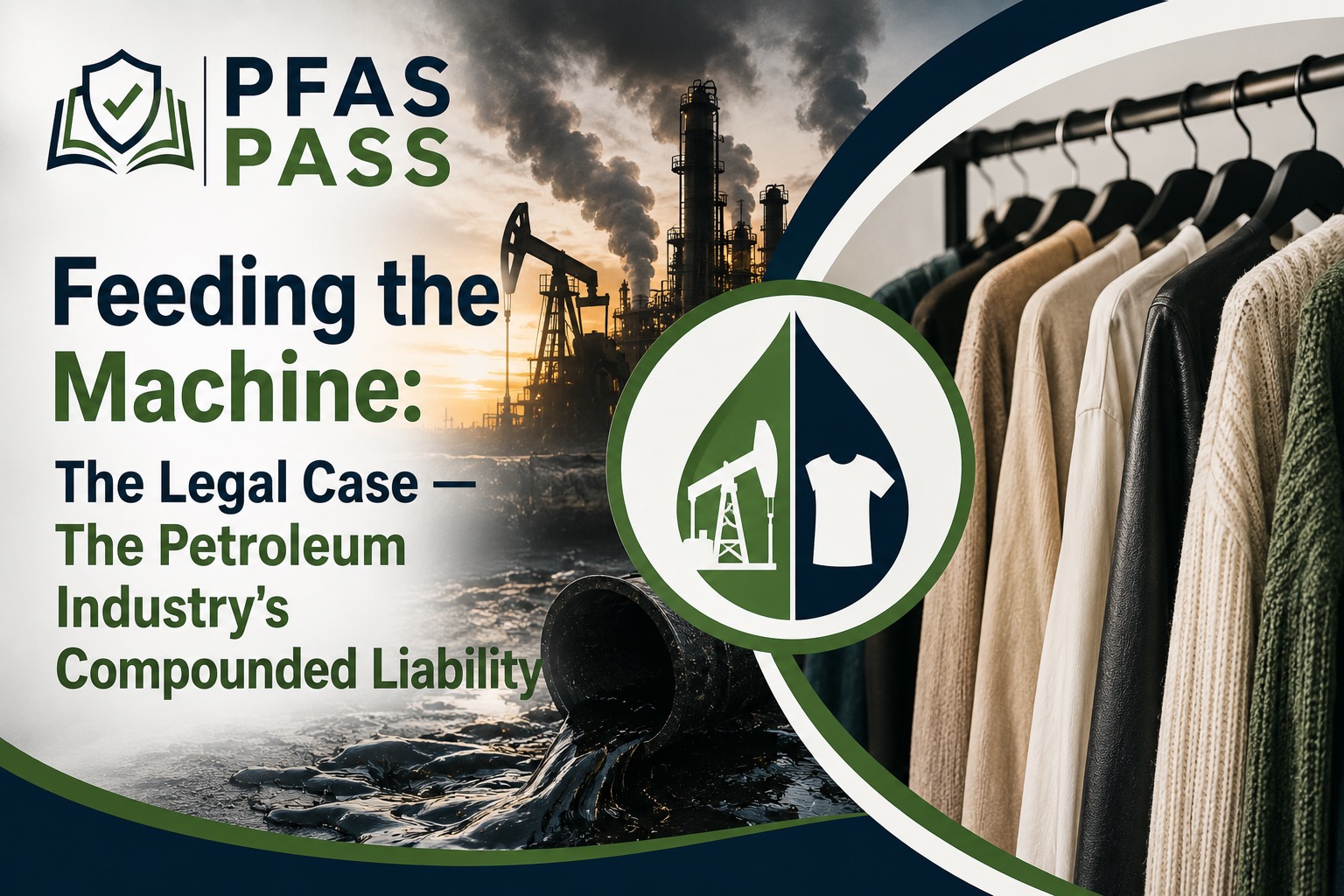
Part Six — Feeding the Machine: The Legal Case — The Petroleum Industry’s Compounded Liability
Read the full argument. Own the book.
The complete Feeding the Machine argument — all parts, the eight gaps, and the personal story behind it — is available in one volume. PDF, signed edition, and Amazon Kindle, paperback, and hardcover formats are linked on the series hub.
For plaintiff counsel and litigation teams.
PFAS PASS™ develops independent litigation research, case gap analysis, and compliance-documentation strategy. Counsel pursuing PFAS contamination, greenwashing, or post-sale compliance matters can request case gap analysis and retained-expert engagement through the litigation strategy and media kit.