| PFAS PASS Compliance Systems | PFASPass.com
Part Three of the Feeding the Machine Series | First published May 11, 2026
PFAS Drift In or Out™ is an original concept of PFAS PASS™. First published May 11, 2026. All rights reserved. This article constitutes independent research and does not constitute legal advice.
The Number Nobody Is Explaining
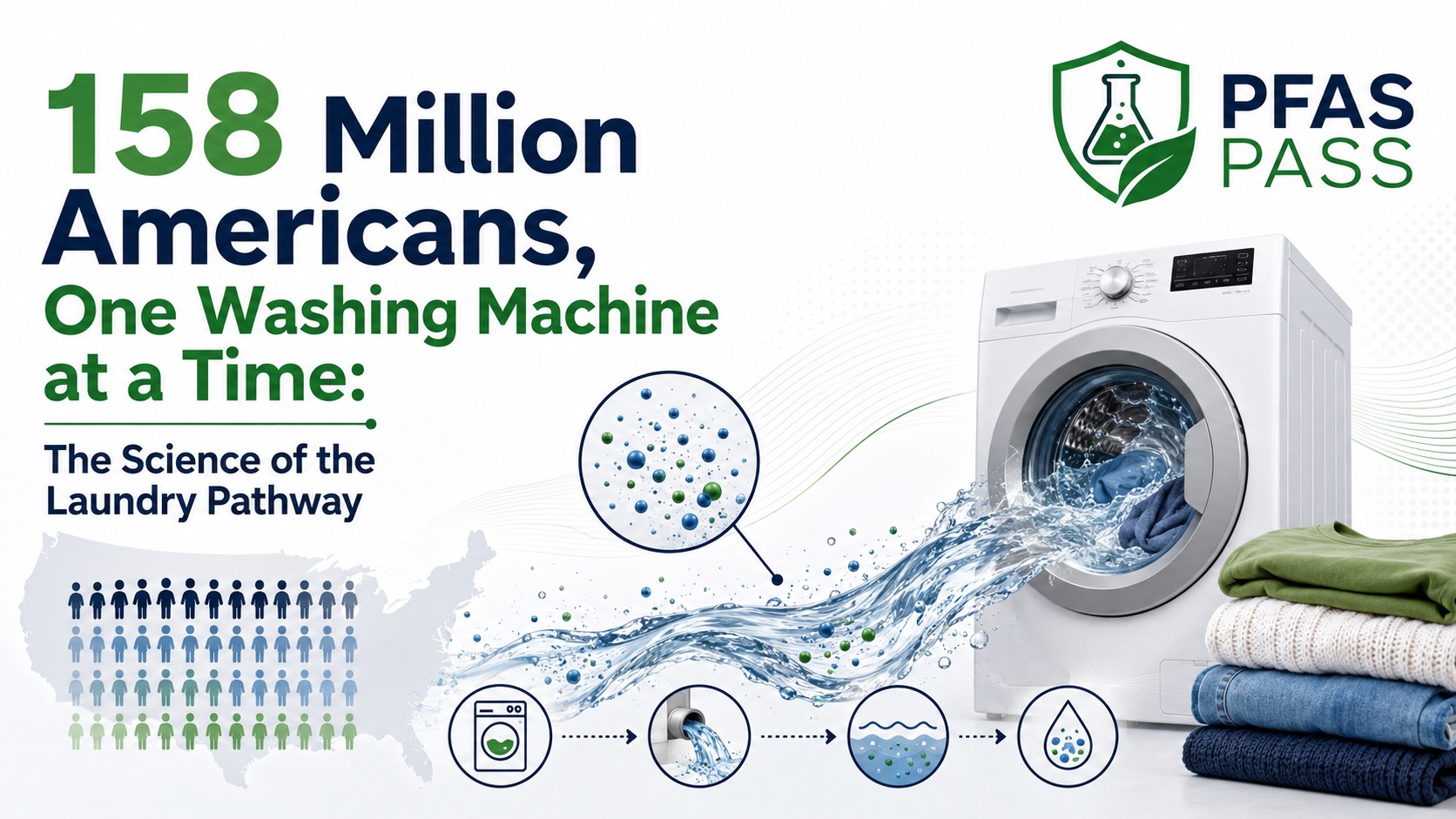
158 million Americans drink tap water contaminated with PFAS. That is the 2025 EPA figure. Nearly half the nation. It is not a rounding error. It is not a regional anomaly. It is a national contamination event of a scale that military bases and industrial facilities alone cannot account for.
The AFFF litigation has established contamination near military installations. The industrial discharge cases have established contamination near manufacturing facilities. Those are point sources. They have radii. The communities inside those radii are identifiable, and the contamination pathway from source to water supply is traceable.
But 158 million Americans do not all live near a military base or a manufacturing plant. The contamination that reaches them is diffuse. It does not have a single point of origin. It has millions of points of origin — one in nearly every home in America.
It is the washing machine.
This article presents the peer-reviewed science establishing the domestic laundry pathway as a significant and documented source of PFAS contamination in municipal water systems — and explains why PFAS Drift In or Out™ provides the jurisdictional mechanism to bring this source into litigation without requiring the geographic traceability that has historically been the plaintiff’s most significant obstacle in diffuse contamination cases.
Part One — The Chemistry: Why Synthetic Textiles Carry PFAS Into Your Wash Cycle
To understand the laundry pathway, you need to understand what PFAS chemistry does inside a fabric and what happens to it when that fabric is washed.
PFAS-based durable water repellent treatments — DWR coatings — are applied to synthetic textiles at the fiber or fabric level. They are not a surface coating in the way paint is a surface coating. They are chemically bonded to the fiber structure, creating a fluorinated layer that causes water and oil to bead off rather than penetrate. That bonding is what makes them durable. It is also what makes them a persistent contamination source.
Synthetic fibers — polyester, nylon, acrylic, spandex — are petroleum derivatives. Their molecular structure is fundamentally different from natural fibers. Natural fibers are hydrophilic — they absorb water and release what they absorb relatively cleanly. Synthetic fibers are hydrophobic — they resist water, but their surface chemistry interacts with PFAS compounds in ways that natural fibers do not.
2025 peer-reviewed research establishes that synthetic fibers show PFAS adsorption 5 to 24 times higher than natural fibers. That adsorption works in both directions. Synthetic fibers pick up PFAS from their treatment chemistry during manufacturing and finishing. They also pick up PFAS from other sources during use — from PFAS-contaminated water they are washed in, from contact with other PFAS-treated materials. And when they are washed, they release what they have absorbed into the wash water.
The wash water goes down the drain. The drain connects to the municipal wastewater system. And the municipal wastewater treatment system is not designed to remove PFAS.
Part Two — The Science: What the Research Actually Shows
Laundry as a PFAS vector is not a hypothesis or an emerging concern. It is a documented, peer-reviewed finding. The 2025 research confirms what earlier studies had begun to establish: laundry fibers are significant vectors for PFAS transport into water systems.
The specific findings matter for litigation purposes because they establish the plausible pathway that courts have required plaintiffs to prove:
Fiber type determines PFAS load. Synthetic fibers — the base material of the fashion industry’s 60 percent synthetic fiber volume — carry dramatically higher PFAS concentrations than natural fibers. This means the fashion industry’s shift toward synthetic fiber over the past four decades did not just change what clothing feels like. It changed what laundry water contains.
Weathering increases release. Fibers that have been worn, washed, and worn again — weathered fibers — show 30 to 45 percent greater PFAS release than new fibers. This means older garments are more significant contamination sources than new ones. The billions of garments currently in consumer wardrobes worldwide — most of them synthetic, many of them weathered — represent an ongoing and accelerating contamination source with every wash cycle.
The Florida study establishes direct causation. A Florida dry-cleaning study identified PFAS from clothing as the source of groundwater contamination. Not cleaning chemicals. Not an industrial facility nearby. Clothing. The contamination pathway from garment to groundwater was established not through modeling or projection but through direct identification of the contamination source. That is the evidentiary standard courts require — and it has been met.
Wastewater treatment cannot solve the problem. PFAS passes through conventional municipal wastewater treatment processes without being removed. The treatment plant is not a filter for forever chemicals. It is a transmission mechanism. PFAS that enters the wastewater system in laundry water exits into surface water and groundwater on the other side of the treatment process, at concentrations that reflect the cumulative input from every washing machine connected to that system.
Update — June 2026: New Peer-Reviewed Corroboration on the Same Track
This update is added after original publication. It does not revise the science above; it adds a peer-reviewed study and related findings that PFAS PASS identified after the May 11, 2026 publication of this article. The research predates this series and is presented as independent prior corroboration of the textile-to-water mechanism this article describes — on the same track as the Florida dry-cleaning findings already cited above — not as a claim of original discovery.
The scale figure has since risen.
This article opens with the 2025 EPA figure of 158 million Americans drinking PFAS-contaminated tap water, accurate as of original publication. The EPA’s subsequent UCMR 5 update, released March 2026, raised that count to at least 176 million — roughly four million more than the prior round — and the figure continues to rise as additional water systems report. Even as the count rose, federal drinking-water limits for several PFAS compounds were proposed for rollback in 2026. The contamination total is growing while the regulatory floor is being lowered — which is precisely the gap that independent research and private litigation now have to close.
A fifth finding: textile PFAS traced to a drinking-water supply through a pathway standard testing could not see.
A Duke University laboratory (Faught, Shojaei, Joyce & Ferguson, Environmental Science & Technology Letters, December 9, 2025) identified the long-unexplained source of PFAS contamination in North Carolina’s Haw River watershed as a textile manufacturing operation. Researchers had measured high PFAS in the river downstream but could not find it in the wastewater they were monitoring. The reason: the facility was not releasing the regulated, monitored forms of PFAS. It was releasing solid nanoparticle “precursors” — side-chain fluorinated polymers used in water- and stain-repellent textile finishes — that only degrade into the regulated PFAS standard tests detect after passing through the wastewater treatment process. Precursor concentrations measured up to 12 million parts per trillion after oxidation.
The same textile finish chemistry described in this article.
The precursors identified were the polymer chemistry behind exactly the water- and stain-repellent finishes this article describes in Part One. A water- and stain-repellent fabric treatment sample provided by a North Carolina State University textile colleague matched what the lab found in the manufacturer’s wastewater. This is direct, peer-reviewed confirmation that the finish chemistry on functional textiles reaches drinking-water supplies through wastewater — and that conventional treatment transmits rather than removes it.
The biosolids pathway.
Most of the precursor mass exiting the treatment plant was associated with sludge rather than treated water, and that sludge was land-applied as biosolids on agricultural fields for years — a secondary distribution route through which textile-origin PFAS continues moving into soil, groundwater, and the food system long after the original discharge. PFAS and microplastics remain analytically distinct contaminants; this finding concerns PFAS precursors specifically.
The Testing Blind Spot Principle.
This finding establishes a principle that runs through the entire Feeding the Machine series: the absence of detection is not the absence of contamination. The precursors went unseen for years not because they were absent, but because the standard testing framework was not built to detect them — they are not on the standard EPA methods. A “non-detect” result against a standard method is not proof of absence. Compliance systems built around known, regulated compounds can appear functional while precursor and transformation-product pathways remain invisible.
If industrial laundry is now a recognized pathway, residential laundry must be evaluated.
Regulators and researchers have begun isolating commercial and industrial laundry as a measurable PFAS source: discharge sampling at industrial laundries servicing commercial textiles has shown PFAS significantly above baseline wastewater; the EPA lists industrial launderers among recognized release sources; and the same Florida line of research detected PFAS in every wet-laundry wastewater discharge sample analyzed. These are point sources — permitted, identifiable, and therefore studied. The residential laundry pathway — the subject of this article — has been flagged as a suspected contributor but has not been isolated and quantified the way permitted industrial dischargers have been, because the point-source regulatory model is built to find single pipes, not millions of diffuse household sources. If isolated industrial laundering measurably elevates PFAS, the aggregate of residential laundering — vastly larger in number of sources — is the parallel pathway that has not yet been evaluated, tested, or litigated, and is potentially a far larger contributor. That evaluation, testing, and litigation is the necessary next step.
Part Three — The Scale: Why This Source Explains What AFFF Cannot
The geographic distribution of PFAS contamination in US drinking water does not map neatly onto the locations of military bases and industrial facilities. There is overlap — communities near those sources show elevated contamination. But the contamination extends far beyond those communities, into areas with no proximate point source.
That distribution pattern is exactly what you would expect from a contamination source that is present in every home in every community in the country. The laundry pathway does not create a contamination hotspot. It creates a contamination baseline — a floor of PFAS concentration in municipal water systems that reflects the aggregate of millions of individual laundry events feeding into those systems daily.
That baseline is what 158 million Americans are drinking. Not the spike from a military base. The floor from the washing machine.
The fashion industry’s overproduction model is directly relevant here. Fast fashion deliberately maximized the volume of PFAS-treated synthetic fiber in circulation. More garments in more wardrobes means more wash cycles. More wash cycles means more PFAS entering more water systems. The overproduction model did not just create a waste problem at end of life. It created an ongoing, daily, distributed contamination event that scales with the volume of PFAS-treated synthetic fiber in consumer wardrobes worldwide.
Part Four — The Traceability Problem and How PFAS Drift In or Out™ Solves It
The laundry pathway presents a litigation challenge that has kept it out of court: geographic traceability. You cannot draw a line from a specific washing machine in a specific home to a specific municipal water supply. The contamination is the aggregate of millions of events. No individual event is identifiable. No individual washing machine is the defendant.
Courts have required plaintiffs to establish a “plausible pathway” connecting each defendant to the plaintiff’s exposure. In a point-source case — a military base, a manufacturing facility — that pathway is traceable geographically. In a diffuse contamination case anchored to the laundry pathway, geographic tracing is impossible by definition.
PFAS Drift In or Out™ solves this problem by shifting the jurisdictional anchor from the contamination event to the commerce event.
You do not need to trace the washing machine. You need to trace the product’s entry into regulated commerce — and establish that the PFAS chemistry in that product was applied by manufacturers who knew it was toxic, persistent, and would enter the water supply through ordinary consumer use including laundering.
PFAS Drift In™ establishes the commerce entry point. A synthetic garment treated with PFAS chemistry, imported through the Port of Los Angeles or Long Beach or New York — which handles the majority of US apparel imports — entered US commerce through a regulated state. At that point, the compliance obligations of New York and California PFAS law attached to that product. The chemical manufacturer who supplied the DWR chemistry, the textile mill that applied it, and the brand that sourced the treated fabric all became participants in regulated commerce at the moment that product crossed through a regulated state’s commercial infrastructure.
PFAS Drift Out™ extends the jurisdictional reach. A consumer in any state who purchased a product that Drifted In through a regulated state, or who gifted, shipped, or donated that product to someone in a regulated state, or who used treated materials in goods sold into a regulated market — retains a claim basis that follows the product regardless of geography.
The combination means the laundry pathway contamination claim is not geographically bounded. The product’s entry into regulated commerce is the anchor. The contamination consequences of that product’s ordinary consumer use — including laundering — follow from that anchor regardless of where the washing machine is located.
This does not eliminate the need to prove the laundry pathway science. It eliminates the need to prove which specific washing machine caused which specific contamination event. Those are different burdens. The science proves the pathway. PFAS Drift In or Out™ establishes the jurisdiction. Together they make the case.
Part Five — The Defendants the Laundry Pathway Identifies
The laundry pathway science, combined with PFAS Drift In or Out™, identifies a defendant structure that current PFAS litigation has not fully assembled:
The chemical manufacturers — 3M, DuPont/Chemours, Daikin, Arkema, BASF — manufactured PFAS-based DWR chemistry knowing it was toxic and persistent. Internal documents establishing that knowledge are already in evidence from existing litigation. They supplied the chemistry that is now in every washing machine in America, entering the water supply with every load of synthetic laundry.
The textile mills and finishing houses that applied PFAS chemistry to fabric at the fiber and fabric level, knowing it would enter consumer products and be washed in household machines. The application of PFAS chemistry to textile is not incidental manufacturing residue — it is the product. Mills applied DWR coatings specifically because they made fabric perform better. They knew what the chemistry was. Many knew what was being documented about its persistence and toxicity.
The fashion brands that sourced PFAS-treated fabrics and sold PFAS-treated garments into regulated markets — including markets that now regulate PFAS in apparel. The carpet manufacturer precedent establishes that a textile company whose PFAS-treated product enters the wastewater stream is a contamination defendant, not just a consumer fraud defendant. PFAS Drift In or Out™ establishes that brands selling into regulated markets or sourcing through regulated state supply chain infrastructure are subject to that contamination liability regardless of where the consumer’s washing machine is located.
The petroleum industry as the supplier of both the synthetic fiber base material and the PFAS chemistry — and as the funder of the overproduction model that maximized the volume of contaminating material in circulation. The petroleum industry’s role is addressed in full in Part Six of this series.
Part Six — What This Means for Communities Whose Contamination Has No Point Source
There is a category of community that current PFAS litigation cannot reach: communities whose drinking water is contaminated with PFAS at levels that cannot be attributed to a proximate military base or industrial facility. These communities have diffuse residential contamination — the floor, not the spike. They have no named defendant. They have no current litigation pathway to the remedy that has been won for communities near AFFF and industrial sources.
The laundry pathway is their source. The fashion and petroleum industries are their defendants. The municipal water system retrofit remedy — established by the $13.7 billion water utility settlement — is their remedy. And PFAS Drift In or Out™ is the jurisdictional mechanism that connects the product that contaminated their water to the regulated commerce infrastructure through which that product traveled.
This is the litigation that has not been filed. It is the case that the gap analysis in Part Two of this series identified as missing. The science in this article establishes why it is a viable case. The remedy framework already exists. The defendant structure is identifiable. The jurisdictional architecture is built.
The question is which plaintiff firm files it first.
PFAS Drift In or Out™ is an original concept of PFAS PASS™. First published May 11, 2026. All rights reserved. This article constitutes independent research and does not constitute legal advice. Plaintiff counsel seeking case gap analysis or retained expert engagement should visit https://pfaspass.com/media-press/
The Feeding the Machine Series
Part One — Feeding the Machine: What the Petroleum Crisis Revealed About Everything You Were Sold
Part Two — What PFAS Litigation Has Won, What It Has Missed, and What the Laundry Pathway Changes
Part Six — Feeding the Machine: The Legal Case — The Petroleum Industry’s Compounded Liability
Read the full argument. Own the book.
The complete Feeding the Machine argument — all parts, the eight gaps, and the personal story behind it — is available in one volume. PDF, signed edition, and Amazon Kindle, paperback, and hardcover formats are linked on the series hub.
For plaintiff counsel and litigation teams.
PFAS PASS™ develops independent litigation research, case gap analysis, and compliance-documentation strategy. Counsel pursuing PFAS contamination, greenwashing, or post-sale compliance matters can request case gap analysis and retained-expert engagement through the litigation strategy and media kit.