| PFAS PASS Compliance Systems | PFASPass.com
Part Two of the Feeding the Machine Series | First published May 11, 2026
PFAS Drift In or Out™ is an original concept of PFAS PASS™. First published May 11, 2026. All rights reserved. This article constitutes independent research and does not constitute legal advice.
The State of Play
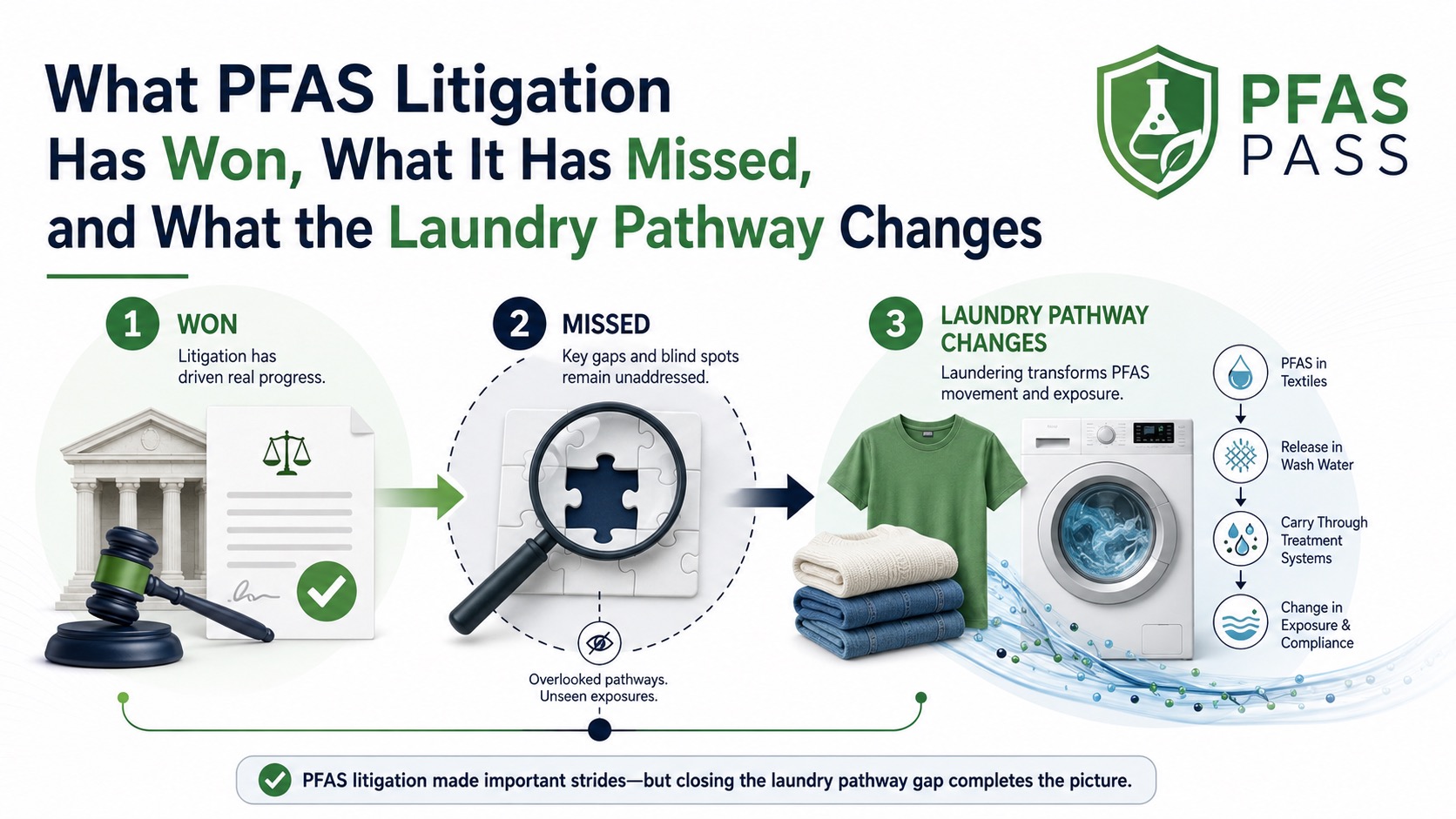
PFAS litigation is the largest toxic tort action in American legal history. As of 2026, settlements stemming from PFAS pollution claims have exceeded $18 billion in the United States alone. Thirty-one state Attorneys General have initiated PFAS litigation. The AFFF multidistrict litigation in the District of South Carolina comprises thousands of cases. Personal injury bellwether trials are scheduled. The momentum is real, the settlements are historic, and the litigation machine is running at full speed.
And it is missing the biggest contamination source of all.
Every major settlement, every active MDL, every state AG action to date has been anchored to one of three contamination sources: aqueous film-forming foam (AFFF) used at military bases and airports, industrial manufacturing facility discharge, or specific site contamination traced to a named facility. These are geographically bounded sources. You can point to a place, draw a radius, identify the affected communities, and build a damages case.
The domestic laundry pathway is different in kind, not just degree. There is no radius. There is no point source. There is a washing machine in virtually every home in America running PFAS-treated synthetic garments through municipal water systems that were never designed to remove forever chemicals — and discharging the effluent into surface water and groundwater that communities drink.
According to 2025 EPA data, more than 158 million Americans drink tap water contaminated with PFAS. The AFFF and industrial sources explain concentrated contamination near military bases and factories. They do not explain 158 million Americans. The diffuse residential contamination that cannot be traced to a military base or industrial facility — that is the laundry pathway. That is fashion. That is the washing machine in every home. And it is not in any current filing.
This article documents what PFAS litigation has established, what it has not yet asserted, and how PFAS Drift In or Out™ — a jurisdictional framework developed through independent field research and published by PFAS PASS in May 2026 — closes the escape routes that have kept this source out of court.
Part One — What Litigation Has Established: The Remedy Template
Before mapping the gaps, it is essential to understand what has already been won — because the remedy framework that applies to the laundry pathway already exists in law. It does not need to be invented. It needs to be applied to a source that has not yet been named.
The chemical manufacturer liability framework is established. 3M agreed to pay $12.5 billion and DuPont agreed to $1.2 billion to fund water system testing and treatment for PFAS contamination in public water utilities. These settlements establish the fundamental principle: if you manufactured the contaminating substance, knew it was toxic and persistent, and your product entered the water supply, you fund the cleanup. That chain has been proven and settled for over $13 billion.
The downstream manufacturer framework is established. Carpet manufacturers in Alabama and Georgia were named as defendants alongside the chemical companies in municipal water contamination cases. The carpet manufacturers used PFAS for stain resistance. Their permitted wastewater entered water utilities. Downstream municipalities sued both the carpet manufacturers and the chemical companies to recover remediation and filtration costs. This is the precedent. A textile company whose PFAS-treated product enters the wastewater stream is a contamination defendant — not just a consumer fraud defendant. That logic has been established. It has not yet been applied to apparel.
The municipal water system retrofit remedy is established. The 3M and DuPont settlements specifically fund water system testing and treatment infrastructure. The remedy is not abstract — it is a documented, court-approved mechanism for making chemical producers pay for filtration infrastructure their products made necessary.
The consumer fraud framework is established. The REI class action, the Gore-Tex greenwashing case filed in February 2025, the Thinx settlement — these cases establish that brands making sustainability or PFAS-free claims on products containing PFAS are liable for consumer fraud. Breach of warranty, negligent misrepresentation, and violation of state consumer protection statutes are all in evidence.
The traceability requirement is established — and is currently the plaintiff’s most significant obstacle. The Sixth Circuit ruled that a plaintiff failed to establish standing because they could not establish “traceability” — specifically, how each defendant manufactured or provided a “plausible pathway” that delivered PFAS to the plaintiff’s body. This ruling is a defense victory that plaintiffs’ counsel must solve. The laundry pathway science — and PFAS Drift In or Out™ as the jurisdictional mechanism — solves it.
Part Two — What Litigation Has Not Asserted: The Eight Gaps
Gap 1 — The Laundry Pathway Has Never Been the Named Contamination Source
Every active PFAS contamination case is anchored to an industrial or military point source. Not one case names the domestic laundry pathway — the washing of PFAS-treated consumer textiles in household machines — as the contamination mechanism connecting a product to a water supply.
This is not because the science does not exist. 2025 peer-reviewed research confirms that laundry fibers are significant vectors for PFAS transport into municipal water systems. Synthetic fibers show PFAS adsorption 5 to 24 times higher than natural fibers. Weathered fibers show 30 to 45 percent greater PFAS release than new fibers. A Florida study identified PFAS from clothing as the source of groundwater contamination — not cleaning chemicals, not an industrial facility. Clothing. Wastewater treatment plants cannot remove PFAS. The effluent enters surface water and groundwater.
The science establishes the plausible pathway that the Sixth Circuit requires. It has not been put before a court.
Gap 2 — The Traceability Problem and How PFAS Drift In or Out™ Solves It
The geographic traceability requirement — proving which specific source contaminated which specific water supply — is what has kept the laundry pathway out of court. You cannot trace a specific washing machine in Tulsa to a specific aquifer. The contamination is diffuse by design. That diffuseness has functioned as a shield.
PFAS Drift In or Out™ removes that shield. It provides a jurisdictional hook that does not require geographic tracing of the contamination event. It requires tracing the product’s entry into regulated commerce — which is documentable from import records, port manifests, distribution records, and brand headquarters location.
PFAS Drift In™ establishes that goods entering US commerce through a regulated state — imported through the Port of Los Angeles, Long Beach, or New York; warehoused or distributed from California or New York facilities; branded by companies headquartered in New York or California — carry compliance obligations from the point of entry regardless of where the goods ultimately land, where they are washed, or where the contamination enters the water supply.
You do not need to prove which washing machine caused which contamination. You need to prove the product entered regulated commerce — and that the PFAS chemistry in that product was applied by manufacturers who knew it was toxic, persistent, and would enter the water supply through ordinary consumer use. That is provable. It is documented in internal manufacturer records already in evidence from existing litigation.
Gap 3 — Apparel Brands Are Not Named as Contamination Defendants
Current apparel PFAS litigation asserts consumer fraud only. REI, Gore-Tex, Thinx — these cases attack sustainability claims and PFAS-free marketing. They seek purchase price refunds. None of them assert environmental contamination liability.
The carpet manufacturer precedent established that a textile company whose PFAS-treated product enters the wastewater stream is a contamination defendant alongside the chemical companies. That precedent has not been applied to apparel brands. The pathway is identical: PFAS treatment applied to textile, consumer washes the textile, PFAS enters municipal wastewater, treatment plant cannot remove it, PFAS enters drinking water supply. The only difference is the product category and the mechanism of entry into the wastewater stream.
PFAS Drift In or Out™ applies here: apparel brands headquartered in New York or California, selling into those regulated markets, are subject to the contamination defendant framework regardless of where the laundry occurs. The goods Drifted In through a regulated market. The compliance and contamination obligations attached at that point.
Gap 4 — Municipal Water System Retrofits Have Not Been Sought from Fashion or Petroleum
The $13.7 billion water utility settlement established the remedy: chemical manufacturers fund water system testing and treatment infrastructure for communities whose water supplies they contaminated. That remedy has been applied exclusively to AFFF and industrial discharge sources.
The communities whose diffuse residential PFAS contamination cannot be traced to AFFF or an industrial facility — which represents a significant portion of the 158 million Americans drinking PFAS-contaminated water — have no current litigation pathway to water system retrofit funding. The laundry pathway is their source. Fashion and petroleum are their defendants. The remedy template exists. The application to this source does not yet.
Gap 5 — PFAS-Contaminated Textiles Are Not Classified as Regulated Hazardous Material
The EPA has classified PFOA and PFOS as hazardous substances under federal Superfund law. The classification logic that makes a contaminated industrial site hazardous waste also makes a PFAS-saturated garment in a landfill hazardous waste. That logic has not been applied to textiles.
PFAS-contaminated textiles are currently entering landfill and incineration as general solid waste across every state in the country. At landfill, PFAS leaches into soil and groundwater. At incineration, PFAS survives combustion, concentrates in hazardous ash, and releases via smokestacks. Neither disposal pathway is being managed as the hazardous material event it legally is under existing Superfund classification. The liability for that misclassification belongs to the chemical manufacturers who created the contaminating substances and the brands who deployed them at scale.
PFAS Drift In or Out™ applies to disposal: goods that Drifted In through a regulated state carry their hazmat status to the landfill in any state. The disposal liability follows the product’s origin in regulated commerce, not the location of the landfill.
Gap 6 — Overproduction as Aggravated Contamination Liability
The fast fashion industry’s deliberate overproduction model is not incidental to PFAS contamination — it is the mechanism that maximized the volume of PFAS-treated synthetic fiber in circulation globally. Overproduction is documented and intentional. Brands produce volumes they know exceed sellable demand. The excess enters landfill, incineration, or export markets as waste. That waste is contaminated. The contamination consequences of deliberate overproduction of a known toxic material are calculable and attributable to the brands and chemical manufacturers who drove the overproduction model.
No current PFAS litigation asserts overproduction as an aggravating factor in contamination liability. It should be.
Gap 7 — Recycling Fraud as Compounded Liability
Brands making recycling claims on PFAS-contaminated textiles are directing hazardous material into recycling infrastructure not designed to handle it. PFAS-contaminated synthetic fiber cannot be safely recycled — it contaminates the recovered fiber stream and produces recycled materials that carry the PFAS contamination forward into new products.
The recyclability claims being made on PFAS-contaminated textiles are not just greenwashing — they constitute a second layer of fraud that actively compounds the contamination. They direct hazardous material into the wrong disposal stream, contaminate that stream, and produce downstream products carrying the original contamination. No current case asserts this theory. The FTC Green Guides, state consumer protection statutes, and environmental liability frameworks all provide potential vehicles.
Gap 8 — The Petroleum Industry’s Role as Funder and Architect
The chemical manufacturers who made the PFAS chemistry are in litigation. What is not yet asserted is the role of the petroleum industry as the architect and funder of the entire system — not just the chemistry producer.
Synthetic fiber — polyester, nylon, acrylic, spandex — is petroleum-derived. The fashion industry is approximately 60 percent synthetic fiber by volume. PFAS chemistry is fluorinated petroleum chemistry. The petroleum industry supplied both the base material and the treatment chemistry. It funded the fast fashion industry’s overproduction model through cheap synthetic fiber supply. And — as documented in Feeding the Machine — the publication most positioned to cover the PFAS compliance question in the fashion supply chain is owned by a company whose largest outside investment came from the sovereign wealth fund of an oil-producing nation.
The information suppression theory — that petroleum capital funded the media infrastructure that kept the compliance story from reaching the brands and consumers who needed it — has tobacco litigation precedent. It has not been asserted in PFAS litigation.
Update — June 2026: Independent Prior Corroboration of the Textile-to-Water Pathway
This update is added after original publication. It does not revise the gaps above; it strengthens Gap 1 and Gap 3 with peer-reviewed research and a settled enforcement matter that PFAS PASS identified after the May 11, 2026 publication of this article. The research predates this series and is presented here as independent prior corroboration of the mechanism this series describes — not as a claim of original discovery.
A peer-reviewed study has now traced textile PFAS to a drinking-water supply — through a pathway standard testing could not see.
A Duke University laboratory (Faught, Shojaei, Joyce & Ferguson, Environmental Science & Technology Letters, December 9, 2025) identified the long-unexplained source of PFAS contamination in North Carolina’s Haw River watershed as a textile manufacturing operation. The source had evaded detection for years because the facility was not releasing the regulated, monitored forms of PFAS. It was releasing solid nanoparticle “precursors” — side-chain fluorinated polymers used in water- and stain-repellent textile finishes — that degrade into regulated PFAS only after entering the wastewater system. Precursor concentrations measured up to 12 million parts per trillion after oxidation, and the particles concentrated into sewage sludge that was land-applied as biosolids on farm fields for years.
This corroborates Gap 1.
The textile-to-water mechanism this series names is no longer hypothetical. It has been documented in a peer-reviewed study and resolved through a Clean Water Act citizen-suit settlement reached by the Southern Environmental Law Center on behalf of the Haw River Assembly with the City of Burlington, North Carolina, which named textile manufacturers among the responsible industrial sources. Influent PFAS that had spiked as high as roughly 33,000 parts per trillion dropped sharply after source controls were applied. Two distinctions remain essential and intact: that matter concerned industrial manufacturing discharge, not the consumer laundry pathway, and it was a negotiated settlement, not binding precedent. The consumer-laundry version of this pathway — the subject of this series — still has not been filed. What has changed is that the underlying mechanism is now proven, litigated, and on the public record.
This corroborates Gap 3.
The Burlington matter applied the downstream-manufacturer logic to textile operations: the entities whose treated-textile chemistry entered the wastewater stream were treated as responsible sources. That is the same logic this series argues should reach apparel brands — not merely as consumer-fraud defendants for unsubstantiated “PFAS-free” claims, but as contributing parties properly joined in contamination and cleanup actions. The defensible framing is contribution apportioned by documented role and benefit: the chemical producers supplied the chemistry; the brands chose, sourced, profited from, and distributed the treated goods at volume. A brand’s share is measured by its own documented contribution, scoped to products demonstrated to carry the relevant finishes — not asserted categorically against all apparel.
One clarification on the greenwashing route: it needs no jurisdictional hook, and it reaches back further than the state PFAS bans.
Several gaps above rely on PFAS Drift In or Out™ to escape the geographic limits of the New York and California PFAS statutes. The consumer-fraud and greenwashing theory does not require that hook. Liability for deceptive “PFAS-free,” sustainability, and recyclability claims runs on Section 5 of the Federal Trade Commission Act, as interpreted through the FTC Green Guides — guidance first issued in 1992 and last revised in 2012, not a standalone statute and not a recent enactment. That framework is federal in reach and is also incorporated into several state consumer-protection laws, including California’s. A deceptive environmental claim is therefore actionable nationwide, not only in the regulated PFAS states, and its reach-back is governed by the applicable consumer-protection statute of limitations measured from when the claims were made — reaching conduct that predates the January 1, 2025 PFAS statutes entirely.
The Testing Blind Spot Principle.
The Haw River finding establishes a principle that runs through this entire series: the absence of detection is not the absence of contamination. The precursors went unseen for years not because they were absent, but because the testing framework was not built to detect them. Compliance systems built around known, regulated compounds can appear functional while significant precursor and transformation-product pathways remain invisible. A “non-detect” result against a standard method is not proof of absence.
If industrial laundry is now a recognized pathway, residential laundry must be evaluated.
Regulators and researchers have begun isolating commercial and industrial laundry as a measurable PFAS source: discharge sampling at industrial laundries servicing commercial textiles has shown PFAS significantly above baseline wastewater, the EPA lists industrial launderers among recognized release sources, and the Florida wet-laundry research detected PFAS in every wastewater discharge sample analyzed. These are point sources — permitted, identifiable, and therefore studied. The residential laundry pathway has been flagged as a suspected contributor but has not been isolated and quantified the way permitted industrial dischargers have been, because the point-source regulatory model is structurally built to find single pipes, not millions of diffuse household sources. If isolated industrial laundering measurably elevates PFAS, the aggregate of residential laundering — vastly larger in number of sources — is the parallel pathway that has not yet been evaluated, tested, or litigated, and is potentially a far larger contributor. That evaluation is the necessary next step.
Part Three — The Unified Argument
Put together, the unasserted case looks like this:
The petroleum industry manufactured PFAS chemistry knowing it was toxic and persistent since the 1970s. Internal documents establishing that knowledge are already in evidence from existing litigation. The textile and fashion industry deployed that chemistry at an unprecedented global scale through a deliberate overproduction model that maximized the volume of PFAS-treated synthetic fiber in circulation. That fiber is now in virtually every home, every washing machine, and every municipal water system on earth.
The resulting contamination is diffuse, residential, and global. It is not traceable to a military base or an industrial facility. It is traceable to a supply chain — and PFAS Drift In or Out™ provides the jurisdictional mechanism to establish that supply chain liability regardless of where the contamination event occurs geographically.
The remedy framework exists: chemical manufacturer liability for water system retrofit funding, downstream textile manufacturer liability as contamination defendants, extended producer responsibility for disposal costs, and consumer fraud liability for recycling claims made on hazardous material. What does not yet exist is the application of those frameworks to the textile laundry pathway at the scale the contamination actually represents.
Part Four — What Plaintiff Counsel Should Do With This
The eight gaps identified in this article represent eight distinct legal theories that are not currently appearing in any active PFAS filing. Each is grounded in established precedent applied to an unaddressed source. None requires a novel legal standard — only the application of existing frameworks to a contamination mechanism that has not yet been named.
PFAS Drift In or Out™ is the jurisdictional architecture that makes every component of this argument viable beyond the boundaries of New York and California. It prevents the defense from containing liability to regulated markets. It solves the traceability problem that has been the plaintiff’s most significant obstacle in diffuse contamination cases. And it was published and timestamped before any specific litigation engagement — establishing it as independent research available to any plaintiff counsel who can use it.
The litigation data infrastructure to support these theories is in development at PFAS PASS: declined compliance documentation records, a non-compliant SKU database, and a compliance status registry documenting who has produced verified compliance documentation and who has remained silent. That infrastructure, when complete, provides the evidentiary foundation for the supply chain accountability argument at scale.
Plaintiff counsel seeking case gap analysis, retained expert engagement, or early access to the litigation data infrastructure should inquire directly.
PFAS Drift In or Out™ is an original concept of PFAS PASS™. First published May 11, 2026. All rights reserved. This article constitutes independent research and does not constitute legal advice. Plaintiff counsel seeking case gap analysis or retained expert engagement should visit https://pfaspass.com/media-press/
The Feeding the Machine Series
Part One — Feeding the Machine: What the Petroleum Crisis Revealed About Everything You Were Sold
Part Two — What PFAS Litigation Has Won, What It Has Missed, and What the Laundry Pathway Changes
Part Six — Feeding the Machine: The Legal Case — The Petroleum Industry’s Compounded Liability
Read the full argument. Own the book.
The complete Feeding the Machine argument — all parts, the eight gaps, and the personal story behind it — is available in one volume. PDF, signed edition, and Amazon Kindle, paperback, and hardcover formats are linked on the series hub.
For plaintiff counsel and litigation teams.
PFAS PASS™ develops independent litigation research, case gap analysis, and compliance-documentation strategy. Counsel pursuing PFAS contamination, greenwashing, or post-sale compliance matters can request case gap analysis and retained-expert engagement through the litigation strategy and media kit.