The Interaction
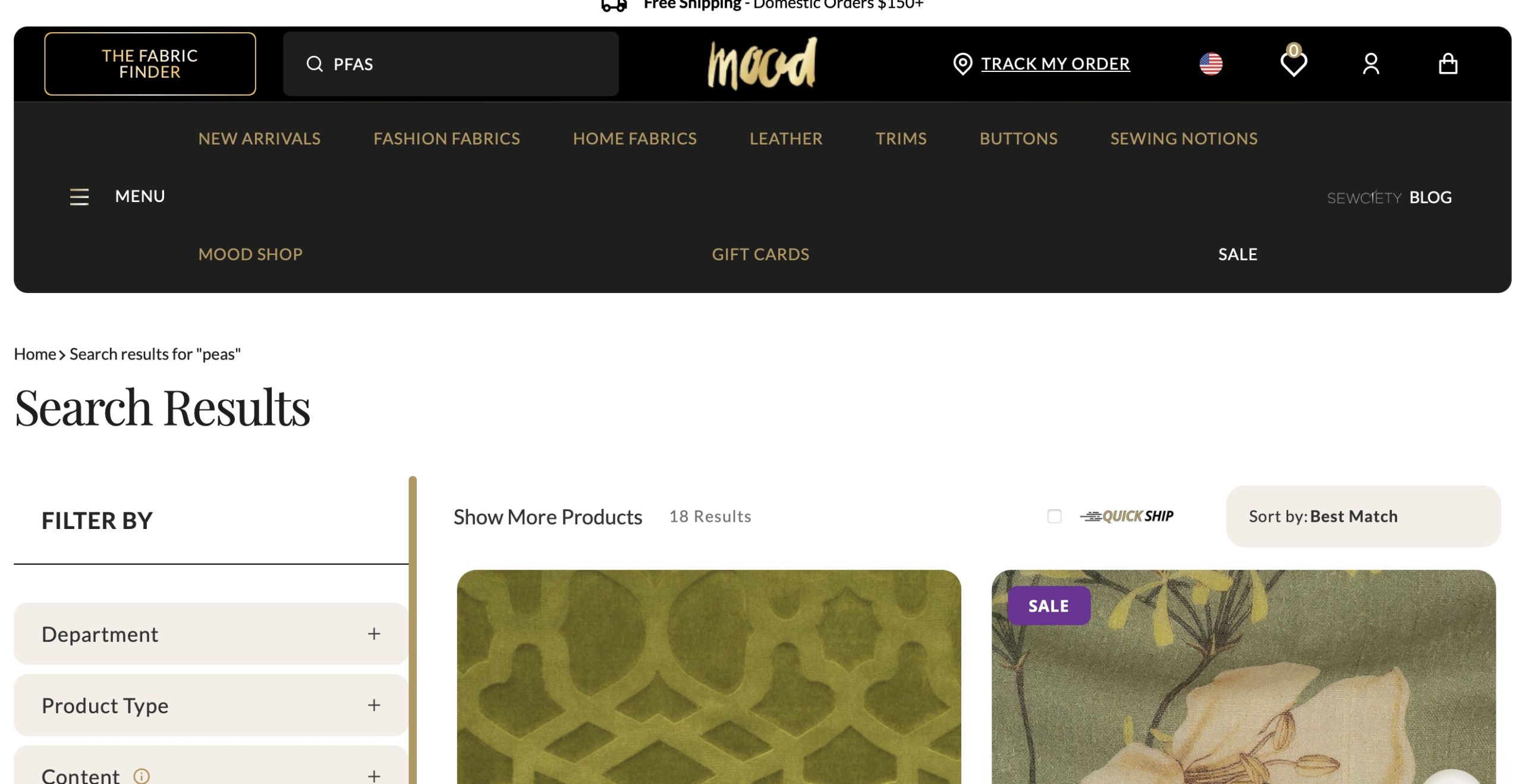
As part of ongoing PFAS compliance investigation across textile supply chains, a search was conducted on the Mood Fabrics website using the term:
“PFAS”
The result:
- No compliance information
- No educational content
- No product filtering
- No acknowledgment of the term
Instead, the system returned results interpreting “PFAS” as unrelated keywords, including “peas”
Why This Matters
This is not a minor UX issue. This is a systems-level failure.
PFAS is not an obscure term. It is a regulated chemical class tied to:
- State-level bans in New York and California
- Active legislation across the EU
- Ongoing litigation across consumer goods sectors
- Known environmental and human health risks
If a major retailer’s internal systems:
- Do not recognize the term
- Do not map it to compliance categories
- Do not provide any guidance or filtering
Then the conclusion is direct:
The system is not built for compliance.
What This Reveals About the Industry
This case study exposes a deeper layer of the PFAS compliance gap:
1. Search Infrastructure Is Not Compliance-Aware
Retail platforms are built for:
- Color
- Fiber content
- Pattern
- Price
They are not built for regulated chemical tracking
2. No Consumer-Facing Pathway
Even if compliant products exist:
- There is no way to find them
- No tagging system
- No disclosure layer
This makes informed purchasing impossible
3. Terminology Disconnect
If “PFAS” is interpreted as “peas,” it means:
- No synonym mapping
- No compliance taxonomy
- No backend recognition of regulatory language
This is not a content gap. This is an infrastructure gap
Real-World Impact
For professionals working in regulated markets:
- Costume designers
- Uniform manufacturers
- Performance wear developers
- Theme park production teams
This creates a critical problem:
You cannot source compliant materials
Because the system cannot even identify what compliance means
PFAS PASS Position
At PFAS PASS, this is exactly the gap we are addressing.
Compliance cannot rely on:
- Assumptions
- Marketing language
- Certifications without traceability
- Or search systems that don’t recognize the problem
We are building:
- PFAS PASS VERIFIED Registry
- Supplier compliance pathways
- Document-backed verification systems
- Searchable, traceable compliance infrastructure
Because the current system is not failing quietly.
It is failing at the most basic level:
It cannot even understand the question.
Call to Action
If you are a:
- Fabric supplier
- Textile mill
- Retail platform
- Or sourcing intermediary
And your system cannot:
- Recognize PFAS terminology
- Surface compliance data
- Provide verifiable documentation
You are not ready for regulated markets.
PFAS PASS provides a structured pathway to fix that.
Closing
This is not about one retailer.
This is about an entire industry operating on systems that were never designed for regulatory reality.
Search failure is compliance failure.
Who should we investigate next? Comment below…