There is a persistent misconception in fashion and costume production that PFAS compliance is primarily a fabric problem.
It is not.
It is a system problem.
And systems fail at their weakest, most overlooked components.
In this case study, that weak point is thread and notions.
The Supplier
WAWAK Sewing Supplies is one of the most widely used suppliers in the U.S. sewing and costume production industry.
They supply:
- Thread
- Zippers
- Elastic
- Interfacing
- Closures
- Hardware
Their products are standard issue in:
- Costume shops
- Theme park fabrication rooms
- Fashion production studios
- Industrial sewing environments
This is not a fringe supplier.
This is infrastructure.
The Finding
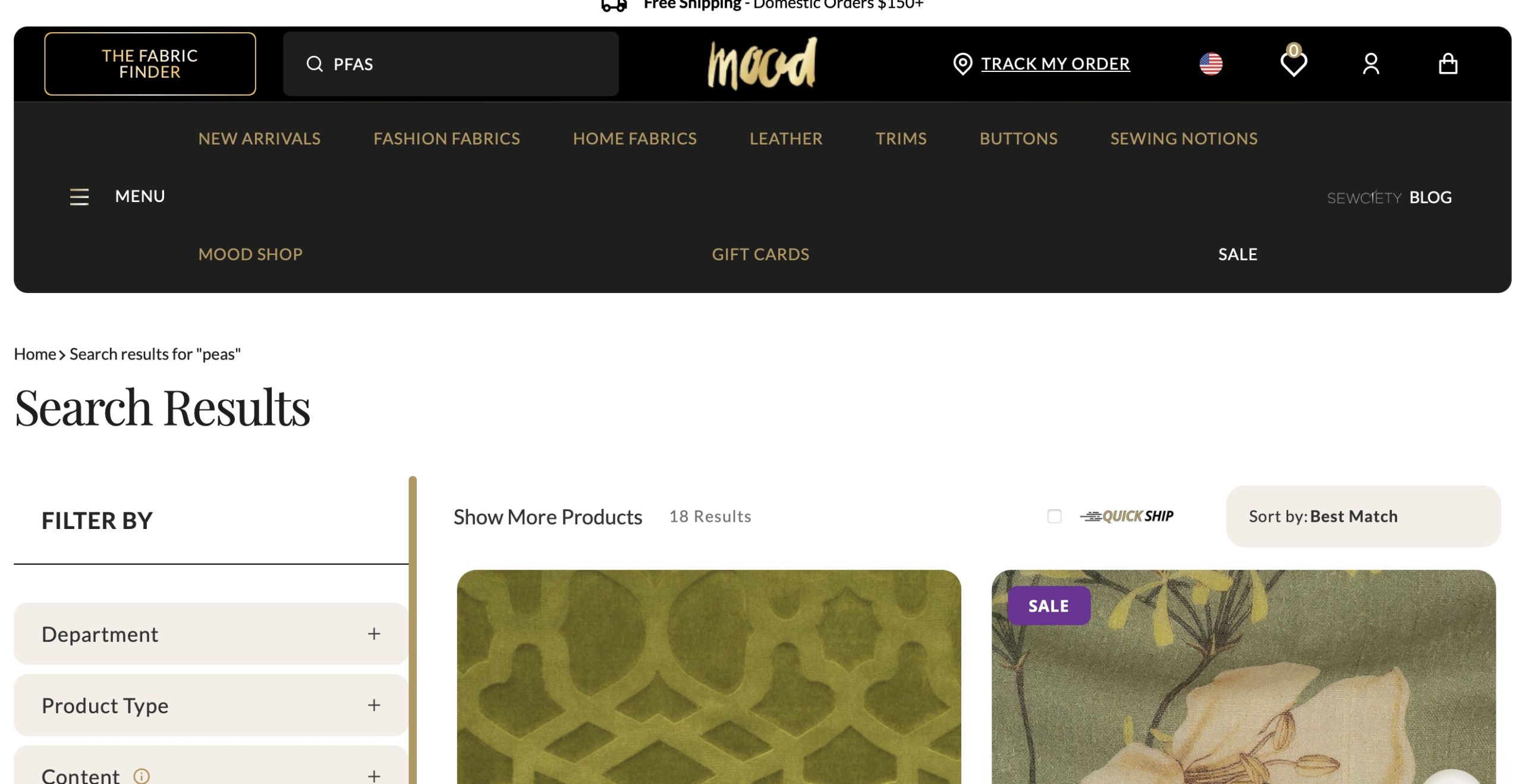
A direct search for PFAS-related information on their platform returns:
“We looked and looked… sorry, we can’t find anything for ‘PFAS’…”
There is:
- No PFAS policy
- No compliance statement
- No restricted substances disclosure
- No testing documentation
- No supplier guidance
Not even baseline educational content.

No documentation
No clarification
- No follow-up
UPDATE — May 7, 2026
Wawak Responds to a PFAS Status on a zipper I ordered. The Documentation Does Not Hold Up.
Following publication of this case study, a formal compliance inquiry was submitted directly to Wawak requesting PFAS-specific documentation for their product categories.
Wawak responded by forwarding a third-party manufacturer compliance letter.
PFAS PASS VERIFIED reviewed the submitted document. It was a YKK Corporation of America product compliance letter dated November 30, 2023, addressed to Cleaner’s Supply.
The review identified four disqualifying deficiencies:
1. The letter does not address PFAS. It covers REACH SVHCs, CPSIA lead and phthalate limits, California Proposition 65 (with a disclosed nickel exception), and EU RoHS heavy metals and phthalates. None of those frameworks map to New York ECL § 37-0121 — the operative standard banning intentionally added PFAS in apparel effective January 1, 2025. The word “PFAS” does not appear anywhere in the submitted document.
2. The letter is expired. Its own language states validity of one year from the date of issue. It expired November 30, 2024.
3. The letter was not issued to Wawak. It was issued to Cleaner’s Supply. Supplier compliance letters are issued to specific customers for specific supply chain relationships. A letter issued to a different company does not extend its representations to a different buyer.
4. The letter does not meet New York’s documentation standard. (Wawak is headquartered in NY) NY ECL § 37-0121 requires an affirmative certification that products contain no intentionally added PFAS — ideally supported by third-party testing or a current manufacturer-issued certification responsive to that standard. This letter makes no such certification.
PFAS PASS VERIFIED responded to Wawak in writing, identifying each deficiency and requesting a current, PFAS-specific certification issued directly to Wawak, dated within the past year, that addresses intentionally added PFAS under NY ECL § 37-0121.
As of the date of this update, no corrected documentation has been received.
June 10, 2026 Update — WAWAK Responded With an Indemnification Agreement, Not a Compliance Document
The original inquiry documented in this case study received no response. Following a formal, escalated demand sent to all available WAWAK / Cleaner’s Supply contacts, a document was finally produced. It did not answer the question.
On June 8–9, 2026, WAWAK’s parent company, Cleaner’s Supply Inc., provided an executed Vendor Compliance Agreement and PFAS Addendum between Cleaner’s Supply Inc. and YKK (U.S.A.) Inc., e-signed by a YKK Vice President of Sales. PFAS PASS conducted a Rapid Document Review (RDR) of that document.
What the document appears to be: a private vendor agreement in which YKK agrees to indemnify Cleaner’s Supply against claims arising from the presence, release, or exposure of PFAS in connection with its products. It allocates legal liability between two private companies.
What the document is not: a PFAS compliance document for any product sold to a customer. The RDR identified the following:
- It does not certify that any product is free of intentionally added PFAS.
- It contains no test data, no total organic fluorine (TOF) results, and no defined compliance threshold.
- It does not reference the specific stock number or order at issue.
- It is an agreement between Cleaner’s Supply and YKK; the purchasing customer is not a party to it and holds no rights under it.
- Its own “Limitation of Liability” clause caps the vendor’s obligation at the fees Cleaner’s Supply paid the vendor.
RDR RESULT: FAIL. An agreement about who pays if there is a PFAS problem is not the same as documentation showing there is no PFAS problem.
This distinction is the central issue. WAWAK / Cleaner’s Supply sells in and from New York, where intentionally added PFAS in apparel has been restricted under NY ECL § 37-0121 since January 1, 2025. A zipper is a component built into apparel, placing it within that regulatory scope. A private indemnification agreement between a seller and its vendor does not displace a statutory obligation imposed by the State of New York, and it does not bind the downstream purchaser who never signed it.
The request remains open and unanswered: current, product-level documentation demonstrating that the purchased component complies with NY ECL § 37-0121. PFAS PASS has requested that WAWAK / Cleaner’s Supply route the matter to its regulatory compliance or legal department and identify the responsible contact. This case study will be updated as the record develops.
Powered by PFAS Library and PFAS PASS Rapid Document Review™ Systems.
Why This Matters More Than Fabric
A garment can be constructed with:
- Fully compliant fabric
- Verified coatings
- Approved trims
And still fail compliance due to:
- Synthetic or coated thread
- Fusible interfacings
- Adhesives
- Elastic
- Coated or polyester trims
- Plastic zippers
- Hook and loop tape
- Plastic buckles or snaps
These are not secondary materials.
They are integrated components of the final product.
Under regulations emerging in states like California and New York, the entire product is evaluated, not just the primary textile.
The Engineering Reality
From a production standpoint, thread and notions are:
- Distributed across every seam
- Embedded into structural integrity
- Impossible to remove post-construction
- Often sourced separately from fabric supply chains
This creates a scenario where:
A single unverified input contaminates the entire system.
This is not theoretical.
It is a direct failure pathway.
The Industry Gap
Suppliers like WAWAK operate at scale, serving thousands of professionals daily.
Yet:
- There is no standardized disclosure model
- No material-level traceability
- No publicly accessible compliance framework
This creates a downstream burden where:
- Designers cannot verify inputs
- Fabricators cannot certify builds
- Clients cannot confidently deploy products in regulated markets
The system does not support compliance.
It obstructs it.
Real-World Risk Scenario
A costume designer builds a production for California using:
- PFAS-conscious fabrics
- Approved dye processes
- Documented sourcing
But uses:
- Standard polyester thread
- Off-the-shelf interfacing
- Common zipper stock
All sourced from a supplier with zero PFAS transparency.
Outcome:
- The garment cannot be verified
- The production cannot be certified
- The liability shifts downstream to the designer or production entity
This is how six-figure builds become regulatory risks overnight.
Why This Case Study Matters
This is not about calling out a single supplier.
It is about exposing a structural failure:
The industry has not accounted for the compliance status of the smallest components that hold everything together.
Thread is not decorative.
Notions are not optional.
They are load-bearing elements in both construction and compliance.
The Core Problem
PFAS Compliance Is Required
The System Cannot Prove It
And in the case of thread and notions:
The system is not even attempting to.
Where This Leads
This gap creates three immediate consequences:
- False Confidence
Designers believe they are compliant based on fabric alone - Unverifiable Products
No documentation chain exists for full garment validation - Liability Misplacement
Responsibility shifts to the builder instead of the supplier
The Solution Pathway
This is precisely the gap PFAS PASS is designed to address.
Not at the fabric level alone, but at the component level:
- Thread
- Interfacing
- Adhesives
- Trims
- Hardware
Verification must extend to every input that becomes part of the final product.
In Closing
If thread is in every seam,
and no one can verify it,
then every seam is a potential failure point.
Until suppliers provide transparent, document-backed compliance pathways,
no garment can be considered fully verified.
Call to Action:
If you are a supplier of thread, trims or notions and cannot provide PFAS-related documentation, you are now part of the compliance gap.
If you are a designer or production house building for regulated markets, you are carrying that risk.
PFAS PASS is building the verification system to close this gap.
Because compliance does not fail at the surface.
It fails in the details no one is tracking.
Download our PFAS Compliance Playbook – Hardware, Notions & Construction Systems Deep Dive Edition to learn what components are the most HIGH RISK and which ones are SAFER
If you have any suggestions on what we can cover next in our Case Studies, comment below.