PFAS PASS Investigative Series
In this case, a U.S.-based textile supplier, Carr Textile, initially responded with a familiar industry position:
“A majority of our fabrics are PFAS compliant.” – Dave Smith, Carr Textiles
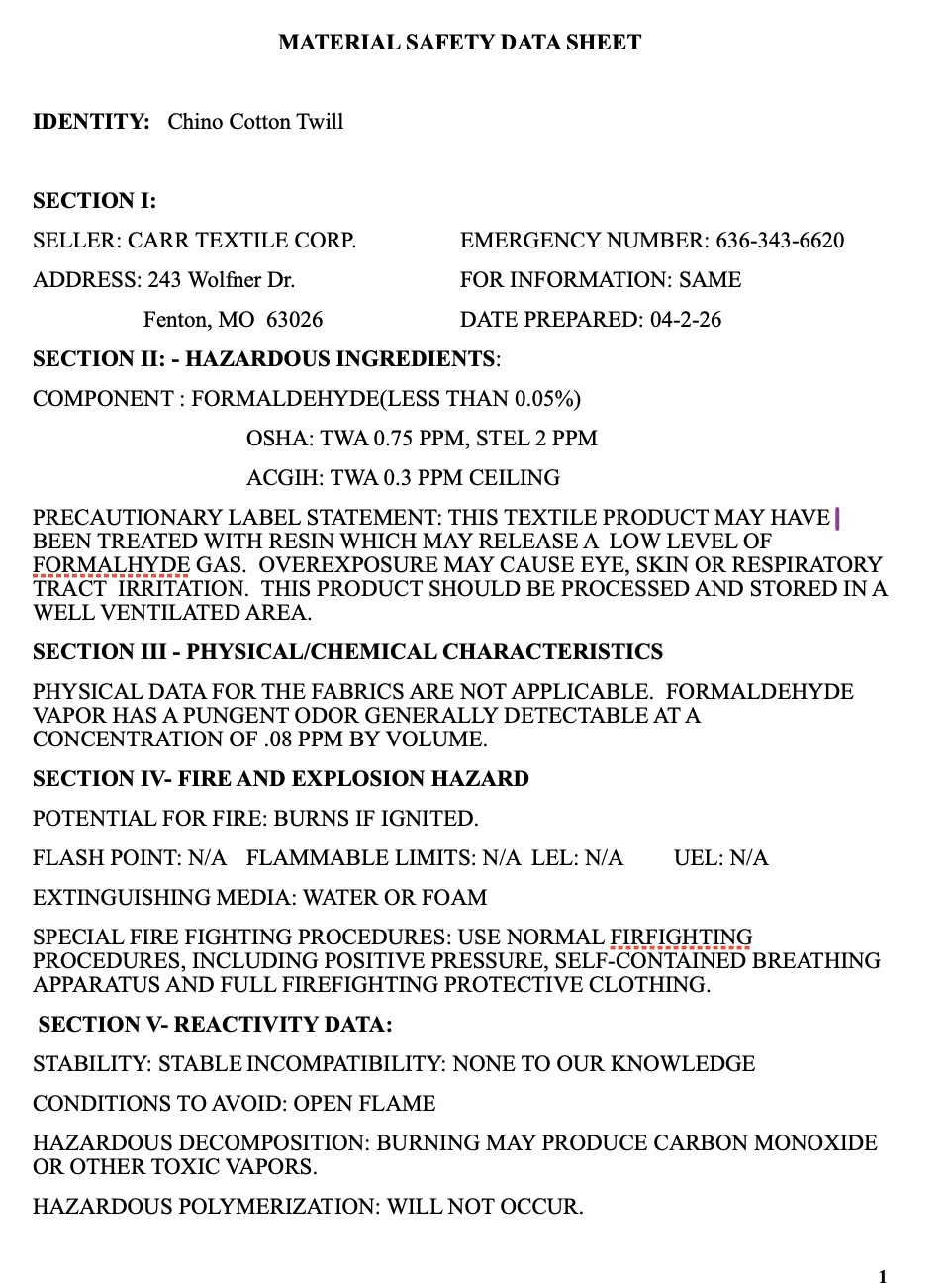
When asked to provide verification, the supplier submitted a Safety Data Sheet (SDS) for a Chino Twill fabric.
The document included a statement that the fabric was PFAS free.
At first glance, this appears to satisfy the request.
In practice, it does not.

What Was Provided
Carr Textile supplied an SDS document with the following characteristics:
- Focused on general safety and handling
- Listed limited chemical disclosures (example: formaldehyde under threshold levels)
- Included a line stating the fabric is PFAS free
- Contained a disclaimer noting reliance on third-party information and lack of guaranteed completeness
When questioned further, the supplier confirmed their position:
“No PFAS is included in our SDS Document. This information is listed somewhere near the middle of the data.”

Where the Breakdown Occurs
This case highlights a critical industry misunderstanding:
An SDS is not a PFAS compliance document.
SDS documents:
- Are designed for hazard communication, not full chemical disclosure
- Do not require reporting of all substances present
- Do not verify absence of PFAS
- Do not meet regulatory documentation standards for NY or CA
A statement inside an SDS that a material is “PFAS free” is considered: A supplier claim, not verified compliance.
Regulatory Reality
For products entering regulated markets such as New York and California, PFAS compliance requires:
- Analytical testing (total fluorine or targeted PFAS testing)
- Third-party lab verification
- Fabric-specific documentation tied to identifiable materials
Without this, materials cannot be confidently specified for:
- Theme park costumes
- Uniform programs
- Apparel sold or distributed in regulated states
What Makes This Case Different
Unlike many suppliers who deflect or disengage, Carr Textile showed a different signal.
After clarification, the supplier responded:
“I will try to sort this out with our lab team… Could you send me an example of what document you are requesting?”
This is the first step toward alignment.
Not compliance.
But awareness.
Key Insight
This case represents a transitional supplier:
- Not currently compliant at a documentation level
- Operating on internal assumptions of compliance
- Willing to engage when the gap is clearly defined
This is where the industry shifts.
Not through claims.
Through structure.
Conclusion
Carr Textile is not yet PFAS verified.
However, they are one of the first suppliers in this investigation series to:
- Acknowledge a documentation gap
- Engage with the requirements
- Request a pathway forward
That matters.
Because the future of textile supply into regulated markets will not be determined by who claims compliance.
It will be determined by who can prove it.
PFAS PASS Note
Frameworks now exist to help textile suppliers translate existing materials into verifiable, compliant documentation systems for regulated markets.
This is not an isolated interaction.
It reflects a broader issue:
Regulation is advancing faster than supply chain transparency
— UPDATE: The Conversation Continues — Late April 2026 into May.
The following exchanges occurred after the original case study was published. They are documented here as the investigation progressed in real time.
Defining the Documentation Standard
Following the initial SDS exchange, the supplier asked for clarification — a request for a specific fabric and an example of the documentation being requested.
That clarification was provided.
A compliant PFAS documentation set requires:
— Lab-based test results: total fluorine or targeted PFAS panel testing — Fabric-specific identification, not a general product category — Testing methodology and stated detection limits — Date and batch or production traceability where possible
The Chino Twill was proposed as a starting point. One core fabric, properly documented, establishes the process. Then it scales.
That is how compliant supply chains are built. One fabric at a time. With real data.
The Certification Pivot
Carr Textile’s next response represented a meaningful shift in sophistication — but not a resolution of the documentation gap.
Key positions offered:
— Prior internal PFAS compliance evaluations had been conducted — “PFAS-free” claims are difficult to certify in absolute terms; most standards rely on thresholds and restrictions on intentional use — The majority of partner facilities hold OEKO-TEX® STANDARD 100 and GOTS certifications — Actual certification documents cannot be shared due to proprietary and company policy restrictions — OEKO-TEX® certification is “generally accepted as meeting PFAS compliance expectations across major global markets”
This is a more informed position than an SDS submission.
It is not sufficient documentation under current U.S. state law.
Why: OEKO-TEX® STANDARD 100 restricts intentional use of certain PFAS compounds and tests against a Restricted Substances List. It is a respected certification. But it was not designed as a compliance instrument under New York’s Chemical Clothier Act or California’s AB 1817 / SB 903 framework. Those laws require analytical evidence — not just restricted intentional use. A certification that cannot be produced at the buyer level cannot be relied upon.
The Printed Fabric Question
The investigation expanded to a second fabric category: printed fabric bases.
Context: Spoonflower, a commonly used source for custom printed fabrics, CLAIMS compliant inks — but holds no verified data to support that claim, and provided zero information on the PFAS content of their globally sourced base fabrics per their own Fabric Types page. The question to Carr was whether THEIR printed fabric bases could be documented for PFAS status.
This response introduced the most substantive chemistry disclosure in the exchange to date:
— Carr has moved away from fluorocarbon (C6/C8) finishes, now primarily using polyurethane (PU) based systems — Performance finishes — DWR, stain release, oil repellency — now use C0 chemistry designed to meet current regulatory expectations — Fabrics are certified under OEKO-TEX® STANDARD 100 and/or STeP programs — Mill-specific documentation remains unavailable due to proprietary restrictions — Compliance is best evaluated case-by-case given the breadth of the line (100+ fabric types)
The move to C0 chemistry is genuinely significant. It puts Carr ahead of many suppliers still using legacy fluorocarbon systems.
And yet — the documentation gap remains.
Why C0 is not the same as verified: C0 chemistry is not inherently PFAS-free by definition. Some C0 systems use short-chain fluorinated compounds or fluorinated precursors that still qualify as PFAS under EPA and EU definitions. Without lab testing data confirming actual PFAS levels in finished fabric — not just chemistry category selection — “C0” is a process claim, not an analytical result.
The printed fabric context adds a separate layer of complexity. Printed fabrics involve dye chemistry, ink carriers, binders, and finishing agents that are chemically distinct from DWR or performance finish lines. Each of those input categories carries its own PFAS risk profile. A certification covering a base fabric’s performance finishes does not automatically cover what is introduced during the printing process.
The Liability Conversation
In response, the regulatory and legal stakes were made explicit:
“When I purchase your printed fabrics and use them in garments shown or sold in New York or California — including through runway or theme park presentations — your fabrics enter that regulated supply chain. At that point, ‘we vet our mills’ and ‘we use C0 chemistry’ becomes a representation that can be tested, challenged, and if found insufficient, litigated. The proprietary nature of your mill relationships does not provide a legal shield from a downstream buyer’s PFAS claim — it can actually complicate your defense, because you cannot produce the documentation that would exonerate you.”
This is not a theoretical concern. Brands and suppliers — Lululemon, Knix, Shein, among others — have already faced exactly this exposure.
The proprietary barrier, framed as business protection, can function as a liability in litigation. An absence of documentation is not a neutral position. It is an evidentiary gap.
The Verification Gap: What Exists in the Market and Why It Doesn’t Fully Solve This
Before presenting the PFAS PASS VERIFIED pathway, it is worth establishing the full landscape of existing verification options — and why none of them, alone, closes the gap Carr Textile currently faces.
Intertek PFAS Free Certification Intertek offers one of the most rigorous product-level certifications currently available. It requires Total Organic Fluorine (TOF) testing below 20 ppm (more stringent than most regulatory thresholds), targeted PFAS panel analysis via LC-MS/MS, material data audits, and a quality system review. It produces a certifiable PFAS Free mark that is science-based and defensible.
The gap for Carr: Intertek certification is a product-level process that requires Carr to submit specific fabrics through a full testing and audit cycle. It does not accommodate the proprietary mill barrier — the mill documentation and chemical management systems would need to be accessible for the quality system review. It is also a product-certification model, not a supplier-documentation framework. It certifies an outcome; it does not build the traceable paper trail that a supply chain buyer — or a regulator — needs to follow.
GreenScreen Certified® for Textile Chemicals GreenScreen, administered by Clean Production Action, is currently the most comprehensive PFAS restriction standard in the textile certification space. It prohibits all intentionally added PFAS, requires total organic fluorine below 20 ppm verified through quarterly testing (three samples per quarter per facility), and restricts thousands of other chemicals of concern. It is the only textile certification cited by major environmental organizations as meeting a whole-class PFAS restriction standard.
The gap for Carr: GreenScreen certifies textile chemical formulations — it is designed for chemical formulators (the companies making the finishes and treatments), not fabric suppliers selling finished goods. Carr would need its mill partners to pursue GreenScreen certification for the specific chemistries used in their fabrics. Given that Carr cannot share mill identity or documentation, this pathway is currently inaccessible without a change in their supplier transparency policy.
OEKO-TEX® STANDARD 100 + STeP (What Carr Already Has) As established earlier in this case, OEKO-TEX® STANDARD 100 now includes a 100 ppm total fluorine limit (as of January 2025 updates), which aligns with California’s AB 1817 threshold for 2025. STeP adds a process-level chemical management assessment at the facility level.
The gap: OEKO-TEX® tests against a Restricted Substances List and sets limits on intentional PFAS use. It does not constitute targeted analytical documentation at the individual fabric level — which is what NY and CA supply chain traceability requirements are moving toward. Critically, without the ability to produce the actual certificate for a specific fabric to a specific buyer, “we are OEKO-TEX® certified” is still a claim, not verifiable documentation.
Hohenstein / Eurofins / UL Solutions — Accredited Laboratory Testing These are accredited testing laboratories that can produce the actual analytical data — TOF, targeted PFAS panels — that compliance documentation requires. They are not verification or certification bodies; they produce the test data that a verification system then organizes and evaluates.
The gap: Lab testing alone produces data. It does not produce a compliance record. Without a structured framework that ties the test results to a specific fabric, a specific production run, a specific buyer relationship, and the applicable regulatory standard — the data exists but is not organized into something defensible at the supply chain level.
What PFAS PASS VERIFIED Provides That Nothing Else Does
This is the structural difference:
Every existing pathway requires either (a) full mill transparency, (b) product-level testing that Carr must initiate independently, or (c) a certification that covers chemistry inputs but not finished fabric documentation at the buyer level.
PFAS PASS VERIFIED is the only system currently structured to:
— Work within Carr’s existing proprietary constraints (mill identity not required) — Organize whatever documentation exists into a structured, gap-identified compliance record — Accept and evaluate accredited third-party lab results from any certified laboratory — Produce a buyer-facing Verification Report that is fabric-specific and regulation-referenced — Provide a publicly confirmable VERIFIED Registry listing — tied to a unique Verification ID — that a buyer can look up to confirm the listing is legitimate and has not been copied or misappropriated
That last point matters more than it may first appear.
The Stolen Logo Problem — and Why Registry Verification Protects Buyers
In the compliance space, certification marks are routinely misappropriated. A supplier can claim OEKO-TEX® certification, reproduce the logo on marketing materials, and a buyer has no quick way to verify that the specific fabric they are purchasing is actually covered by an active certificate.
OEKO-TEX® has its own Label Check system. GOTS maintains a Certified Suppliers Database. But these systems verify that a company holds a certificate — not that a specific fabric, in a specific order, from a specific production run, is covered.
PFAS PASS VERIFIED addresses this directly through the public VERIFIED Registry.
Every listing is tied to a unique Verification ID. Every listing is specific to the item verified — not the company as a whole. A buyer can go to PFASpass.com, look up the Verification ID, and confirm:
— The specific fabric or product is listed — The verification tier and status — The date of verification — That the listing is live and has not been revoked
This is not a logo on a data sheet. This is a confirmable, revocable, fabric-specific public record.
If a supplier copies the PFAS PASS VERIFIED mark and applies it to a fabric that has not been verified, that discrepancy is immediately detectable by any buyer who checks the Registry. There is no equivalent buyer-protection mechanism built into the existing certification landscape at the fabric-specific level.
For Carr Textile — a company that declines to share mill documentation but operates in good faith — this actually works in their favor. The Registry listing confirms their verified fabrics are legitimate without requiring them to expose proprietary supply chain relationships.
The Pathway Forward for Carr Textile
Given everything documented in this case, here is where Carr Textile stands and what the path to PFAS PASS VERIFIED looks like:
What they have done: Transitioned away from C6/C8 fluorocarbon finishes. Adopted C0 chemistry for performance applications. Obtained OEKO-TEX® STANDARD 100 and STeP certifications. Engaged with every documentation request rather than deflecting.
What they have not yet done: Produced fabric-specific, buyer-facing, regulation-referenced documentation that would hold up under NY or CA regulatory scrutiny or downstream litigation.
What the pathway looks like: Begin with one fabric — the Chino Twill, as proposed. Submit whatever documentation exists. Receive a gap analysis identifying exactly what accredited lab testing is needed. Obtain that testing through any certified laboratory. Submit results for evaluation. Receive a PFAS PASS™ Verification Report with a status assignment: Verified, Partial, or Not Verifiable. If Verified, opt into the PFAS PASS™ VERIFIED Registry with a unique Verification ID.
That is a defensible buyer-facing compliance record. Built without exposing proprietary mill relationships. Confirmable by any buyer in real time.
Given the chemistry work Carr has already done, they may be significantly closer to Verified status than the current paper trail reflects.
The gap is not in the chemistry. The gap is in the documentation.
And that gap has a solution.
Where This Case Stands
Carr Textile is not PFAS PASS VERIFIED.
The arc of this case, however, is the most instructive in this investigation series:
Stage 1 — Verbal compliance claim Stage 2 — SDS submission: insufficient, but good-faith response Stage 3 — OEKO-TEX® and GOTS reference: more informed, not yet documentation Stage 4 — Substantive chemistry disclosure: C0 systems, STeP certification, printed fabric context — the most detailed response in the series Stage 5 — Liability and pathway conversation: regulatory stakes defined, PFAS PASS VERIFIED introduced as a resolution
Each stage represents a supplier moving toward alignment.
That is not compliance. But it is how compliance happens.
PFAS PASS\xe2\x84\xa2 — Founder, PFAS PASS
The future of textile supply into regulated markets will not be determined by who has done the compliance work internally. It will be determined by who can show their work.
Submit your fabric or materials for PFAS PASS VERIFIED →
PFAS compliance in textiles is not being clearly communicated at the point of sale. That changes through documentation.
If you have supplier responses, share them, comment below.
If you want a supplier investigated, name them, comment below.
This series will continue.