Case Study Overview
This case examines Spoonflower, a print-on-demand fabric supplier who sources their fabrics globally, shows the gap between process-level claims and material-level verification in the context of PFAS compliance.
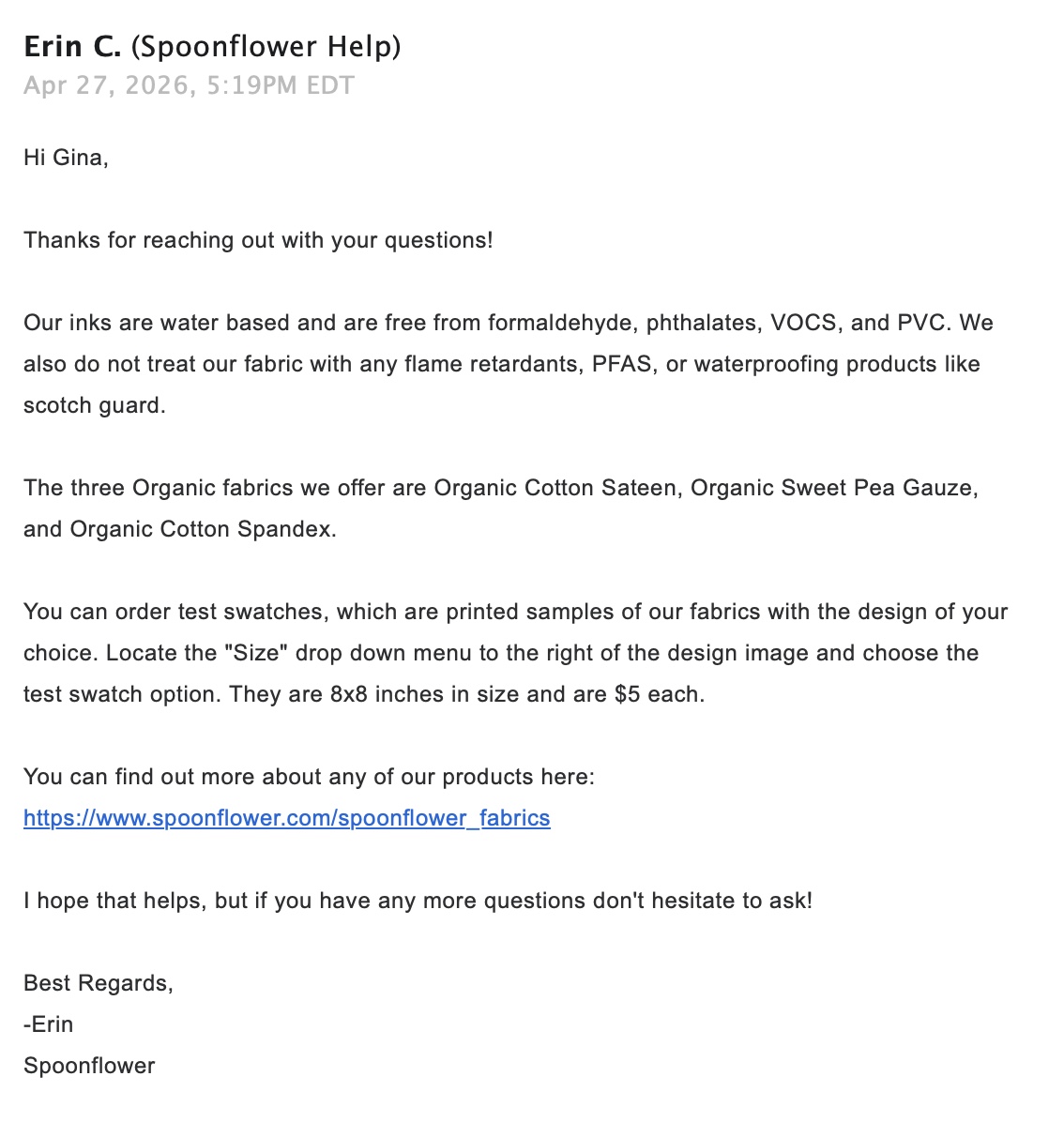
A direct inquiry was made regarding PFAS content in their fabrics. The response provided focused on inks and finishing processes, but did not address base fabric sourcing or testing.
Documented Response
Spoonflower Support (Erin C.) stated:
“Our inks are water based and are free from formaldehyde, phthalates, VOCS, and PVC. We also do not treat our fabric with any flame retardants, PFAS, or waterproofing products like scotch guard.”
Additional information:
- Three organic fabrics were listed (Organic Cotton Sateen, Organic Sweet Pea Gauze, Organic Cotton Spandex)
- No mention of PFAS testing, certification, or base textile verification
- Customer directed to general product information page with no PFAS compliance references

Observed Gaps
1. No Base Fabric Disclosure
Spoonflower’s response addresses:
- Inks
- Printing processes
- Post-treatment exclusions
However, it does not address:
- PFAS use at the textile mill level
- Chemical treatments applied before fabric reaches Spoonflower
- Risk associated with synthetic and blended fabrics
This is critical given their offerings include:
- 100% polyester fabrics
- Performance textiles
- Blended materials
- Globally sourced base fabrics (China, Turkey, etc.)

2. No Testing or Certification Provided
There is:
- No third-party PFAS testing disclosed
- No total fluorine or PFAS panel results
- No certification confirming PFAS-free status
The statement “we do not treat fabrics with PFAS” is not equivalent to:
- PFAS-free fabrics
- PFAS verified fabrics
- PFAS compliant fabrics at the finished product level
3. No PFAS Reference in Official Materials
The support link provided directs to a sustainability and safety FAQ that:
- Does not mention PFAS
- Does not define chemical compliance scope
- Does not provide regulatory alignment for textile restrictions in states like California or New York (where the fabrics I bought from them, ended up, in use in 2025)
Real-World Impact Scenario
This gap is not theoretical.
Spoonflower fabrics were used in a 2024 costume design and fabrication project for a show installed in California, a regulated market.
As of 2026:
- There is no documentation verifying PFAS status of those materials
- There is no ability to confirm compliance retroactively
- The production cannot be confidently stated as compliant when fabric suppliers are not compliant
For a theme park production with a six-figure investment, this creates:
- Compliance uncertainty
- Operational risk
- Potential liability exposure
System-Level Failure Point
This case highlights a broader structural issue:
- Designers are expected to comply with evolving PFAS regulations
- Suppliers provide partial or process-based disclosures
- Global textile sourcing lacks traceable chemical transparency
Result:
Compliance responsibility is pushed downstream to designers and production teams, without upstream support.
Conclusion
Spoonflower’s position reflects a common industry condition:
- “We do not add PFAS”≠ “This material is PFAS-free or verified compliant”
Without:
- Base textile disclosure
- Verified testing
- Clear compliance documentation
It is not possible to confidently specify these materials for regulated markets.
Industry Implication
As PFAS regulations expand, this gap will increasingly impact:
- Costume design
- Fashion production
- Uniform and performance wear systems
Designers attempting to operate responsibly are currently constrained by:
A supply chain that does not yet provide the data required to comply.
May 18, 2026 Update: Spoonflower Now Publicly Claims Its Fabrics Do Not Contain PFAS, While Stating Directly That It Has “Never Offered PFAS Compliance”
On May 14, 2026, Spoonflower stated that:
Its suppliers have confirmed they do not intentionally add PFAS into the fabrics Spoonflower purchases
Many of its fabrics had OEKO-TEX® STANDARD 100 certifications in 2025 that included PFAS-related testing, but those certificates expired in February 2026
Not all fabrics are listed on those certificates
If full assurance is needed, outside testing of the finished printed products themselves would need to be done
The documents Spoonflower provided were reviewed through the PFAS PASS™ Rapid Document Review System


The result was:
On May 18, 2026, after a refund was requested for Spoonflower fabrics purchased after PFAS textile regulations took effect and now implicated in downstream compliance audits, Spoonflower declined the refund and stated:
“While we do not intentionally source PFAS in any of our fabric products, we have never offered PFAS compliance or have promised that.”

This clarification is significant because Spoonflower’s public Environmental Sustainability and Health & Safety FAQ currently states:
“None of our fabrics contain Per- and polyfluoroalkyl substances (PFAs). All have passed tests confirming there are no harmful chemicals such as formaldehyde and lead present…”
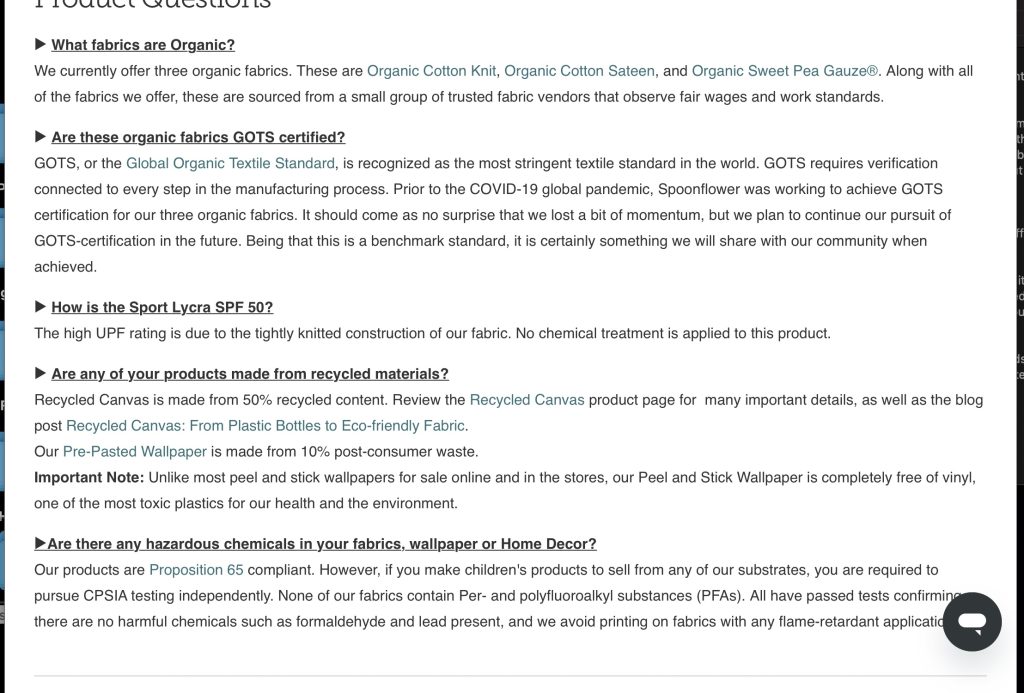
Screenshot of Spoonflower’s public Environmental Sustainability and Health & Safety FAQ, captured May 18, 2026, stating: “None of our fabrics contain Per- and polyfluoroalkyl substances (PFAs).”
The updated record now reveals a central compliance contradiction:Spoonflower publicly represents that none of its fabrics contain PFAS, yet when asked for documentation that could support downstream regulated-market review, it provided only partial and expired supporting documents and stated that it has never offered PFAS compliance.
This case reinforces the PFAS Drift In or Out™ framework. The Spoonflower fabrics at issue were purchased by a customer in Florida, incorporated into finished design work now being audited for PFAS-compliance on one project that went to New York, California and another to France. That means restricting or gating where fabric is originally shipped to does not fully contain regulatory exposure. Materials can enter regulated jurisdictions later through downstream designers, costumers, makers, resellers, brands and production clients.For fabric suppliers serving a national customer base, this is the operational reality:PFAS compliance exposure does not end at the first shipping address. It follows the material wherever the finished product ultimately goes. This is why we coined the phrase PFAS Drift In or Out™.
The public PFAS absence claim, the incomplete verification record and the direct statement that Spoonflower has “never offered PFAS compliance” together make this a materially stronger example of the documentation gap PFAS PASS™ was created to identify. (support.spoonflower.com)This is not an isolated interaction.
It reflects a broader issue:
Regulation is advancing faster than supply chain transparency
PFAS compliance in textiles is not being clearly communicated at the point of sale. That changes through documentation.
If you have supplier responses, share them, comment below.
If you want a supplier investigated, name them, comment below.
This series will continue.