Core Finding
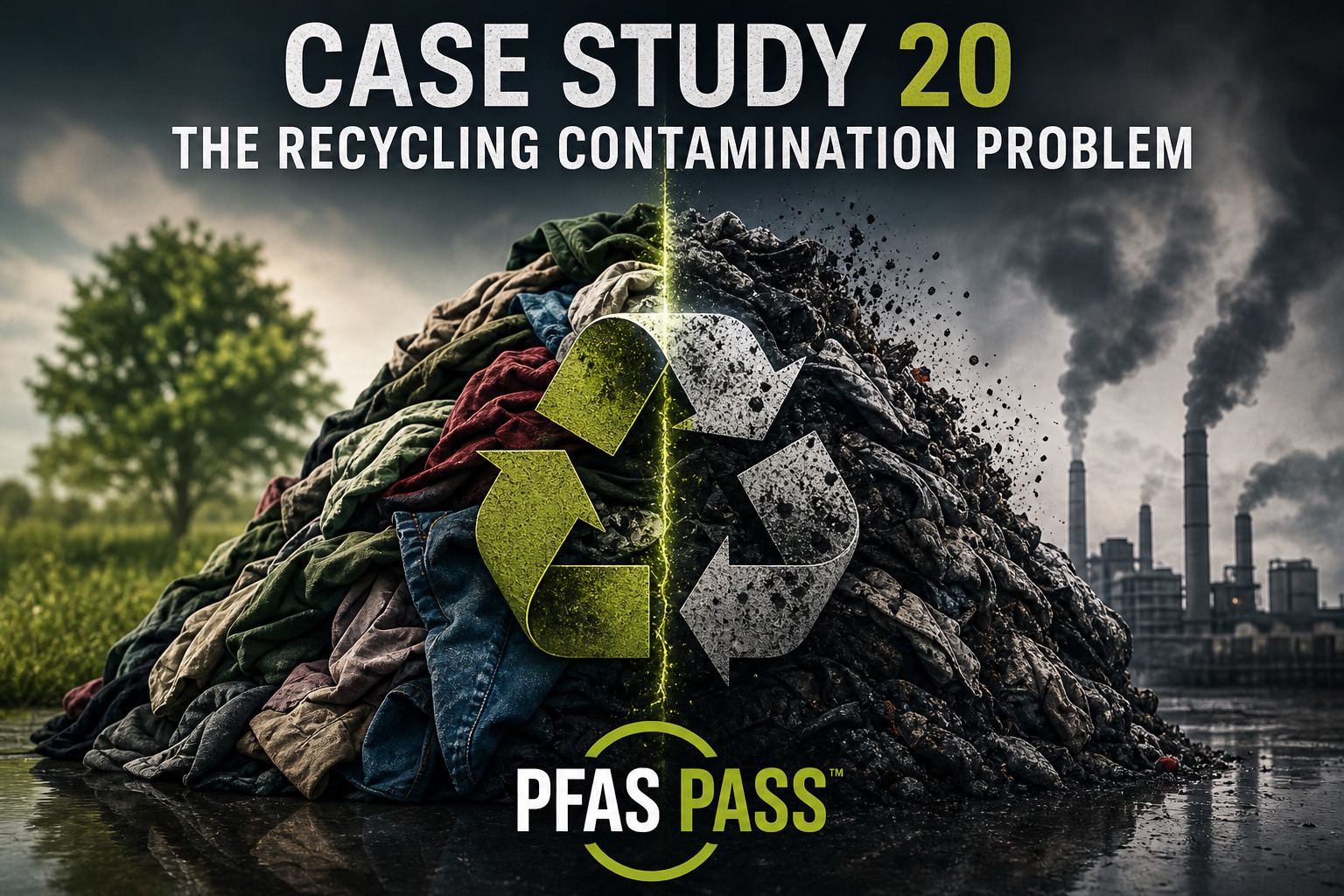
Recycling without chemical verification is not circularity. It is redistribution of liability.
The global fashion industry built recycling systems to manage volume, not toxicity.
PFAS regulation is now exposing that flaw at scale.
How We Got Here
Modern textile recycling and “circular fashion” did not emerge as neutral environmental solutions. They were developed and promoted through systems aligned with continued material production and consumption.
- American Chemistry Council promoted recycling and circular material flows while representing companies producing synthetic materials at industrial scale.
- Ellen MacArthur Foundation defined and popularized the circular economy model adopted across fashion and consumer industries.
- Sustainable Apparel Coalition operationalized sustainability metrics through tools like the Higg Index, enabling brands to measure impact without requiring chemical-level verification.
These systems addressed:
- Waste visibility
- Material recovery
- Sustainability reporting
They did not address:
- Persistent chemical contamination
- Material toxicity
- End-of-life liability
The Assumption That Broke
Circular fashion is built on a foundational assumption:
Materials are safe enough to circulate.
PFAS breaks that assumption completely.
- It does not degrade
- It persists through processing
- It transfers across material streams
- It remains present after recycling
This creates a non-negotiable contradiction:
If a textile is unsafe to sell, it is not made safe by shredding it.
The EU Has Forced the Issue
Under the European Union Ecodesign regulation:
- Destruction of unsold textiles is restricted beginning 2026
- Expanded enforcement will follow
At the same time, PFAS restrictions under REACH Regulation are advancing across product categories including textiles.
This creates a systemic collision
Unsold inventory may now be:
- Non-compliant for sale
- Restricted from destruction
- Unverified for recycling
- Increasingly restricted from export
Which leads to the real question:
What happens to contaminated overproduction when none of the exit routes are viable?
Recycling Is Not a Neutral Pathway
Current downstream textile pathways include:
- Mechanical recycling
- Fiber shredding
- Downcycling into:
- Carpet padding
- Insulation
- Upholstery fill
- Composite materials
- Export to secondary markets
Without chemical verification, these are not solutions.
They are:
contamination distribution systems
PFAS does not disappear in these processes.
It moves.
The Hidden Liability Shift
The current system distributes responsibility without resolving it:
| Stage | Outcome |
|---|---|
| Production | Brand profits |
| Sale | Consumer exposure |
| Overstock | Liquidation channels |
| Donation | Charitable redistribution |
| Recycling | Material breakdown |
| Export | Externalized impact |
| Disposal | Public burden |
PFAS changes this dynamic.
Because once contamination becomes traceable:
liability does not disappear. It migrates.
Clarifying Responsibility
This case study does not assign brands sole responsibility for PFAS chemistry.
It establishes a more precise position:
Brands are responsible for the volume they produce and place into circulation.
That includes:
- Overproduction decisions
- Inventory distribution strategies
- Downstream pathways for excess goods
Therefore:
Brands that overproduce must be responsible for what happens next.
Not just at the point of sale
but at the point of disposal
The End of Invisible Disposal
Historically, excess inventory could be:
- Burned
- Dumped
- Exported
- Written off
Those options are closing.
PFAS regulation, EU anti-destruction laws and tightening waste export scrutiny are removing the industry’s ability to quietly eliminate surplus.
There is no longer an invisible exit.
Operational Reality: You Cannot Test Everything
Full PFAS testing across all inventory is not operationally feasible.
- Testing is conducted per material and component
- A single garment may contain multiple risk points
- Costs scale quickly across inventory
This creates a deadlock:
Without a system, compliance becomes either guesswork or financially unsustainable.
The Missing Layer: Inventory Triage
Before testing, inventory must be evaluated and sorted.
Not all garments carry equal risk.
Risk can be assessed using:
- Fiber composition
- Coatings and finishes
- Performance claims (waterproof, stain-resistant, wrinkle-resistant)
- Supplier transparency
- Component-level inputs (thread, trims, appliqués, laminates)
This allows inventory to be separated into:
- Low-risk (likely compliant or verifiable)
- Moderate-risk (requires documentation or selective testing)
- High-risk (likely non-compliant or unverified)
- Do-not-circulate (should not enter resale, donation or recycling)
Without this step, everything downstream fails.
Solution Pathway: 01 — PFAS PASS Audit System™
The 01 — PFAS PASS Audit System™ was developed to address this exact gap.
It provides a structured framework to:
- Evaluate existing inventory using real-world garment knowledge
- Identify PFAS risk factors without immediate testing
- Sort inventory into actionable compliance categories
- Document findings for internal control and defensibility
- Reduce unnecessary testing costs by focusing on high-risk items
This system does not replace testing.
It makes testing targeted, strategic and financially viable.
Why This Step Is Now Mandatory
Under current and emerging regulatory conditions:
- Unverified inventory cannot safely enter resale or recycling streams
- Supplier claims without documentation are insufficient
- Blanket testing is cost-prohibitive
This leaves only one viable starting point:
You must understand your inventory before you move it.
Industry Challenge
To the organizations that advanced the circularity model:
- American Chemistry Council
- Ellen MacArthur Foundation
- Sustainable Apparel Coalition
Where is the chemical verification layer in your circular systems?
Because without it:
circularity becomes a mechanism for dispersing contamination rather than eliminating it
Conclusion
Recycling was built to manage volume.
It was never built to manage toxicity.
PFAS forces the industry to confront that difference.
The question is no longer whether circular systems work.
The question is:
What are you circulating — and do you have proof?
Until chemical verification and inventory control are integrated into the textile lifecycle:
circular fashion is not a solution.
It is a redistribution system for risk.
And the first step toward resolving that is not recycling.
It is knowing exactly what you have.
